Construction Law In In Cuyahoga
Description












Get your form ready online
Our built-in tools help you complete, sign, share, and store your documents in one place.
Make edits, fill in missing information, and update formatting in US Legal Forms—just like you would in MS Word.
Download a copy, print it, send it by email, or mail it via USPS—whatever works best for your next step.
Sign and collect signatures with our SignNow integration. Send to multiple recipients, set reminders, and more. Go Premium to unlock E-Sign.
If this form requires notarization, complete it online through a secure video call—no need to meet a notary in person or wait for an appointment.
We protect your documents and personal data by following strict security and privacy standards.
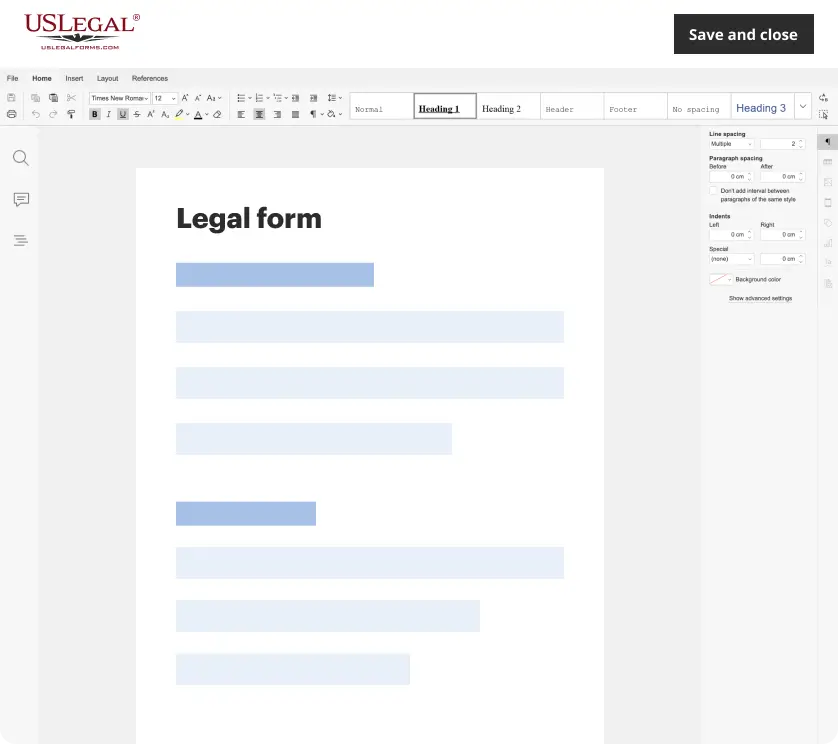
Make edits, fill in missing information, and update formatting in US Legal Forms—just like you would in MS Word.
Download a copy, print it, send it by email, or mail it via USPS—whatever works best for your next step.
Sign and collect signatures with our SignNow integration. Send to multiple recipients, set reminders, and more. Go Premium to unlock E-Sign.
If this form requires notarization, complete it online through a secure video call—no need to meet a notary in person or wait for an appointment.
We protect your documents and personal data by following strict security and privacy standards.
Looking for another form?






Form popularity
FAQ
A contract is an agreement between parties, creating mutual obligations that are enforceable by law. The basic elements required for the agreement to be a legally enforceable contract are: mutual assent, expressed by a valid offer and acceptance; adequate consideration; capacity; and legality.
"Any person who wishes to file a Mechanic's Lien shall make and file for record in the office of the county recorder in the counties in which the improved property is located, an affidavit showing the amount due over and above all legal setoffs, a description of the property to be charged with the lien, the name and ...
That contract must include specific information about your rights and responsibilities. In addition, any changes made to that contract must be in writing, be legible, be easy to understand, and inform you of your rights to cancel or rescind the contract.
There are four essential elements of forming a contract: offer, acceptance, consideration, and intention to create legal relations. Beyond this, the terms of the contract must also be unambiguous, and the parties must have the mental capacity to agree.
You have two options for filing a complaint: Fill out online, print and notarize your complaint form and bring it to: Cuyahoga County Administration Building. Attn: Department of Law, 7th Floor. Cleveland, OH 44115. Mail your notarized complaint form to: Cuyahoga County Human Rights Commission. Attn: Department of Law.
7 Essential Elements of A Contract Offer. For there to be a contract, there must first be an offer by one party and an acceptance by the other. Acceptance. Acceptance is the agreement to the specific conditions of an offer. Consideration. Intention to create legal relations. Authority and capacity. Certainty.
Ohio Construction Law and Regulations Consumer Sales Practices Act (CSPA): This law (Ohio Revised Code Chapter 1345) provides remedies for shoddy workmanship that include three times your damages, attorney fees, and a statutory fine of Five Thousand Dollars ($5,000.00).
For example, in California, the statute of repose is four years for most problems, but 10 years for latent defects or problems that aren't readily apparent. Stay on the lookout for contractors who try to shorten the implied warranty by offering a shorter warranty term—sometimes for as brief a period as one year.
Strict liability: The builder is strictly liable for any construction defects in a residential home, even if the work was performed by a subcontractor. The builder is also strictly liable for damages, costs, and fees relating to the construction defects, including property damage.
Common regulations governing construction in California include safety codes, zoning regulations noise regulations, and other environmental regulations. In California, homeowners and real estate developers should have knowledge of construction law to ensure they meet legal compliance and protect their rights.
