Connecticut Statement of Demand
Understanding this form
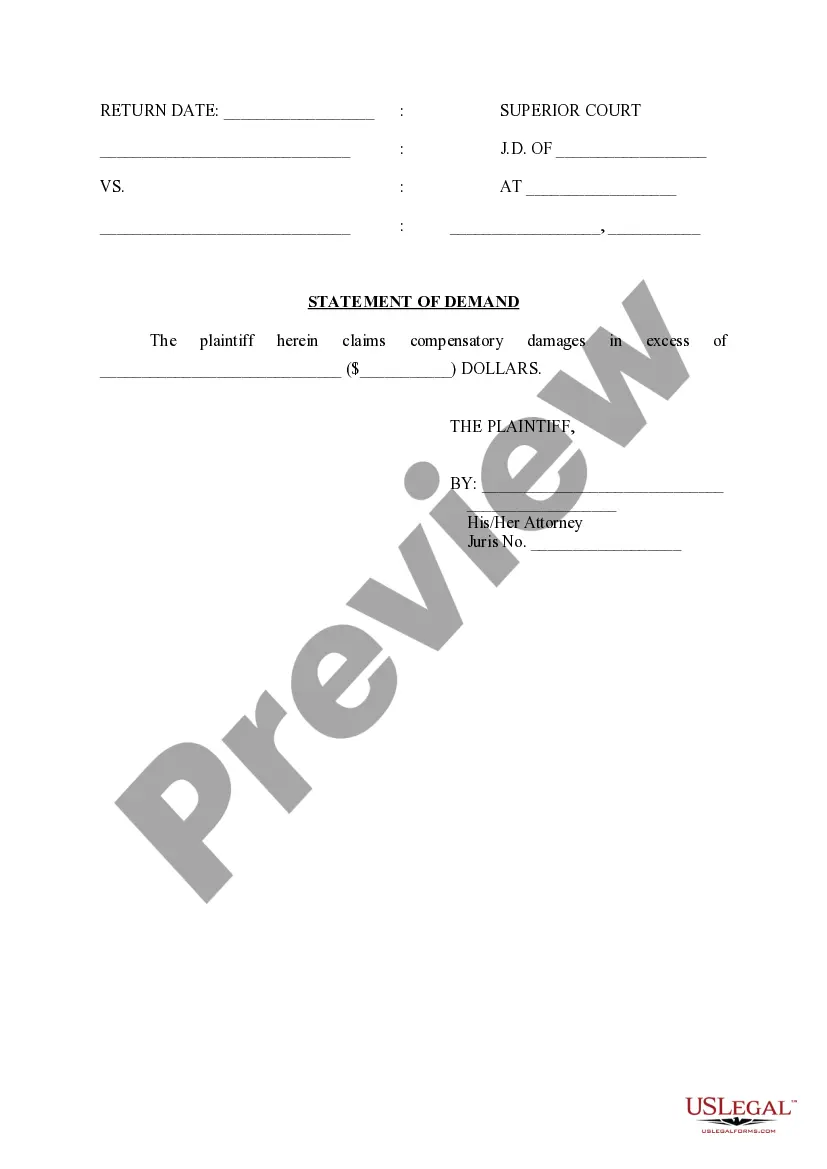
The Statement of Demand is a legal document in which the plaintiff outlines the specific demands related to their case. This form is essential for formally presenting compensatory damages sought by the plaintiff and is typically filed in a superior court. Unlike other legal forms, the Statement of Demand provides a clear statement of the financial compensation being pursued, making it a critical component in civil litigation cases.
Key components of this form
- Return date: The date by which the legal action must be addressed.
- Superior court information: Identification of the court where the case is filed.
- Parties involved: Names and particulars of the plaintiff and defendant.
- Claim detailing: Statement of the damages being sought, including the amount in dollars.
- Attorney information: Signature line for the plaintiffâs attorney and their license number.
Situations where this form applies
This form should be used when a plaintiff wants to formally declare their demands in a civil lawsuit, particularly when seeking compensation for damages. It is relevant in situations where the plaintiff is ready to proceed with legal action and requires the court to acknowledge the specific financial relief being sought.
Who should use this form
Individuals or entities intending to file a lawsuit who wish to demand compensatory damages should utilize this form. This includes:
- Plaintiffs pursuing a claim in superior court.
- Attorneys representing plaintiffs in civil litigation.
- Individuals needing a clear statement of their demands for legal proceedings.
Instructions for completing this form
- Identify the return date and enter it in the designated field.
- Fill in the name and location of the superior court.
- Clearly state the names of the plaintiff and defendant in the appropriate sections.
- Specify the amount of compensatory damages being claimed.
- Sign the document and include the attorney's license number if applicable.
Does this document require notarization?
This form does not typically require notarization unless specified by local law. Always check local regulations to ensure compliance and validity.
Get your form ready online
Our built-in tools help you complete, sign, share, and store your documents in one place.
Make edits, fill in missing information, and update formatting in US Legal Forms—just like you would in MS Word.
Download a copy, print it, send it by email, or mail it via USPS—whatever works best for your next step.
Sign and collect signatures with our SignNow integration. Send to multiple recipients, set reminders, and more. Go Premium to unlock E-Sign.
If this form requires notarization, complete it online through a secure video call—no need to meet a notary in person or wait for an appointment.
We protect your documents and personal data by following strict security and privacy standards.

Make edits, fill in missing information, and update formatting in US Legal Forms—just like you would in MS Word.

Download a copy, print it, send it by email, or mail it via USPS—whatever works best for your next step.

Sign and collect signatures with our SignNow integration. Send to multiple recipients, set reminders, and more. Go Premium to unlock E-Sign.

If this form requires notarization, complete it online through a secure video call—no need to meet a notary in person or wait for an appointment.

We protect your documents and personal data by following strict security and privacy standards.
Mistakes to watch out for
- Failing to provide a clear return date, which can delay processing.
- Leaving out crucial information about the parties involved.
- Incorrectly calculating the amount of damages, leading to under- or over-statements.
- Not signing the document or omitting the attorney's details when necessary.
Advantages of online completion
- Easy access to customizable legal templates crafted by licensed attorneys.
- Immediate download options, allowing for quick completion and submission.
- Convenience of filling out forms from any location, with no need for physical visits to a law office.
- Secure storage of forms for future reference and reuse.
Looking for another form?
Form popularity
FAQ
Filing a claim after the two-year mark typically results in forfeiting your right to seek compensation, as per Connecticut law. This makes timely action essential to protect your interests. To avoid missing deadlines, consider preparing a Connecticut Statement of Demand early in your process.
Filing an annual report in Connecticut requires you to submit specific details about your business to the Secretary of the State. You can typically complete this process online, making it convenient and efficient. Utilizing a Connecticut Statement of Demand can help clarify the necessary information needed for accurate reporting.
To file a lien on a property in Connecticut, you must prepare a written document, typically known as a lien notice, and file it in the town where the property is located. Ensure that your filing complies with Connecticut statutes to maintain its validity. A Connecticut Statement of Demand can serve as an effective template to document your intention clearly.
In Connecticut, the general rule is that you have two years from the date of your injury to file a claim. This rule helps protect your right to seek compensation. Using a Connecticut Statement of Demand can help streamline your filing process and ensure all relevant details are included.
You may usually make a claim for up to two years following an event in Connecticut, depending on the nature of the claim. It's essential to confirm the specific limits relevant to your case. The Connecticut Statement of Demand can be a helpful tool to start your claim process promptly.
Yes, Connecticut law imposes specific time limits, also known as statutes of limitations, for filing different types of claims. For personal injury claims, this limit is generally two years from the date of the incident. Prompt action is vital, so consider using a Connecticut Statement of Demand to expedite your process.
In Connecticut, you typically have two years from the date of the accident to file a claim. This time frame is crucial because it determines your legal rights. To ensure you don’t miss this deadline, consider preparing a Connecticut Statement of Demand as soon as possible.
Deciding whether to pursue a $500 claim in small claims court depends on your circumstances and the potential for resolution. Small claims court is designed to handle smaller disputes efficiently and affordably, making it a viable option. Your Connecticut Statement of Demand will outline your case and objectives, making it easier to present your claim. Additionally, consider the value of time and effort in relation to the amount sought.
A motion to dismiss in Connecticut may rest on various grounds, such as lack of jurisdiction or failure to state a claim. The judge will consider whether the complaint adequately presents a valid legal claim. It's critical to be prepared and precise when responding to such motions. Consult US Legal Forms for guidance on crafting an effective response or for assistance with your Connecticut Statement of Demand.
In Connecticut, you generally have six years to file a small claims suit. This timeframe can vary depending on the nature of the claim, so it's essential to check specific statutes for your situation. Document your Connecticut Statement of Demand promptly to ensure you meet this deadline. Using resources from US Legal Forms can guide you through this timeline effectively.