Florida Motion for Temporary Restraining Order to Stop the Dissipation of Assets By Respondent and Seeking an Accounting from Respondent
Overview of this form
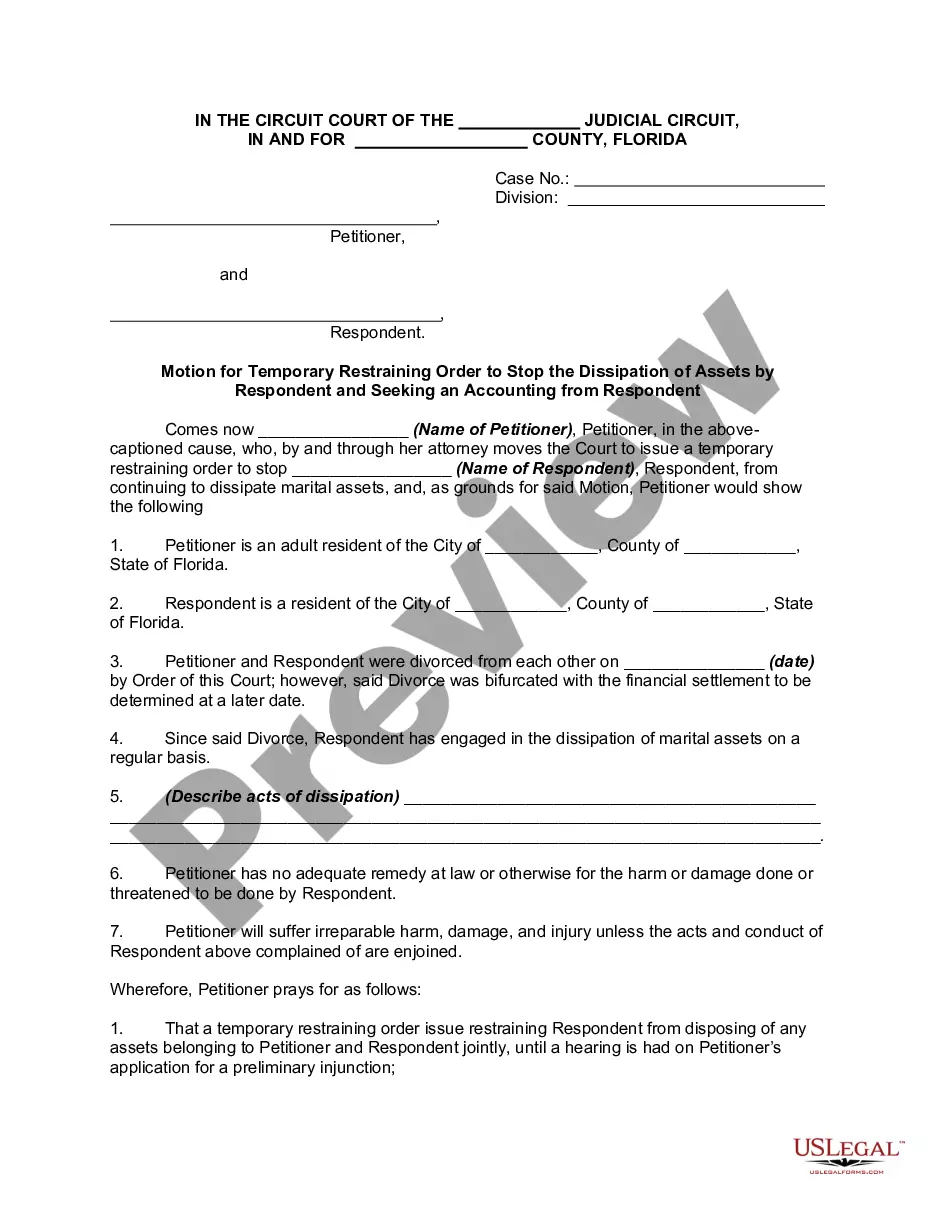
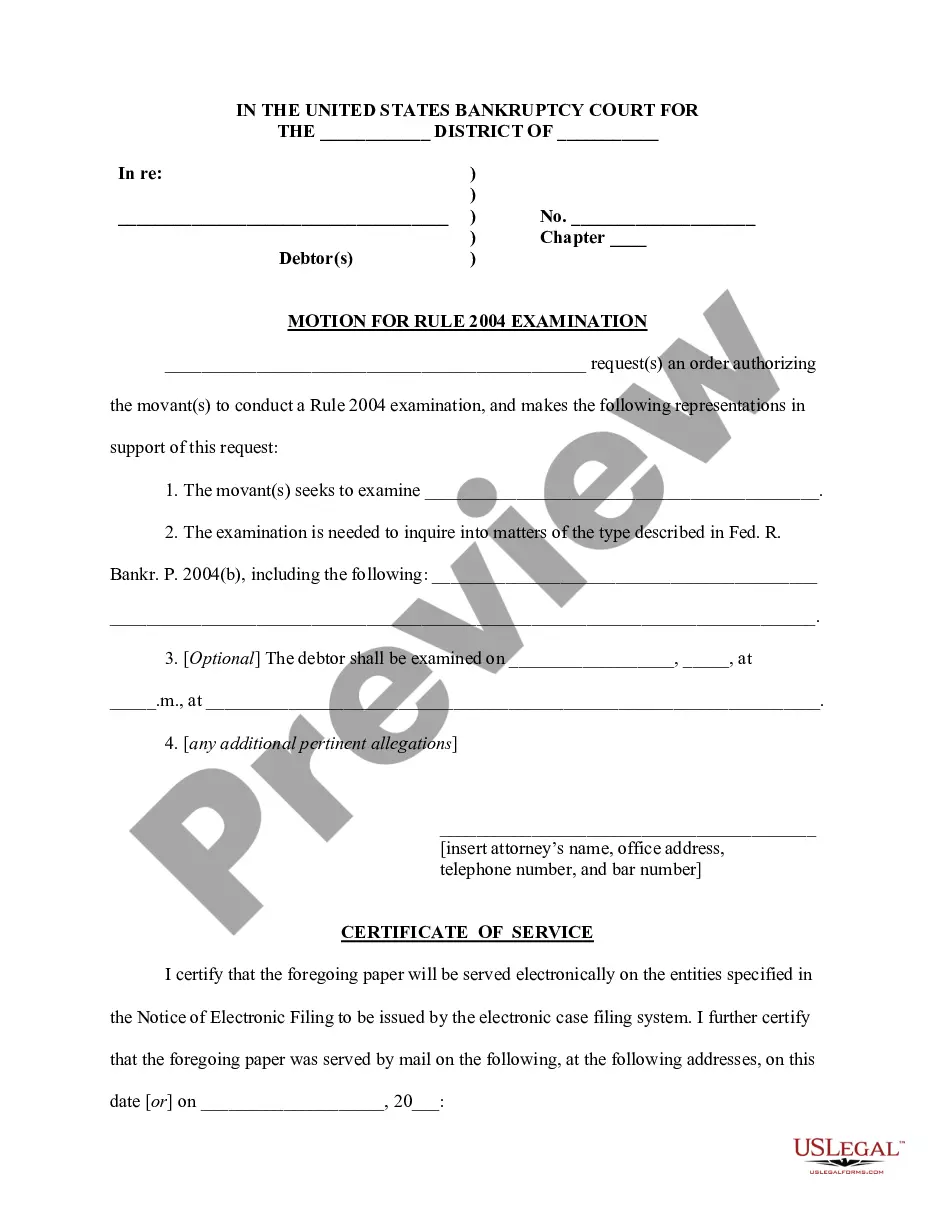
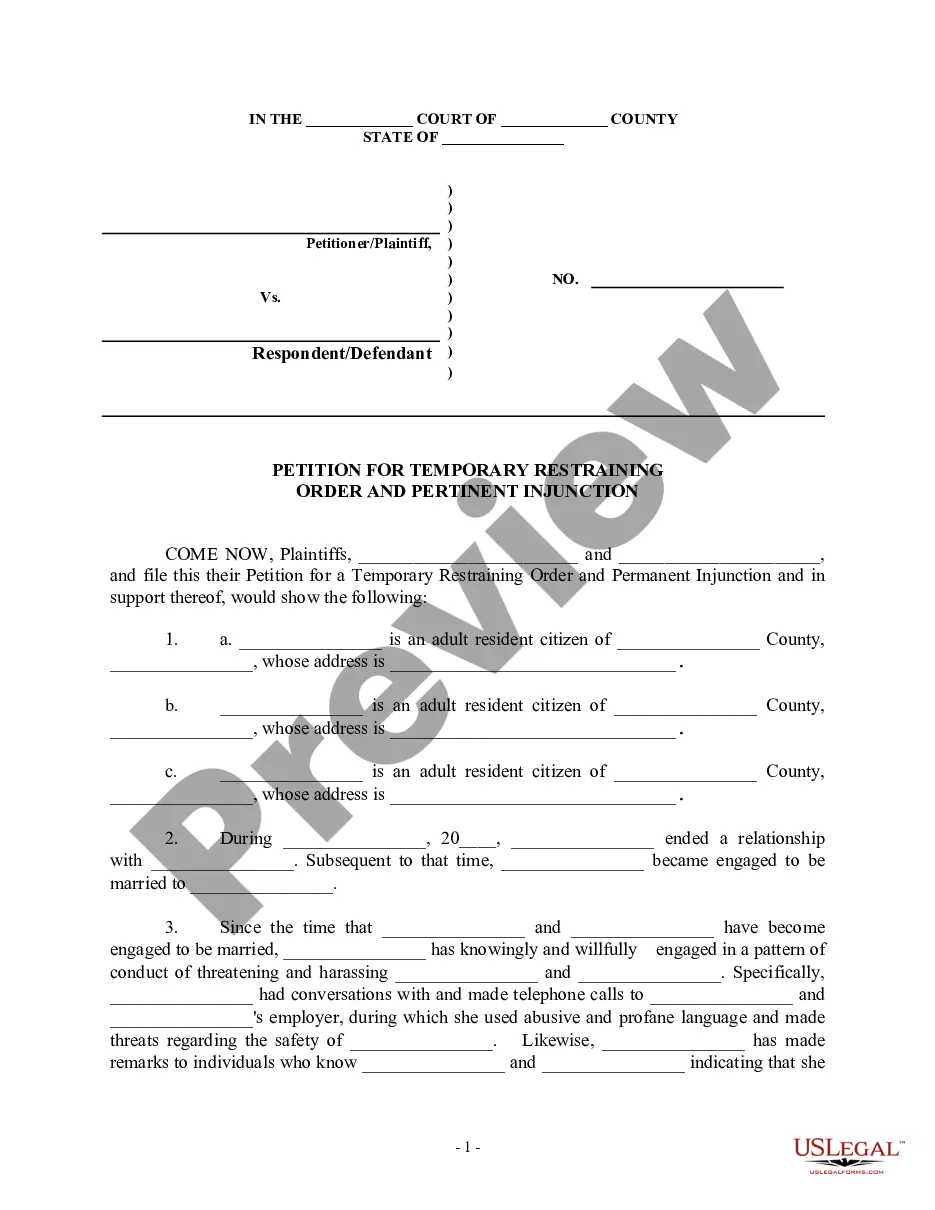
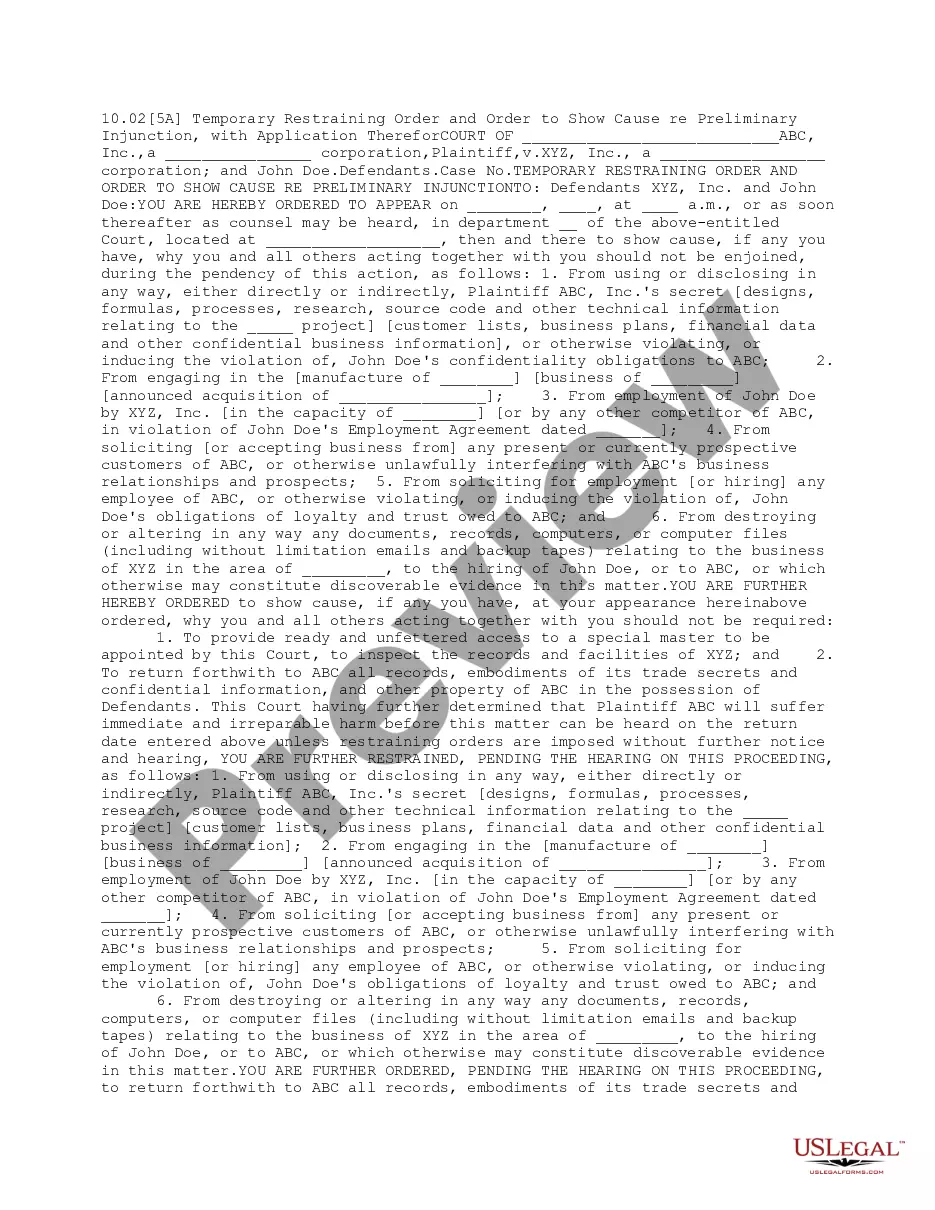
The Motion for Temporary Restraining Order to Stop the Dissipation of Assets By Respondent and Seeking an Accounting from Respondent is a legal document that requests the court to issue a temporary restraining order (TRO) to prevent one party from wasting or hiding assets during litigation, particularly in divorce cases. A TRO is a short-term measure intended to maintain the status quo until a more permanent solution can be ordered. Unlike other motions, this form specifically addresses concerns related to the dissipation of marital assets, ensuring that the court intervenes quickly to protect the interests of the involved parties.
What’s included in this form
- Petitioner and Respondent information: Names and addresses of both parties.
- Details of the divorce: Date of divorce and any relevant orders made by the court.
- Grounds for the motion: Specific acts of asset dissipation committed by the Respondent.
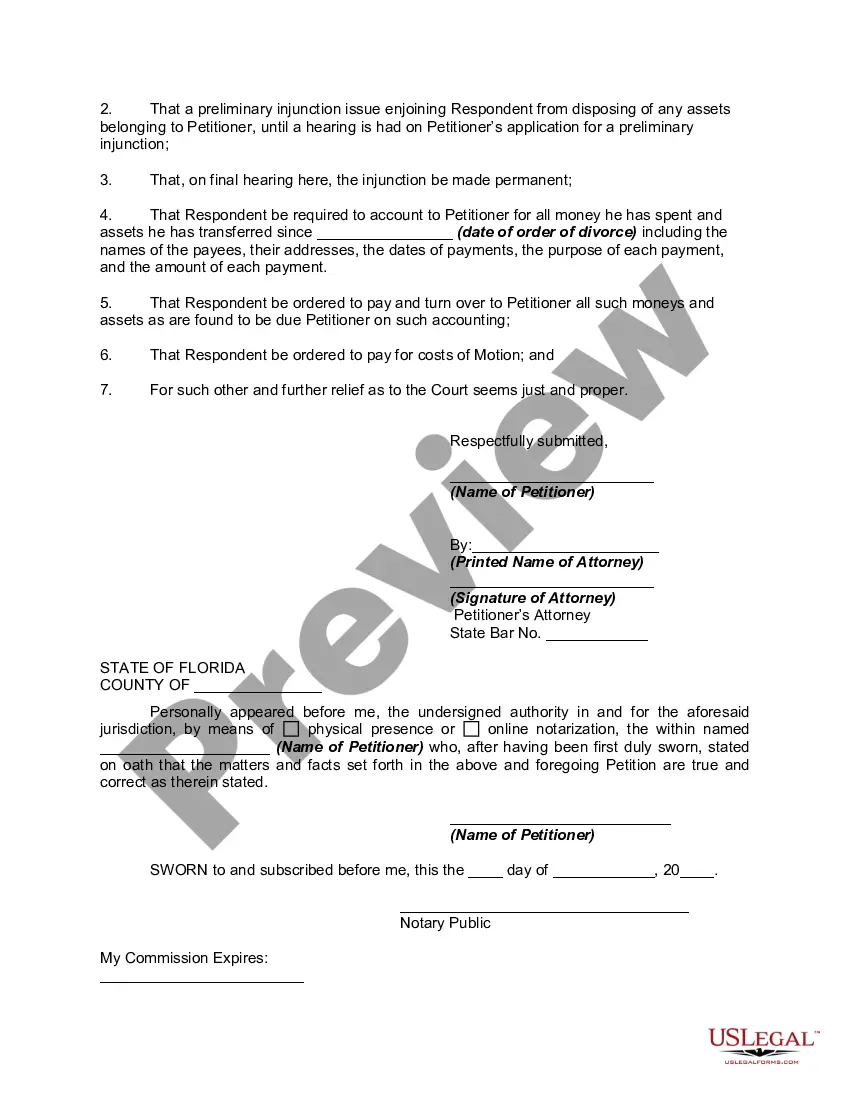
- Request for relief: What the Petitioner seeks from the court, including stopping asset disposal and accounting for expenditures.
- Notary section: Verification of the Petitionerâs statements under oath.
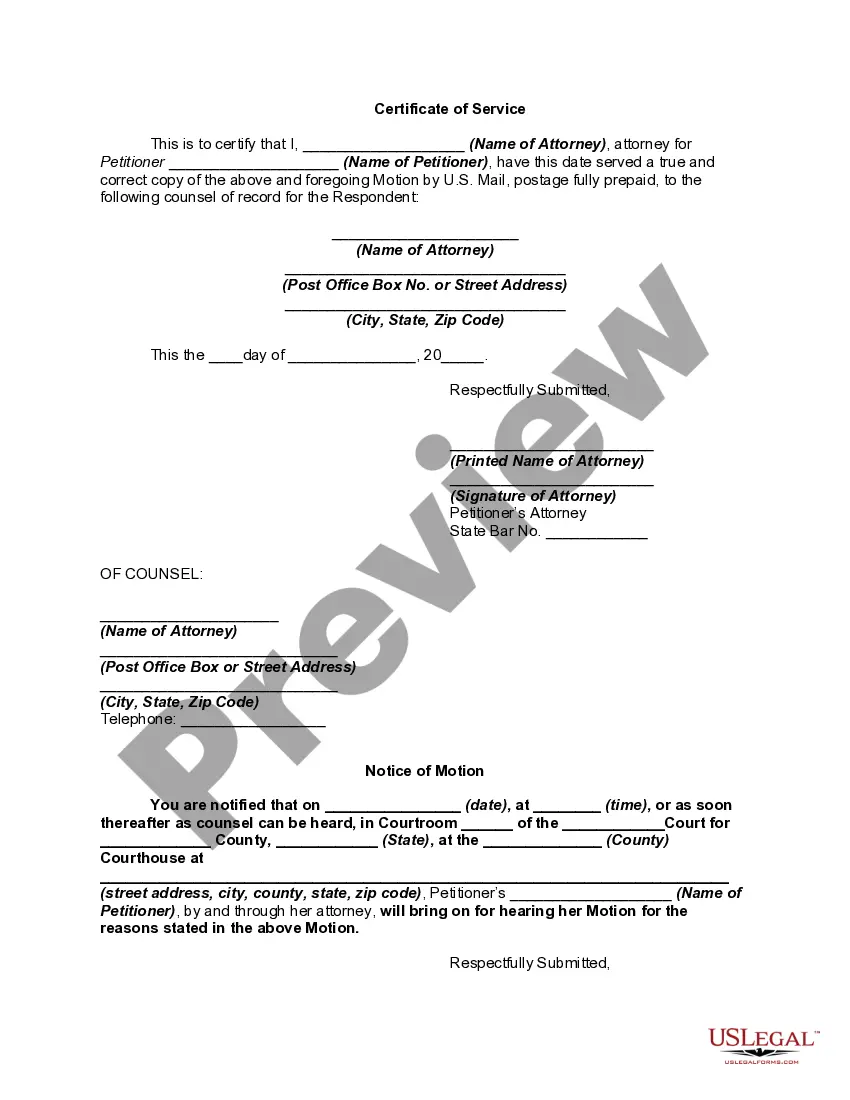
- Certificate of service: Proof that the motion has been served to the Respondentâs counsel.

Situations where this form applies
This form should be used when a person in a divorce proceeding suspects that their spouse is dissipating marital assets, which could harm their financial interests in the outcome of the divorce. It is commonly filed when there are imminent concerns about extravagant spending, fraudulent asset transfers, or any actions that could deplete the couple's shared wealth before the divorce settlement is finalized. By filing this motion, the Petitioner seeks immediate court action to prevent further financial damage.
Who needs this form
- Individuals currently involved in divorce proceedings in Florida.
- Persons who suspect their spouse is hiding or spending marital assets.
- Petitioners seeking protection of their financial interests until matters can be resolved in court.
How to prepare this document
- Identify the parties: Enter the names of both the Petitioner and Respondent, including their addresses.
- Provide case details: Specify the date of divorce and outline any relevant court orders.
- Describe dissipation acts: Clearly detail any specific behaviors by the Respondent that have resulted in asset dissipation.
- Outline your requests: State what you are asking the court to do, including stopping asset disposal and accounting for expenditures.
- Sign and notarize: Ensure that the Petitioner signs the form in the presence of a notary public, if required.
Notarization requirements for this form
Yes, this form must be notarized to be legally valid. A notary public will verify the identity of the Petitioner and witness the signing of the document. US Legal Forms offers integrated online notarization services, providing a secure video call to facilitate this process, ensuring convenience and legal equivalence without requiring travel.
Get your form ready online
Our built-in tools help you complete, sign, share, and store your documents in one place.
Make edits, fill in missing information, and update formatting in US Legal Forms—just like you would in MS Word.
Download a copy, print it, send it by email, or mail it via USPS—whatever works best for your next step.
Sign and collect signatures with our SignNow integration. Send to multiple recipients, set reminders, and more. Go Premium to unlock E-Sign.
If this form requires notarization, complete it online through a secure video call—no need to meet a notary in person or wait for an appointment.
We protect your documents and personal data by following strict security and privacy standards.

Make edits, fill in missing information, and update formatting in US Legal Forms—just like you would in MS Word.

Download a copy, print it, send it by email, or mail it via USPS—whatever works best for your next step.

Sign and collect signatures with our SignNow integration. Send to multiple recipients, set reminders, and more. Go Premium to unlock E-Sign.

If this form requires notarization, complete it online through a secure video call—no need to meet a notary in person or wait for an appointment.

We protect your documents and personal data by following strict security and privacy standards.
Avoid these common issues
- Failing to clearly articulate acts of asset dissipation.
- Missing required signatures or notary acknowledgment.
- Omitting relevant case details that could support the motion.
- Not providing sufficient evidence or documentation to back claims.
Why complete this form online
- Convenience: Download and complete the form at any time.
- Editability: Modify the template to suit your specific case details.
- Reliability: Ensure that the form meets legal requirements and is drafted with professional standards.
- This motion is legally enforceable once filed with the court and can lead to significant protective measures for the Petitioner.
- The court will consider the urgency of the request based on the risk of asset dissipation.
- Failure to comply with a temporary restraining order may lead to legal penalties for the Respondent.
Key takeaways
- The Motion for Temporary Restraining Order is a crucial tool for preventing asset dissipation during divorce.
- It is essential to provide detailed descriptions of asset dissipation to support your case.
- This form is specific to Florida law, reflecting the state's approach to equitable distribution in divorce.
- Online notarization can streamline the process of validating this legal document.
Looking for another form?

Form popularity
FAQ
This form is a Florida legal document used in divorce cases to request a temporary restraining order that prevents the Respondent from dissipating or hiding assets and to obtain an accounting of expenditures. It helps preserve the marital estate while the dissolution is decided and includes petitioner and respondent information, grounds for the motion, the relief sought, a notary verification, and a certificate of service.
To fill out the form, provide the petitioner and respondent names and addresses; include any relevant dates of the divorce and prior court orders; state the grounds showing asset dissipation; specify the relief sought—stopping asset disposal and requiring an accounting; complete the notary section, and add a certificate of service showing who was served.
The form includes petitioner and respondent information, details of the divorce, grounds for asset dissipation, the relief requested (stop asset disposal and an accounting), a notary section for verification, and a certificate of service proving the motion has been served on the Respondent’s counsel.
This form should be used in Florida divorce cases when there is an imminent risk that marital assets could be dissipated, wasted, or hidden before the divorce is finalized. It seeks immediate court action to prevent further financial damage and to secure an accounting from the Respondent.
Typically the Petitioner signs the motion and completes the notary verification. A Certificate of Service must accompany the filing to prove that the Respondent’s counsel was served, ensuring proper notice of the motion and the relief requested. The form includes the required sections for the notary and service.
It is tailored to protect the marital estate in a divorce by targeting asset dissipation and requiring an accounting from the Respondent, with specific grounds, relief, and accompanying verification and service documentation. A generic Florida TRO may not address asset preservation or accounting in this context.