Louisiana Amended Order of Custody
About this form
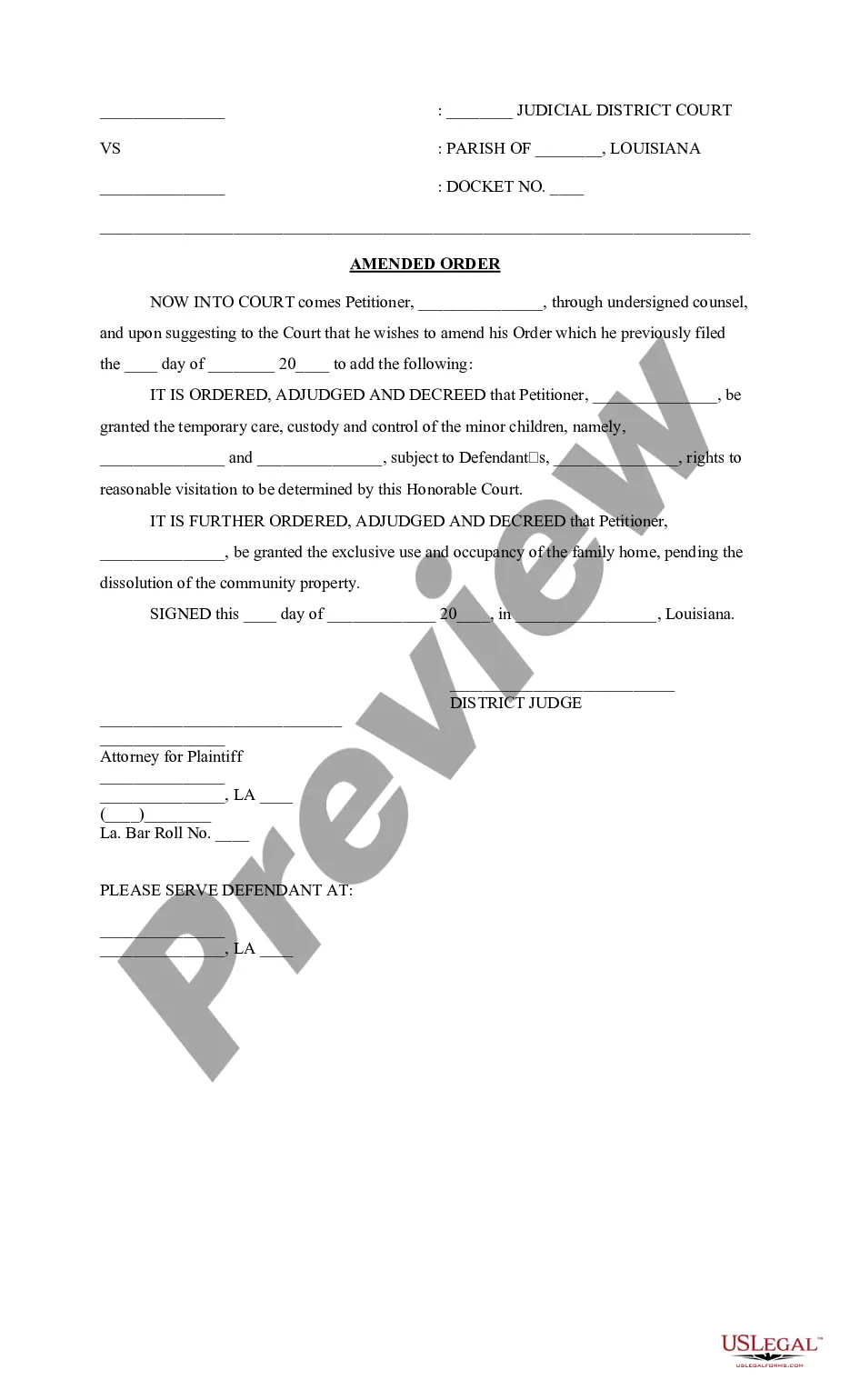
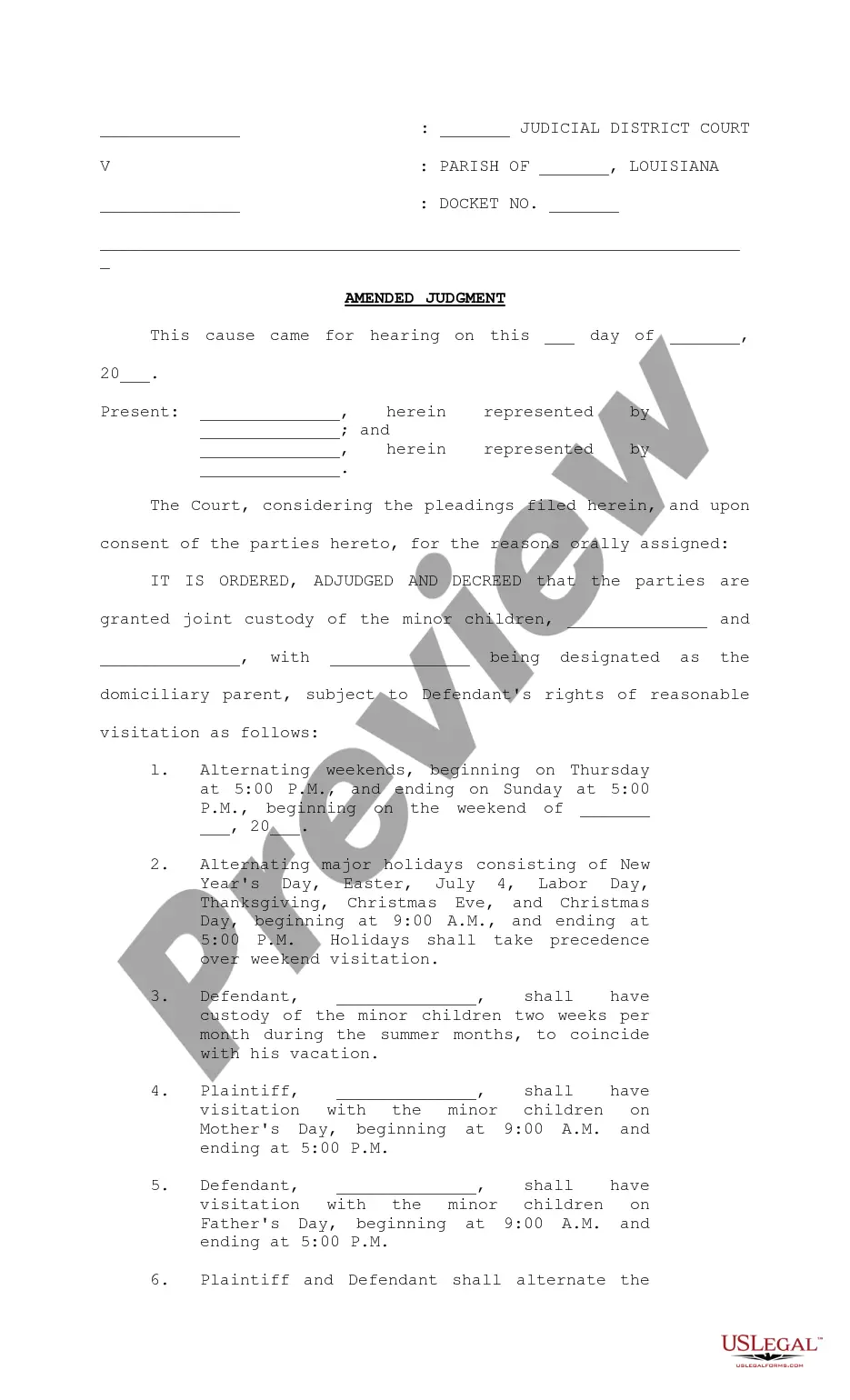
The Amended Order of Custody is a legal document filed by a petitioner during divorce proceedings. This form is essential for modifying custody arrangements, temporarily granting the petitioner care, custody, and control of minor children, as well as exclusive use of the family home until the divorce is finalized. It differs from other custody orders by specifically indicating changes to previously established arrangements.
Key components of this form
- The name of the petitioner and defendant.
- The docket number of the court case.
- Details regarding the temporary custody of minor children.
- Rights of visitation for the defendant.
- Exclusive use and occupancy of the family home pending divorce.
- Signature lines for the district judge and attorney for the plaintiff.

Situations where this form applies
This form is used when there is a need to amend an existing custody order due to changing circumstances in a divorce case. Common scenarios include situations where the petitioner is seeking to obtain temporary custody of children during the divorce process or needs to clarify rights related to parental visitation and property occupancy.
Who can use this document
- Individuals who are currently involved in divorce proceedings and need to modify existing custody arrangements.
- Petitioners who seek temporary custody and control of minor children during a divorce.
- Those requiring exclusive use of a family residence pending the finalization of divorce.
Completing this form step by step
- Identify the petitioner and defendant names and fill in the docket number.
- Provide details of the minor children involved, including their names.
- Specify the visitation rights for the defendant.
- Indicate the exclusive use and occupancy rights of the family home.
- Sign and date the form in the designated areas for the district judge and for the attorney.
Does this form need to be notarized?
Notarization is not commonly needed for this form. However, certain documents or local rules may make it necessary. Our notarization service, powered by Notarize, allows you to finalize it securely online anytime, day or night.
Get your form ready online
Our built-in tools help you complete, sign, share, and store your documents in one place.
Make edits, fill in missing information, and update formatting in US Legal Forms—just like you would in MS Word.
Download a copy, print it, send it by email, or mail it via USPS—whatever works best for your next step.
Sign and collect signatures with our SignNow integration. Send to multiple recipients, set reminders, and more. Go Premium to unlock E-Sign.
If this form requires notarization, complete it online through a secure video call—no need to meet a notary in person or wait for an appointment.
We protect your documents and personal data by following strict security and privacy standards.

Make edits, fill in missing information, and update formatting in US Legal Forms—just like you would in MS Word.

Download a copy, print it, send it by email, or mail it via USPS—whatever works best for your next step.

Sign and collect signatures with our SignNow integration. Send to multiple recipients, set reminders, and more. Go Premium to unlock E-Sign.

If this form requires notarization, complete it online through a secure video call—no need to meet a notary in person or wait for an appointment.

We protect your documents and personal data by following strict security and privacy standards.
Common mistakes to avoid
- Failing to fill out the docket number correctly.
- Not specifying visitation rights clearly, which can lead to confusion.
- Omitting signatures or dates, rendering the form invalid.
- Using improper terminology that does not align with state law.
Benefits of using this form online
- Easy accessibility for immediate downloading.
- Editable templates that allow for personalization.
- Reliable forms drafted by licensed attorneys, ensuring legal compliance.
- Convenient completion from home, saving time and effort.
Legal use & context
- Establishes clear temporary custody arrangements during divorce.
- Helps protect the rights of both parties and children involved.
- Is enforceable in court provided it follows state regulations.
Quick recap
- The Amended Order of Custody modifies existing arrangements for temporary custody and home occupancy.
- Use this form during divorce proceedings when changes to custody or property use are necessary.
- Ensure compliance with Louisiana state requirements when filing.
Looking for another form?
Form popularity
FAQ
Evidence of parenting ability: Courts look for evidence that the parent requesting custody is genuinely able to meet the child's physical and emotional needs, including food, shelter, clothing, medical care, education, emotional support, and parental guidance.
Understand Your State's Child-Custody Laws. Stockbyte / Getty Images. Understand the Better-Parent Standard. Morsa Images / Getty Images. Bring the Right Documents to Court. Learn Proper Courtroom Etiquette. Know What to Expect During the Hearing. Dress Appropriately.
Overview. If one party to a case has filed a motion with the court, the other side can file an opposition. An opposition is a written statement explaining to the judge why the other side is not entitled to whatever he is asking for in his motion. It is your opportunity to oppose the other side's request.
Physical Relocation. The noncustodial parent can reach out to the court to modify custody if the custodial parent moves. One Parent Refuses to Follow the Custody Terms. The Child's Needs Have Changed. A Parent's Situation Has Changed. The Child Is in Danger. 9 Secrets the Insurance Adjuster Doesn't Want You to Know.
Fill out your court forms. Have your forms reviewed. Make at least 2 copies of all your forms. File your forms with the court clerk. Serve your papers on the other parent. File your Proof of Service. Go to your court hearing.
The Reigning King of What Can Be Used Against You in a Custody Battle: Verbal or Physical Altercations. Exposing Your Children to New Partners. Criticizing the Other Parent to Outside Parties.
Fill out your court forms. Have your forms reviewed. Make at least 2 copies of all your forms. File your forms with the court clerk. Serve your papers on the other parent. File your Proof of Service. Go to your court hearing.
Petition. The first step involves filling out a form with the court. Service. This the legal term that refers to actually giving the other parent notice that you are requesting a change. Filing. Once all the paperwork is completed, it must be filed with the court. Scheduling. Court.