Mississippi Waiver of Hearing
What this document covers
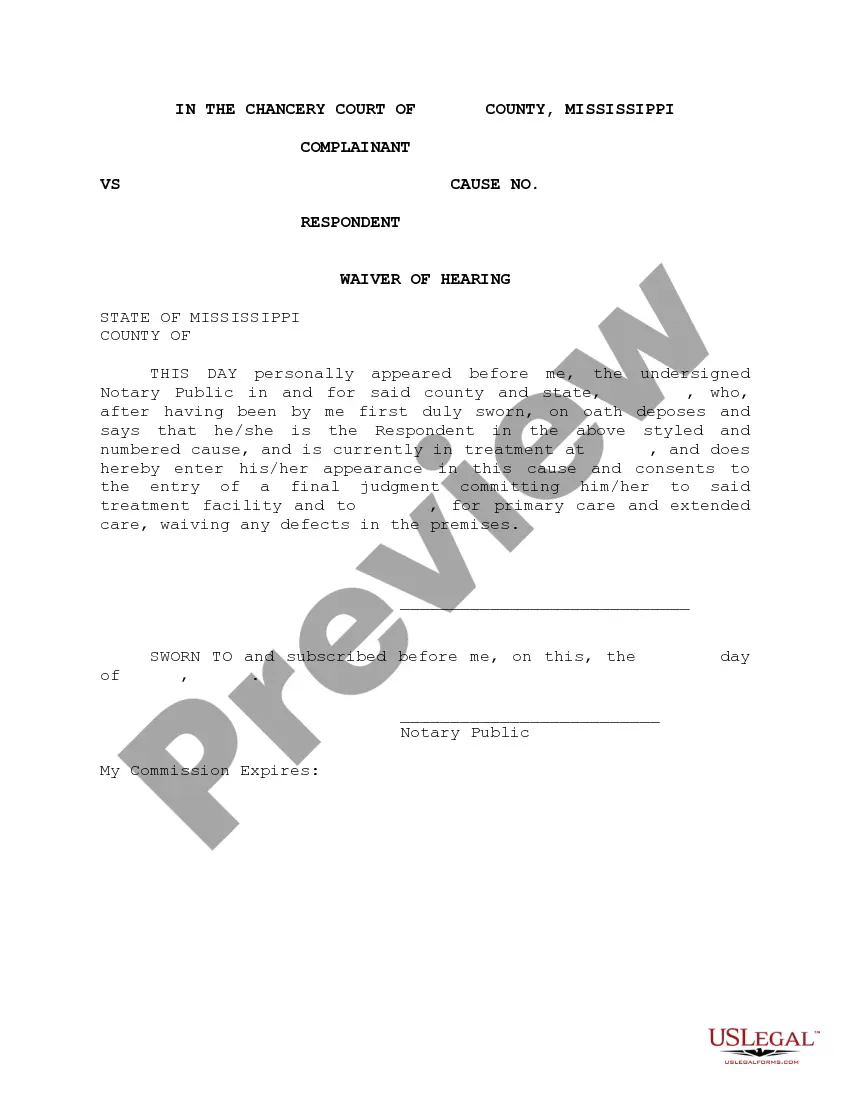
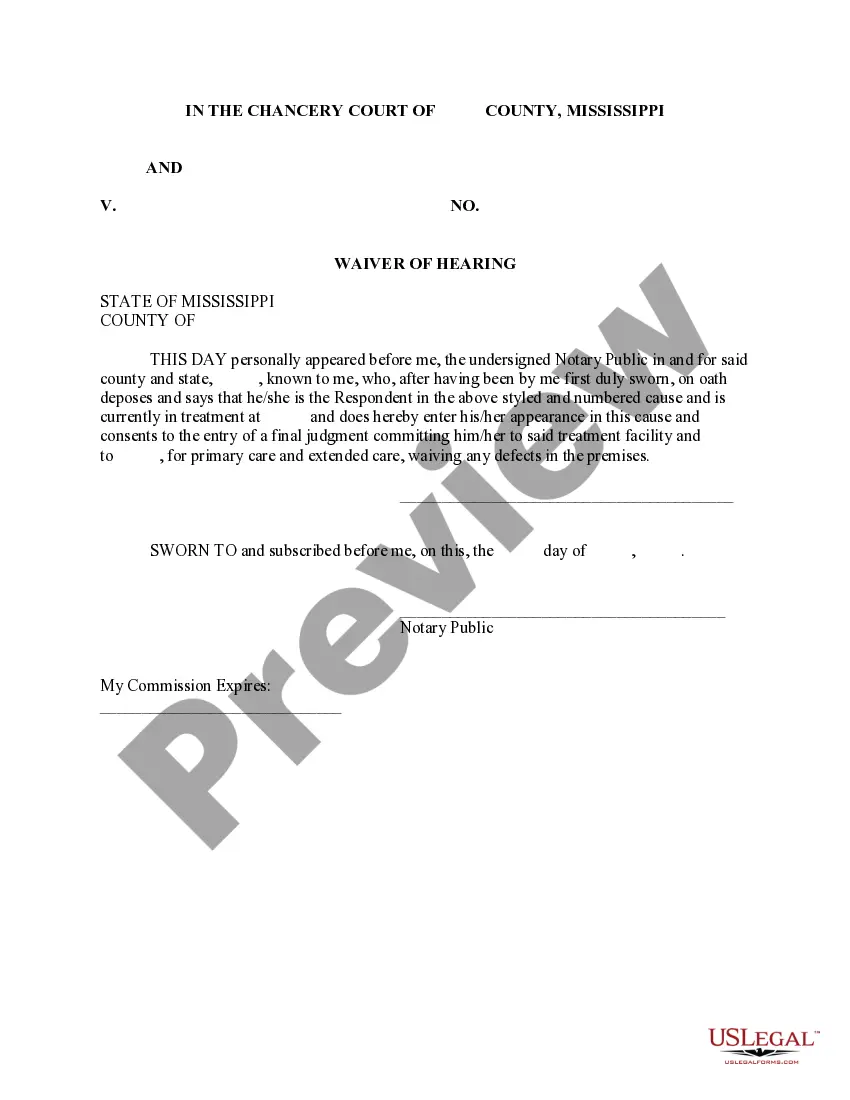
A Waiver of Hearing is a legal document signed by a respondent in a case. It indicates their consent to medical treatment and waives their right to a court hearing about that treatment. This form is essential for ensuring that individuals who are undergoing treatment can proceed without the delays associated with hearings, making it distinguishable from other legal forms that may require more judicial oversight or intervention.
Form components explained
- Title of the case: Identifies the complainant and respondent involved.
- Cause number: The unique number assigned to the case for reference.
- Respondentâs consent: A declaration that the respondent agrees to treatment without a hearing.
- Notary section: For certification of the respondentâs signature, ensuring its legal validity.
- Date section: Indicates when the waiver was signed and authorized.
When this form is needed
This form is typically used when a respondent is in need of mental health or medical treatment and wishes to forgo the formal hearing process typically required for court approval. It can be particularly useful in emergency situations where immediate treatment is necessary, or when a respondent is seeking to expedite their treatment process by voluntarily waiving their right to a hearing.
Who should use this form
- Individuals currently involved in a legal case concerning their medical treatment.
- Respondents in cases where a court hearing is required for treatment approval.
- Persons seeking to voluntarily consent to treatment without judicial delays.
How to prepare this document
- Identify the parties: Enter the names of the complainant and respondent.
- Fill in the cause number: Provide the unique case number assigned to the matter.
- Provide details of treatment: Indicate the treatment facility and the nature of the care being waived.
- Sign the form: The respondent must sign the document to indicate consent.
- Notarize the document: Ensure that a notary public witnesses the signature and certifies it.
Does this document require notarization?
Yes, this form must be notarized to be legally valid. Having a notary public witness the signature ensures that the consent is authentic and provides an added layer of legal protection. US Legal Forms offers integrated online notarization services, allowing you to complete this process securely via video call, with no need for travel.
Get your form ready online
Our built-in tools help you complete, sign, share, and store your documents in one place.
Make edits, fill in missing information, and update formatting in US Legal Forms—just like you would in MS Word.
Download a copy, print it, send it by email, or mail it via USPS—whatever works best for your next step.
Sign and collect signatures with our SignNow integration. Send to multiple recipients, set reminders, and more. Go Premium to unlock E-Sign.
If this form requires notarization, complete it online through a secure video call—no need to meet a notary in person or wait for an appointment.
We protect your documents and personal data by following strict security and privacy standards.

Make edits, fill in missing information, and update formatting in US Legal Forms—just like you would in MS Word.

Download a copy, print it, send it by email, or mail it via USPS—whatever works best for your next step.

Sign and collect signatures with our SignNow integration. Send to multiple recipients, set reminders, and more. Go Premium to unlock E-Sign.

If this form requires notarization, complete it online through a secure video call—no need to meet a notary in person or wait for an appointment.

We protect your documents and personal data by following strict security and privacy standards.
Mistakes to watch out for
- Failing to include the cause number or complete names of the parties.
- Not having the document notarized, making it potentially invalid.
- Leaving sections blank, which may delay processing or complicate legal matters.
Why use this form online
- Convenience: Access and complete the Waiver of Hearing form from home at any time.
- Editability: Easily customize the form to meet specific needs or situations.
- Reliability: Forms are drafted by licensed attorneys, ensuring legal soundness.
What to keep in mind
- A Waiver of Hearing provides legal consent to medical treatment without a hearing.
- It is essential for Defendants undergoing treatment to expedite their legal processes.
- The form must be notarized to ensure its legal validity.
- Tailored for use in Mississippi, reflecting state-specific legal requirements.
Looking for another form?
Form popularity
FAQ
A defendant may decide, after consulting with counsel, to waive the preliminary hearing. This allows the case to proceed to trial (though not immediately).
The criminal statute of limitations requires prosecutors to file criminal charges against a suspect within two years for misdemeanors and within five years for certain felonies, but there is no time limit in Mississippi for charges of murder, kidnapping, rape, burglary, robbery, larceny, and several other serious
Criminal defendants usually have the option to waive the preliminary hearing, but it happens very rarely and no defendant should do this without the advice of an attorney. If you waive a preliminary hearing, you allow the prosecution to proceed on criminal charges against you without having to present its evidence.
Technically under the law, a defendant would need to be indicted within 6 months. CPL 30.30 gives the DA 6 months to be ready for trial on a felony case. If there's no indictment in that time, the case certainly cannot proceed to trial and must be dismissed as a matter of law.
If the defendant waives the right to a preliminary hearing, the court moves on to the arraignment. If there is a contested hearing and the court finds probable cause, the matter is bound over for trial, which means the court moves on to the arraignment.
A waiver is a legally binding provision where either party in a contract agrees to voluntarily forfeit a claim without the other party being liable. Waivers can either be in written form or some form of action.
Sixteen-year-old William Haymon has spent more than 500 days in an adult jail in rural Lexington, Mississippi. There are no state rules governing how long a person can be incarcerated without being formally charged with a crime.
The defendant can waive the right to a speedy trial (called a waiver or "waives time"). This means s/he agrees to have the trial after the 60-day period. Before the trial starts, the lawyers choose a jury. During the trial, witnesses may testify and the lawyers present evidence.