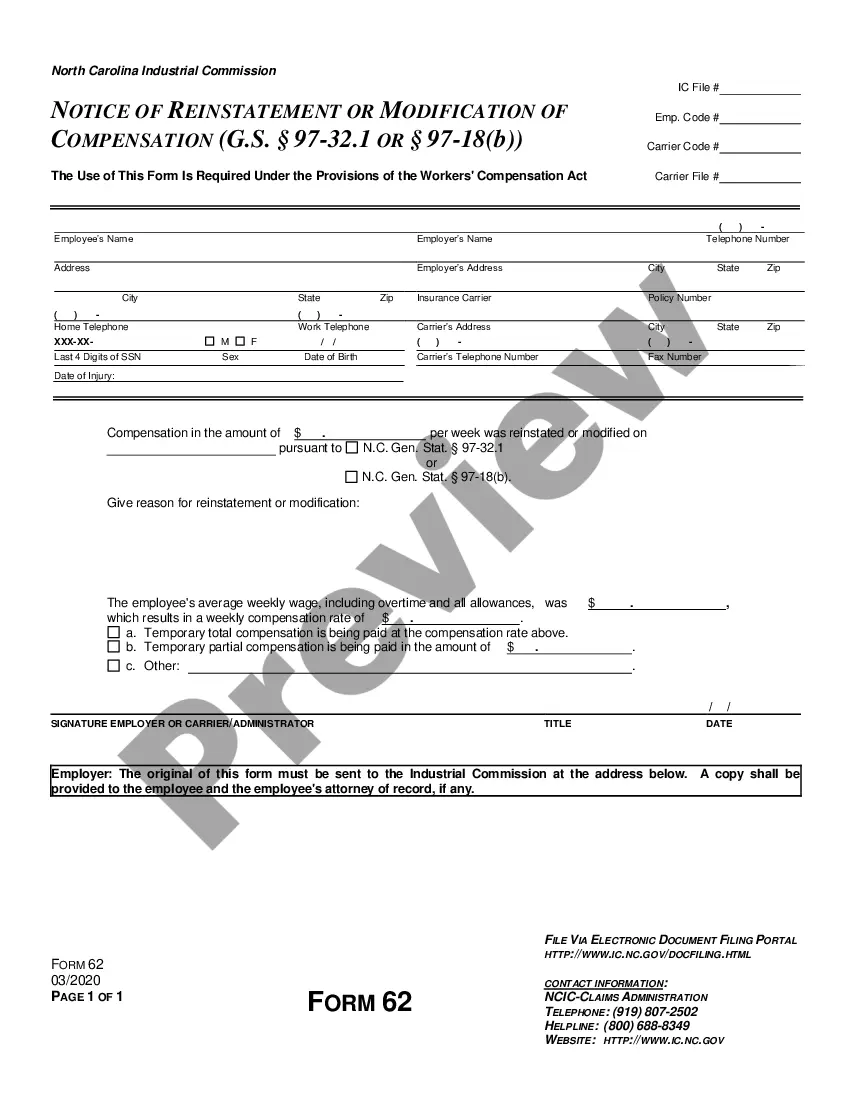
This is one of the official workers' compensation forms for the the state of North Carolina
North Carolina Notice of Reinstatement or Modification for Workers' Compensation
State:
North Carolina
Category:
Control #:
NC-62-WC
Format:
PDF
Instant download
This website is not affiliated with any governmental entity
Public form
Description
Get your form ready online
Our built-in tools help you complete, sign, share, and store your documents in one place.
Built-in online Word editor
Make edits, fill in missing information, and update formatting in US Legal Forms—just like you would in MS Word.
Export easily
Download a copy, print it, send it by email, or mail it via USPS—whatever works best for your next step.
E-sign your document
Sign and collect signatures with our SignNow integration. Send to multiple recipients, set reminders, and more. Go Premium to unlock E-Sign.
Notarize online 24/7
If this form requires notarization, complete it online through a secure video call—no need to meet a notary in person or wait for an appointment.
Store your document securely
We protect your documents and personal data by following strict security and privacy standards.

Make edits, fill in missing information, and update formatting in US Legal Forms—just like you would in MS Word.

Download a copy, print it, send it by email, or mail it via USPS—whatever works best for your next step.

Sign and collect signatures with our SignNow integration. Send to multiple recipients, set reminders, and more. Go Premium to unlock E-Sign.

If this form requires notarization, complete it online through a secure video call—no need to meet a notary in person or wait for an appointment.

We protect your documents and personal data by following strict security and privacy standards.
Looking for another form?
How to fill out North Carolina Notice Of Reinstatement Or Modification For Workers' Compensation?
Steer clear of expensive attorneys and locate the North Carolina Notice of Reinstatement or Modification for Workers' Compensation you need at a reasonable cost on the US Legal Forms site.
Utilize our straightforward categories feature to discover and acquire legal and tax documents. Examine their descriptions and preview them before downloading.
Pay using a credit card or PayPal. Opt to download the document in PDF or DOCX format. Click Download and locate your template in the My documents section. You are welcome to save the form to your device or print it. After downloading, you can fill out the North Carolina Notice of Reinstatement or Modification for Workers' Compensation manually or using editing software. Print it out and reuse the form multiple times. Achieve more for less with US Legal Forms!
- Moreover, US Legal Forms provides clients with detailed guidance on how to access and fill out each form.
- US Legal Forms users just need to sign in and retrieve the exact document they require from their My documents section.
- Those who do not have a subscription yet must follow the instructions outlined below.
- Verify that the North Carolina Notice of Reinstatement or Modification for Workers' Compensation is valid for use in your state.
- If applicable, read the description and utilize the Preview feature before downloading the templates.
- If you are assured the document satisfies your requirements, click on Buy Now.
- If the template is incorrect, use the search bar to find the appropriate one.
- Then, set up your account and select a subscription plan.
Form popularity
FAQ
When it comes to workers' compensation, a return to work will generally mean an end to benefits. It is important not to return to work until you are fully recovered, and a medical professional has determined it is safe to return.
Generally, it will take 4-8 weeks from the time the agreement is reached until there is money in your hands. Once the settlement is reached, the employers' attorney will need to draft the settlement contracts.
Workers' Comp laws in NC provide injured workers medical treatment for their injuries as well as wage replacement when they are disabled. Unlike the tort/negligence system which allows recovery for pain and suffering NC workers' compensation laws provide coverage primarily for economic losses.
As long as you have been given permission to go back to work, you should still be able to receive your workers' compensation benefits. Depending on the details of your case, you might also be able to pursue a settlement.
There is a seven-day waiting period where no compensation for time lost from work is allowed except when the injury results in the inability to work for more than 21 days. If the employee is unable to work for more than 21 days, then weekly compensation is allowed for the first seven days.
California Worker's Compensation Benefits. There is a three calendar day waiting period before injured employees will receive wage benefits. The three days do not have to be consecutive.
Most of the legislation throughout Australia prohibits an employer from dismissing an employee who is absent on workers' compensation until after a specified time period has passed.
When Does Workers' Compensation Start Paying? You are supposed to receive your first Workers' Compensation check within 21 days of telling your employer about your work-related injury.
A worker is disqualified where the injury: (1) is caused by the worker's own intoxication (alcohol or other controlled substance as defined by the Health and Safety Code; (2) is intentionally self-inflicted; (3) occurs out of an altercation (mutual combat) where the claimant was the initial physical aggressor; (4)