Motion to Adjourn at a Reasonable Time
What this document covers
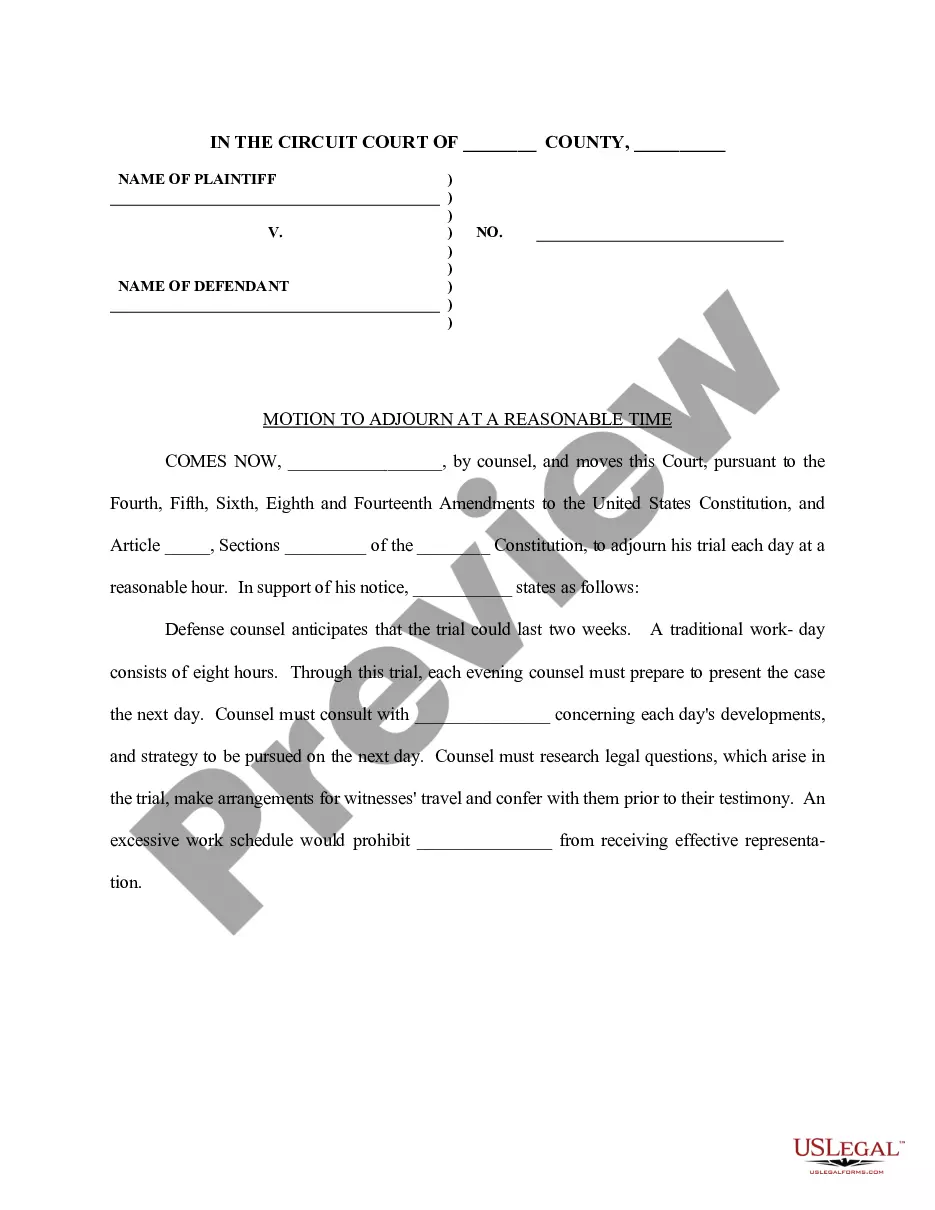
The Motion to Adjourn at a Reasonable Time is a legal document allowing defense counsel to request a delay in trial proceedings. This form specifically addresses the need for adequate time to prepare for court, ensuring that legal representation is effective. Unlike other motions, this one focuses on the balance between trial proceedings and the preparation necessary for a competent defense.
What’s included in this form
- Identification of the defense counsel and associated parties.
- A statement outlining the anticipated duration of the trial.
- Details on necessary preparations required for each phase of the trial.
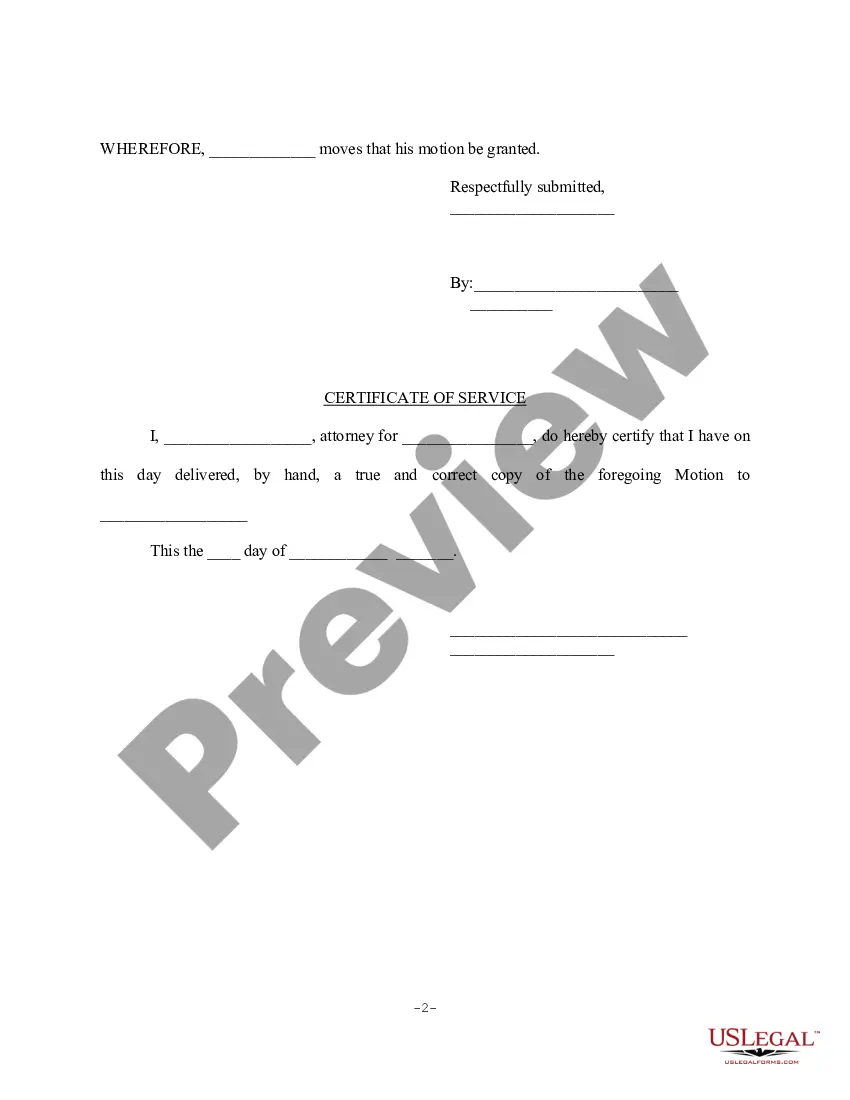
- A request for the motion to be granted, indicating the need for a reasonable adjournment.
- A certificate of service confirming delivery of the motion to the opposing party.
When to use this form
This form is used when defense counsel anticipates that the trial may extend beyond a typical time frame, requiring additional time for adequate preparation. It is particularly relevant in situations where the complexity of the case demands extensive research, consultation with witnesses, and strategic planning each day. Counsel may need to file this motion if the trial schedule is excessively demanding, potentially hindering effective representation.
Who can use this document
- Defense attorneys representing clients in court.
- Legal professionals managing trials that require lengthy preparation.
- Individuals seeking to ensure fair legal representation during trial proceedings.
How to prepare this document
- Identify the parties involved, including the defense counsel and the client.
- Specify the anticipated length of the trial in the appropriate field.
- Outline the specific preparations needed for each court session.
- Clearly state the reasons for requesting an adjournment.
- Sign and date the motion to affirm its validity.
Is notarization required?
Notarization is generally not required for this form. However, certain states or situations might demand it. You can complete notarization online through US Legal Forms, powered by Notarize, using a verified video call available anytime.
Get your form ready online
Our built-in tools help you complete, sign, share, and store your documents in one place.
Make edits, fill in missing information, and update formatting in US Legal Forms—just like you would in MS Word.
Download a copy, print it, send it by email, or mail it via USPS—whatever works best for your next step.
Sign and collect signatures with our SignNow integration. Send to multiple recipients, set reminders, and more. Go Premium to unlock E-Sign.
If this form requires notarization, complete it online through a secure video call—no need to meet a notary in person or wait for an appointment.
We protect your documents and personal data by following strict security and privacy standards.

Make edits, fill in missing information, and update formatting in US Legal Forms—just like you would in MS Word.

Download a copy, print it, send it by email, or mail it via USPS—whatever works best for your next step.

Sign and collect signatures with our SignNow integration. Send to multiple recipients, set reminders, and more. Go Premium to unlock E-Sign.

If this form requires notarization, complete it online through a secure video call—no need to meet a notary in person or wait for an appointment.

We protect your documents and personal data by following strict security and privacy standards.
Mistakes to watch out for
- Failing to provide sufficient details about the preparation needed.
- Leaving out necessary signatures or dates, making the motion incomplete.
- Not delivering a copy of the motion to the appropriate parties, which can lead to delays.
Benefits of completing this form online
- Convenient downloadable format allows for quick access and editing.
- Legal forms are created by licensed attorneys, ensuring quality and reliability.
- Ability to customize the form to fit specific case needs prior to filing.
Looking for another form?
Form popularity
FAQ
Ask for one by saying "Do I hear a motion to adjourn?" The motion to adjourn should clearly specify the time and date of the next meeting as well as any urgent matters that require special session before the next general meeting. Under Robert's rules, the motion needs to be seconded and cannot be amended or debated.
2022 either specify the time and place to which it is adjourned or state that it is to continue at a time and place to be fixed by the directors, and. 2022 have regard to any directions as to the time and place of any adjournment which have been given by the meeting.
: to suspend indefinitely or until a later stated time adjourn a meeting Court is adjourned until 10 a.m. tomorrow. intransitive verb. 1 : to suspend a session indefinitely or to another time or place Congress will not adjourn until the budget has been completed.
Ask for one by saying "Do I hear a motion to adjourn?" The motion to adjourn should clearly specify the time and date of the next meeting as well as any urgent matters that require special session before the next general meeting. Under Robert's rules, the motion needs to be seconded and cannot be amended or debated.
Motions may be made by any voting member of the board other than the chair. Step 2: Motion is seconded by any voting member of the board.
In parliamentary procedure, an adjournment ends a meeting. It could be done using a motion to adjourn. A time for another meeting could be set using the motion to fix the time to which to adjourn. This motion establishes an adjourned meeting.
Just before closing the meeting, the chair may ask board members if there's any more business to discuss. If directors raise a topic, the chair has the choice to discuss it immediately or state it will be added to the next meeting's agenda. Then, the chair can declare the meeting adjourned. Wait!
According to Standard 15.1 of SS 2, a duly convened general meeting shall not be adjourned unless circumstances so warrant. The Chairman may adjourn a general meeting with the consent of the Members, at which a Quorum is present, and shall adjourn a meeting if so directed by the Members.
1Adjourn now: Mr. President, I move to adjourn. Adoption of the motion closes the meeting.2Adjourn to continue the meeting later: Mr. President, I move to adjourn to meet again tomorrow at 8 a.m. This form sets up a continuation of the current meeting.3Adjourn sine die (without day): Mr.