Application to Condominium Association to make Alterations and/or Modifications to Condominium Unit and Indemnification Agreement
What is this form?
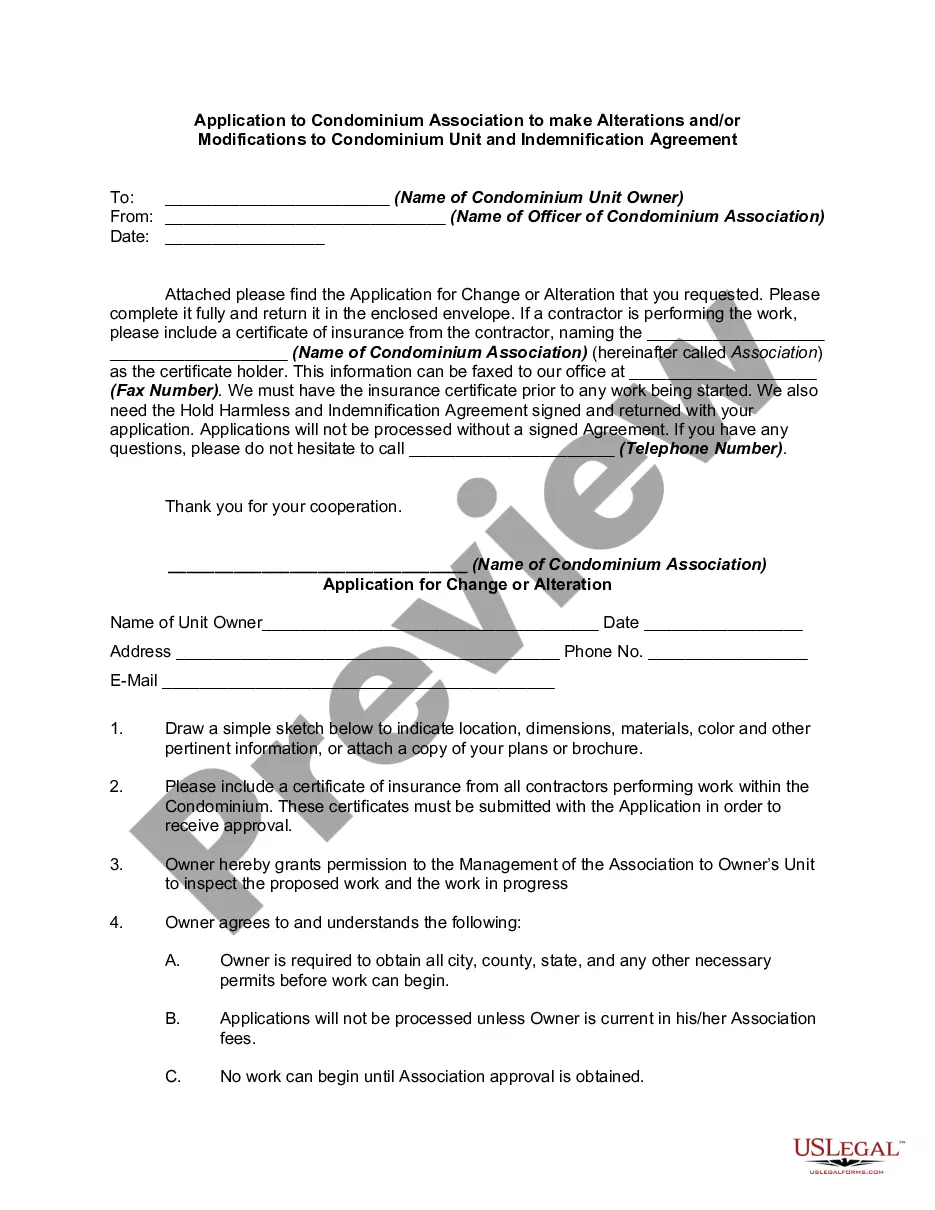
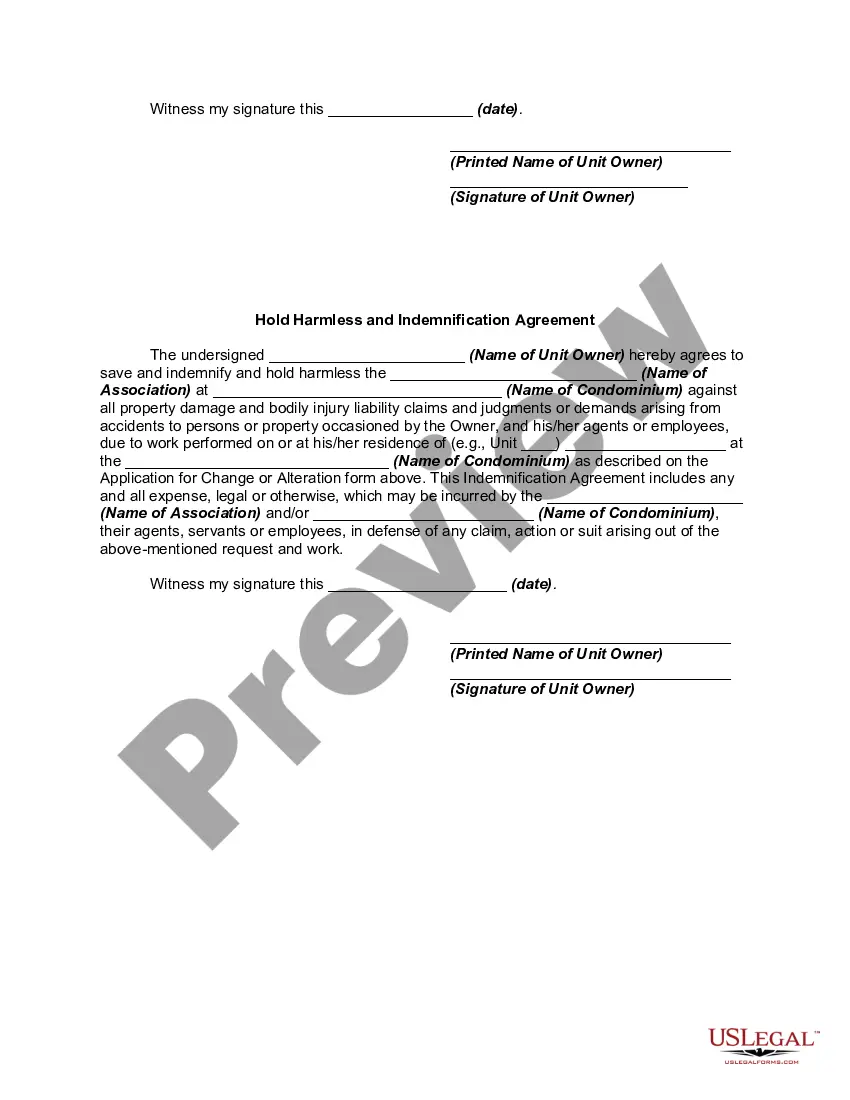
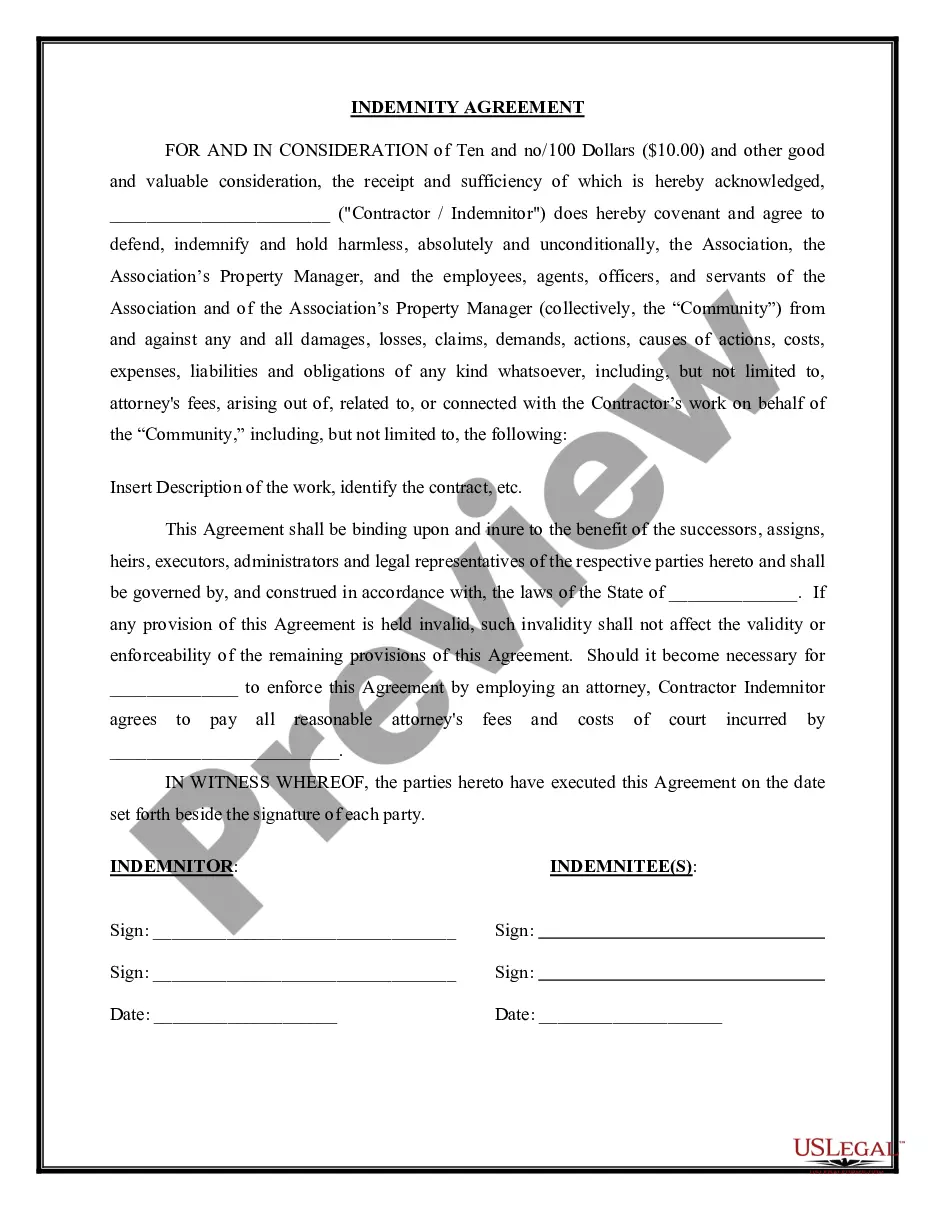
The Application to Condominium Association to make Alterations and/or Modifications to Condominium Unit and Indemnification Agreement is a legal document used by condominium unit owners. This form allows owners to formally request approval from their condominium association for any alterations or modifications they wish to make to their unit. It also includes an indemnification agreement to protect the association from any liabilities arising from the proposed work. This form is essential for ensuring compliance with condominium policies and protecting both the owner and the association legally.
Main sections of this form
- Name and contact information of the condominium unit owner.
- Detailed description of the proposed alterations or modifications, including a sketch or plans.
- Requirements for obtaining contractor insurance certificates.
- A Hold Harmless and Indemnification Agreement section to protect the association from liabilities.
- Signature of the unit owner, affirming understanding of approval requirements and responsibilities.
When to use this document
This form should be used whenever a condominium unit owner intends to make alterations or modifications to their unit that may affect the building or surrounding units. Scenarios include renovations, structural changes, or any significant updates that require the association's approval. Using this form helps avoid misunderstandings and ensures that the proposed changes meet the association's guidelines.
Who should use this form
This form is intended for:
- Condominium unit owners planning to alter or modify their units.
- Contractors hired by unit owners to perform the work, as they will need to provide insurance documentation.
- Members of condominium associations reviewing and approving alteration requests.
How to complete this form
- Identify and provide your name and contact details as the unit owner.
- Clearly describe the proposed alterations, including dimensions and materials, and attach any relevant sketches or plans.
- Include a certificate of insurance from any contractors performing the work.
- Review and sign the Hold Harmless and Indemnification Agreement section.
- Submit the completed application, along with all attachments, to the condominium association.
Does this form need to be notarized?
This form does not typically require notarization to be legally valid. However, some jurisdictions or document types may still require it. US Legal Forms provides secure online notarization powered by Notarize, available 24/7 for added convenience.
Get your form ready online
Our built-in tools help you complete, sign, share, and store your documents in one place.
Make edits, fill in missing information, and update formatting in US Legal Forms—just like you would in MS Word.
Download a copy, print it, send it by email, or mail it via USPS—whatever works best for your next step.
Sign and collect signatures with our SignNow integration. Send to multiple recipients, set reminders, and more. Go Premium to unlock E-Sign.
If this form requires notarization, complete it online through a secure video call—no need to meet a notary in person or wait for an appointment.
We protect your documents and personal data by following strict security and privacy standards.

Make edits, fill in missing information, and update formatting in US Legal Forms—just like you would in MS Word.

Download a copy, print it, send it by email, or mail it via USPS—whatever works best for your next step.

Sign and collect signatures with our SignNow integration. Send to multiple recipients, set reminders, and more. Go Premium to unlock E-Sign.

If this form requires notarization, complete it online through a secure video call—no need to meet a notary in person or wait for an appointment.

We protect your documents and personal data by following strict security and privacy standards.
Avoid these common issues
- Failing to attach required insurance certificates from contractors.
- Not providing detailed descriptions or sketches of the proposed alterations.
- Submitting the application without a signed Hold Harmless and Indemnification Agreement.
- Not checking if all association fees are current before submitting the application.
Why complete this form online
- Convenience: Download and complete the form at your own pace.
- Editability: Make changes easily, ensuring all information is accurate before submitting.
- Accessible: Obtain legal forms anytime, reducing the time spent on paperwork.
Looking for another form?
Form popularity
FAQ
Know Rules and Bylaws. Expect the Best from Your HOA. Communicate with Other Members. Stay Involved. Get Approval Before You Make Changes. Run for a Position on the Board. Pay Your Dues on Time. If You're Fined, Accept It and Pay.
The Board of Directors would have to vote by majority to adopt a resolution to dissolve the Association. 1 100% of the membership must vote in favor of the dissolution. 3 The local government may need to approve the dissolution as well.
In essence, the main difference between most HOAs and condo associations is the type of property they represent. Condominiums represent condos - apartments, while HOAs represent houses. Regardless of the association, they are both democratic institutions and therefore need to conduct elections.
The short answer is yes, you can definitely lower HOA fees. Beyond knowing whether or not you can, though, it's important to learn how to lower HOA fees as well. As you can see, there are a number of ways you can cut back on how much to charge homeowners in dues.
Electing a governing board. Electing an officer or officers. Establishing management. Complying with filing and taxation requirements. Opening bank accounts after obtaining a tax ID. Confirming condo associations insurance. Establishing collection procedures and fines.
One of the hallmarks of a well-run Condo Association is strong policies and rules. The Association will ensure they have rules that make sense and curb negative behavior. In addition to this, the rules will be well-explained and well-understood by Owners.
They can be changed as the community's needs evolve. If you're thinking of moving into a planned development community, it's important for you to be aware of all laws, bylaws, and rules that regulate the HOA before you move in.
Know the rules. You should have read all the government documents, including the rules and regulations, before you closed on your purchase. Respond in writing. Don't argue the rule. Know the penalties.
Among the steps you can take are to request a variance (an exception to the rule they have promulgated and are trying to enforce against you), file a grievance, request a hearing, correspond with your Board and Property Management Company, or pay the fine or pay to take the action they are requiring you to take and