Plan of Merger with Conversion of Outstanding Shares by Payment in Cash to Shareholders of Merging Corporation
Overview of this form
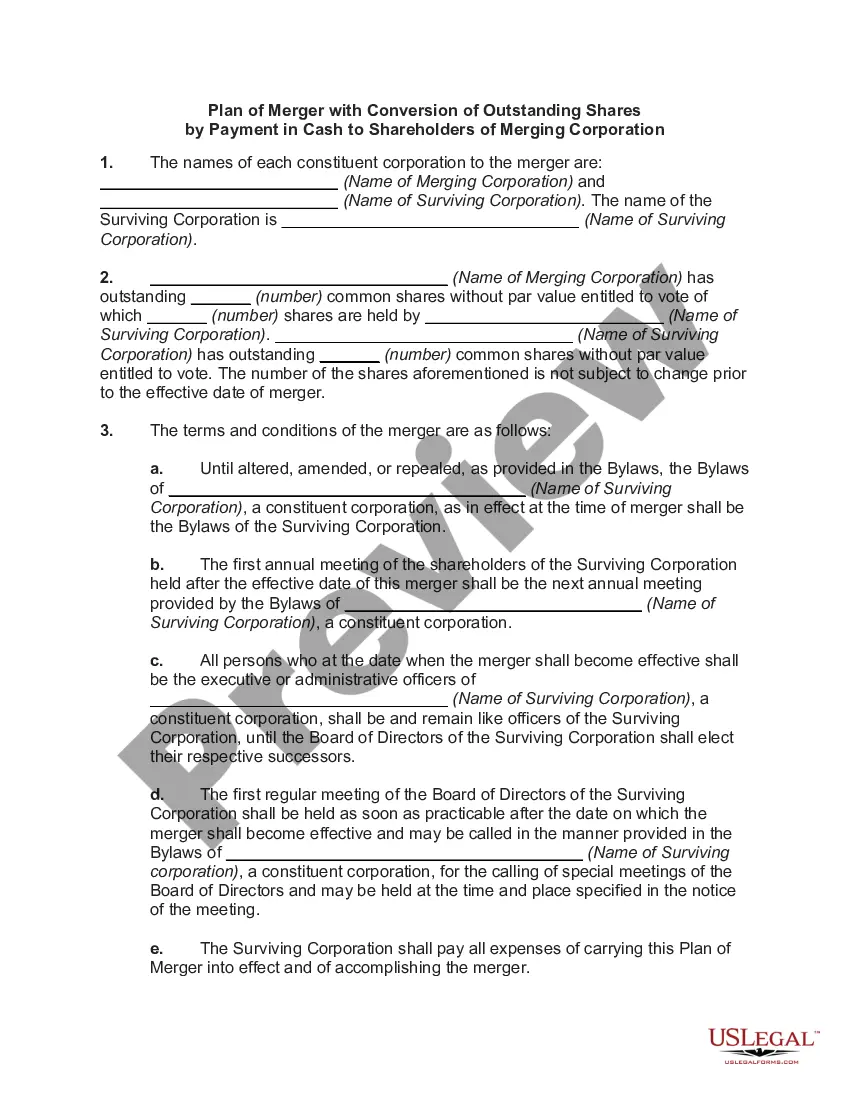
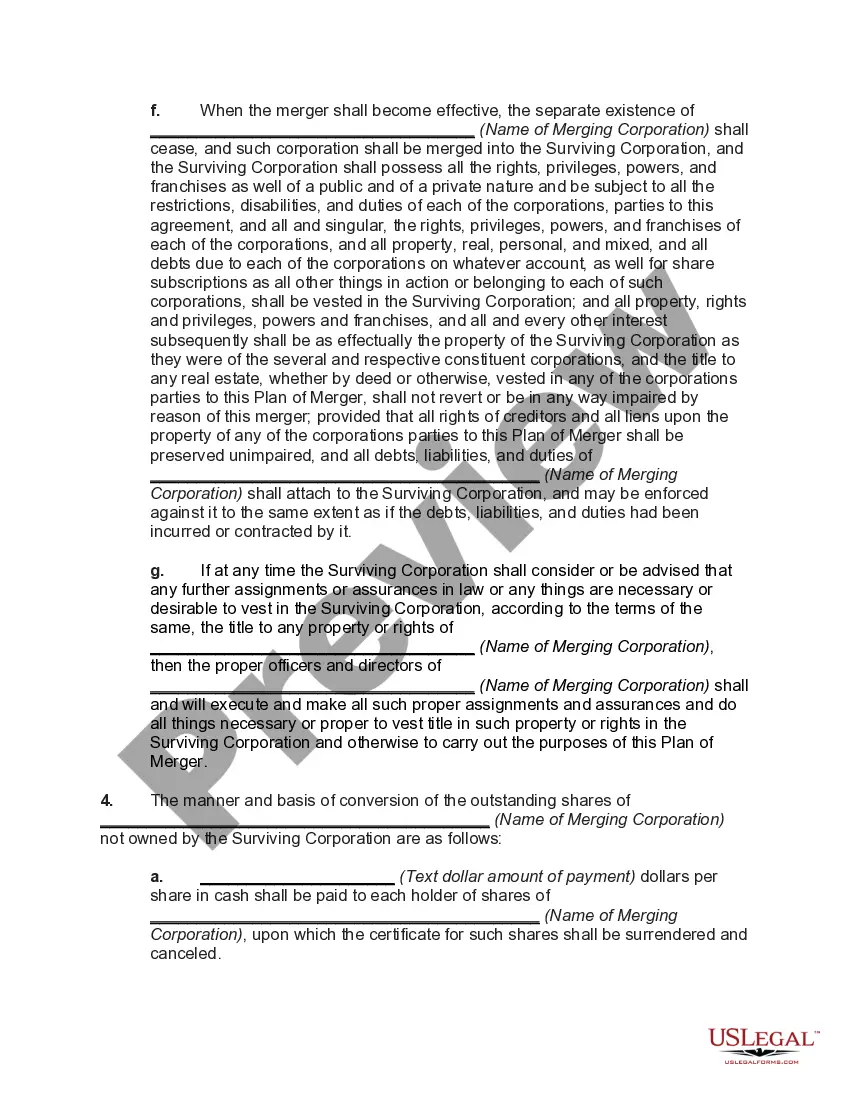
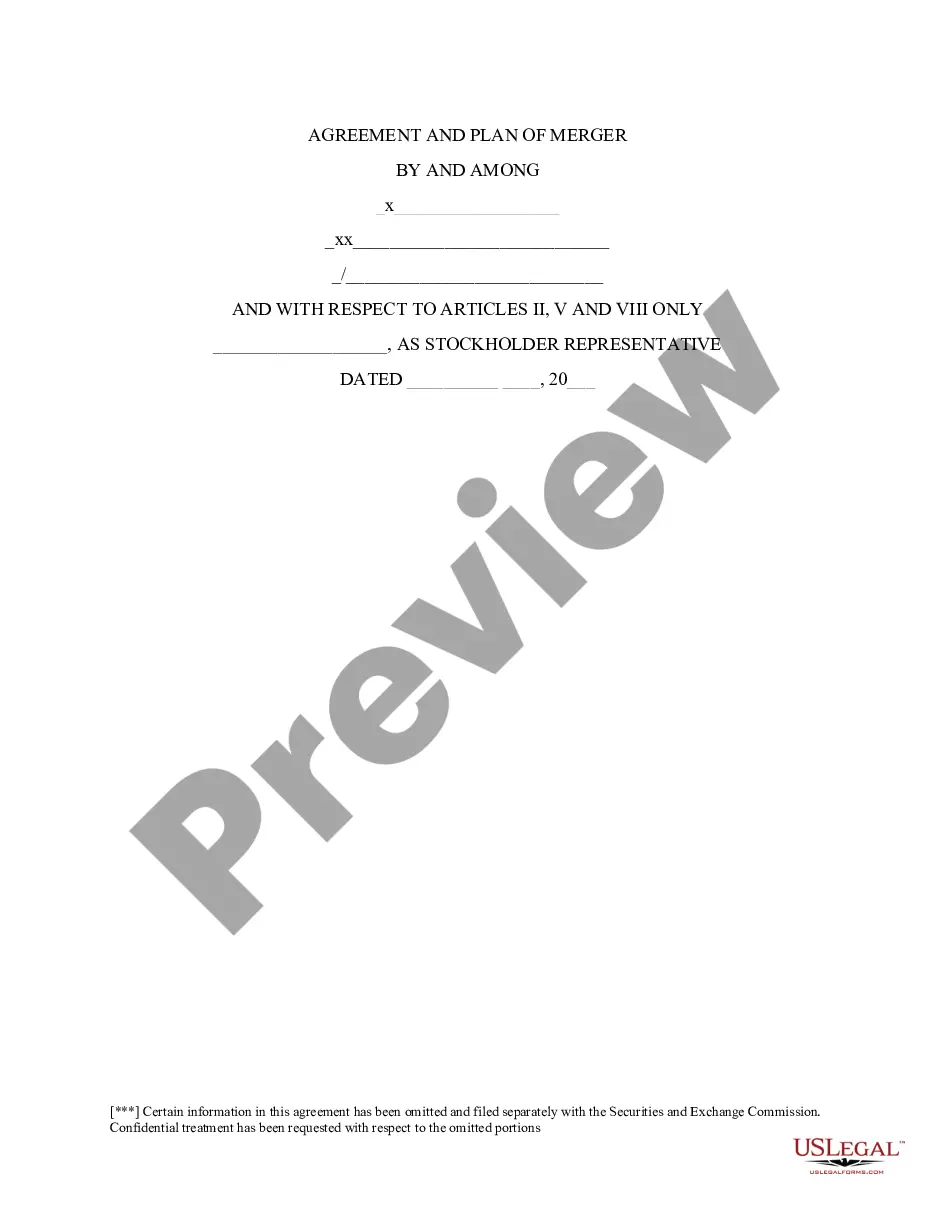
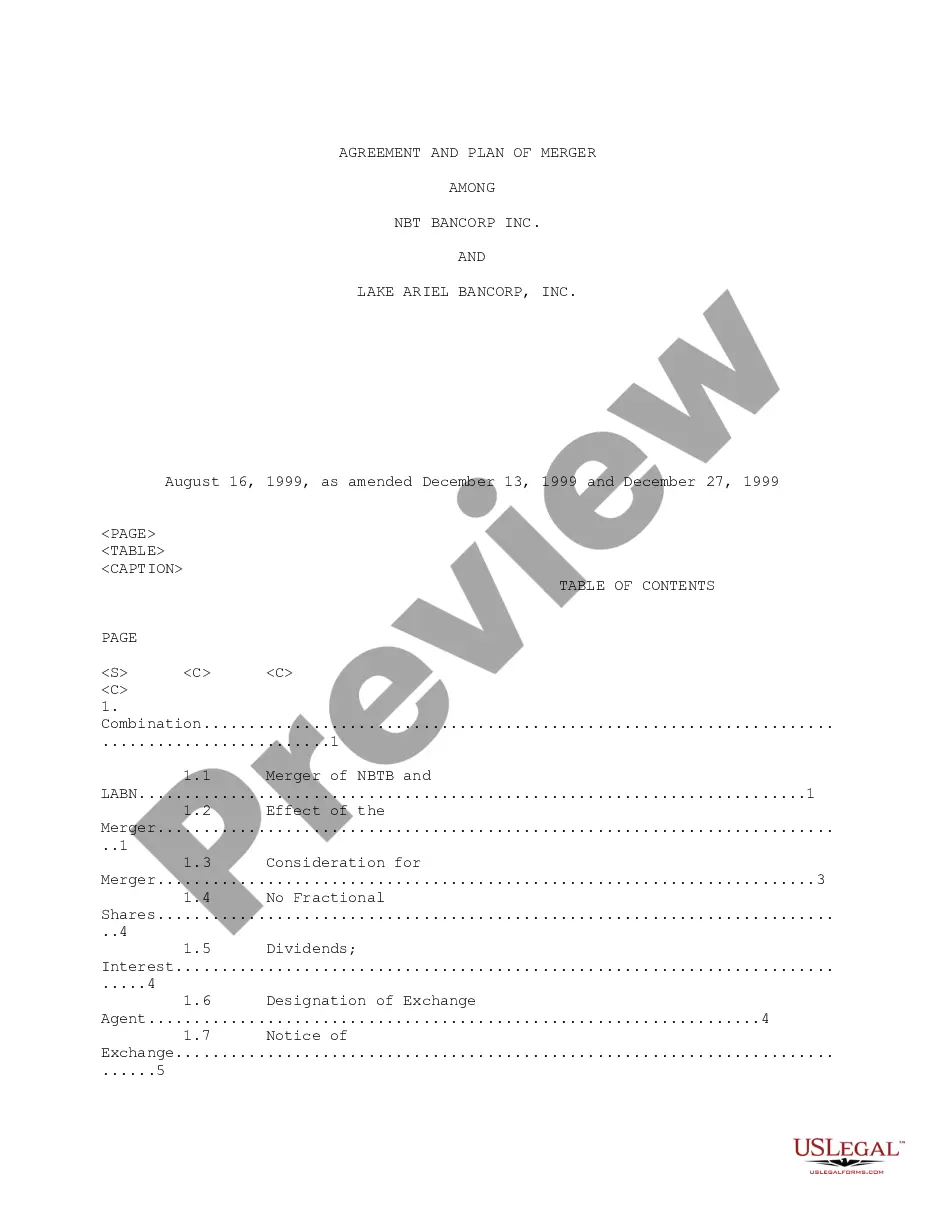
The Plan of Merger with Conversion of Outstanding Shares by Payment in Cash to Shareholders of Merging Corporation is a legal document that facilitates the merger of two corporations. In this agreement, one corporation absorbs the other, terminating its corporate existence while one corporation continues to exist under its original charter. This form outlines the specific terms of the merger, the rights of shareholders, and the conditions under which outstanding shares will be converted into cash payments, distinguishing it from other merger agreements that might not involve cash transactions or shareholder compensation.
Key parts of this document
- Identification of the merging and surviving corporations.
- Details regarding the number of outstanding shares and their ownership.
- Terms and conditions governing the merger process, including bylaws and meetings.
- Procedures for converting shares into cash payments for shareholders.
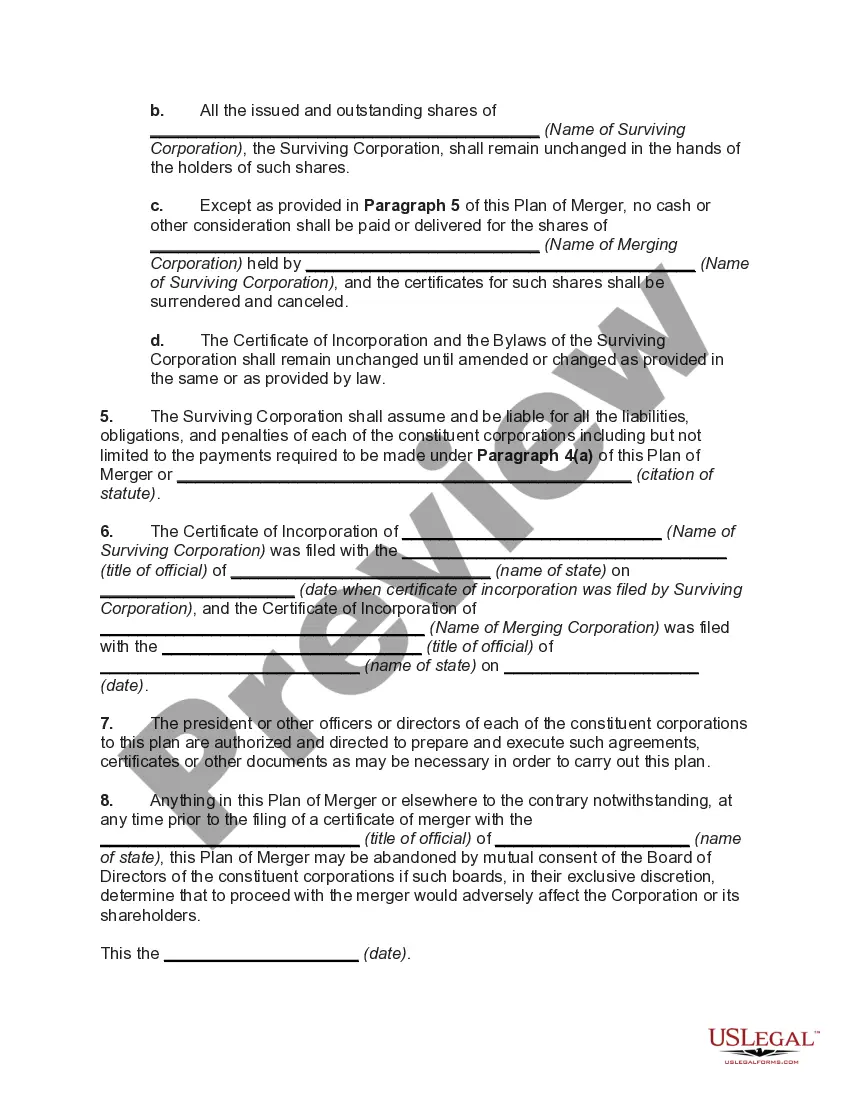
- Responsibilities of the surviving corporation concerning liabilities and obligations.
- Legal validations and signature requirements for the officials of both corporations.
Common use cases
This form should be used when two corporations have agreed to merge and one corporation will absorb the other, resulting in the dissolution of the latter. It is particularly relevant when shareholders of the merging corporation will receive cash payments in exchange for their shares. Utilize this form to ensure legal compliance and protect the interests of all parties involved in the merger.
Who can use this document
- Corporation executives or board members involved in planning a merger.
- Legal representatives of companies seeking to merge.
- Shareholders of the merging corporation who will receive cash payments.
- Accountants or financial advisors advising on corporate mergers.
How to prepare this document
- Identify and enter the names of both the merging and surviving corporations in the designated fields.
- Specify the number of outstanding shares for each corporation and the respective holders of those shares.
- Detail the terms of the merger, including payment amounts and any necessary documentation or bylaw references.
- Obtain signatures from authorized officers of both corporations to validate the agreement.
- File the signed form with the appropriate state authority as required.
Is notarization required?
This form does not typically require notarization unless specified by local law. However, consulting with a legal professional is advisable to ensure compliance with any specific jurisdictional requirements.
Get your form ready online
Our built-in tools help you complete, sign, share, and store your documents in one place.
Make edits, fill in missing information, and update formatting in US Legal Forms—just like you would in MS Word.
Download a copy, print it, send it by email, or mail it via USPS—whatever works best for your next step.
Sign and collect signatures with our SignNow integration. Send to multiple recipients, set reminders, and more. Go Premium to unlock E-Sign.
If this form requires notarization, complete it online through a secure video call—no need to meet a notary in person or wait for an appointment.
We protect your documents and personal data by following strict security and privacy standards.

Make edits, fill in missing information, and update formatting in US Legal Forms—just like you would in MS Word.

Download a copy, print it, send it by email, or mail it via USPS—whatever works best for your next step.

Sign and collect signatures with our SignNow integration. Send to multiple recipients, set reminders, and more. Go Premium to unlock E-Sign.

If this form requires notarization, complete it online through a secure video call—no need to meet a notary in person or wait for an appointment.

We protect your documents and personal data by following strict security and privacy standards.
Mistakes to watch out for
- Failing to accurately count and disclose the number of outstanding shares.
- Not securing the required signatures from all necessary corporate officers.
- Completing the form without verifying compliance with state-specific merger regulations.
- Neglecting to include terms that protect shareholder rights during the conversion process.
Benefits of using this form online
- Convenient access to legal forms from anywhere, at any time.
- Easily editable templates allow for quick updates and adjustments.
- Access to attorney-drafted content ensures legal accuracy and reliability.
- Ability to create a legally binding document without needing to visit a law office.
Looking for another form?
Form popularity
FAQ
Mergers involve two or more equals, while takeovers involve one larger company that takes over a smaller company. Mergers are always agreed upon using mutual consent, while acquisitions may or may not be friendly. Merged companies choose a new name, while acquired companies often use the parent company's name.
Purchase Mergers As the name suggests, this kind of merger occurs when one company purchases another company. The purchase is made with cash or through the issue of some kind of debt instrument. The sale is taxable, which attracts the acquiring companies, who enjoy the tax benefits.
Conversions are like mergers in that the converted entity has all the duties, debts, obligations, and resources as the old entity. The converted entity is deemed to have existed without interruption and will have the same formation date as the old entity with a new entity type or home state.
Horizontal Merger A merger occurring between companies in the same industry. Horizontal merger is a business consolidation that occurs between firms who operate in the same space, often as competitors offering the same good or service.
A prominent example of a vertical merger is the merger between eBay and PayPal. eBay provides a platform that allows people to sell items, while PayPal allows buyers to pay for these items. This kind of merger can greatly increase efficiency.
The three main types of mergers are: Horizontal. Vertical. Concentric.
An occasion when two or more companies join and where the buying company buys the other company's shares with cash, rather than exchanging them for its own shares: The company proposed a cash merger valued at $170 million with a manufacturer of industrial machine parts. Want to learn more?
Example #1 sells steel products, and PQR Ltd. sells steel at the retail level to individuals. In this example, there can be a horizontal merger between these two companies to create synergy and increase the revenues and market shares of the group.