Jury Instruction - Modified Allen Charge
What this document covers
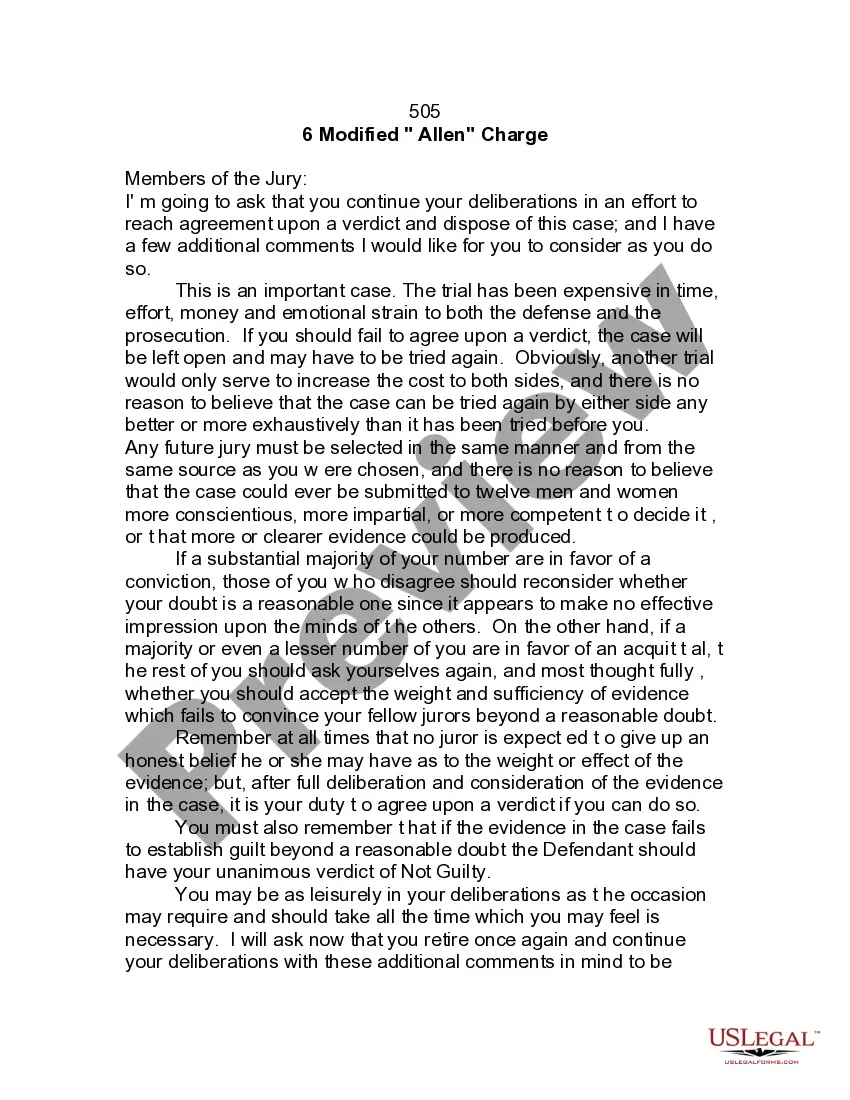
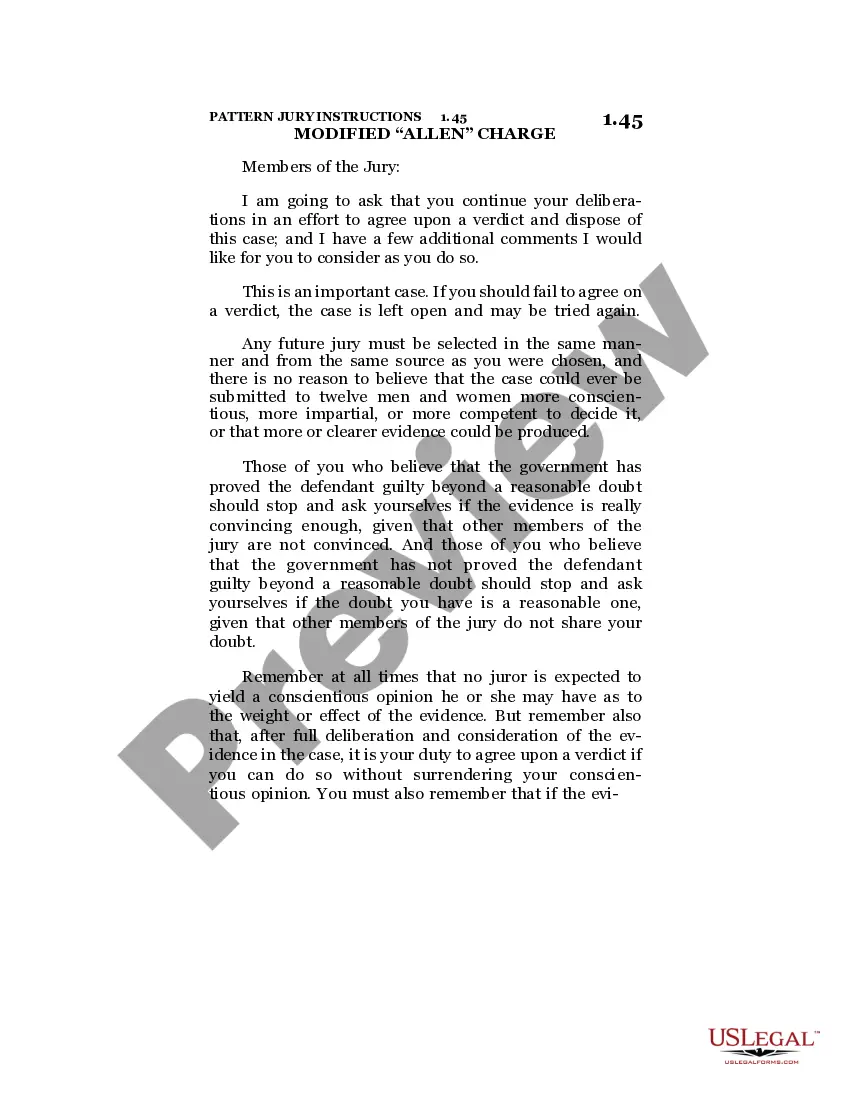
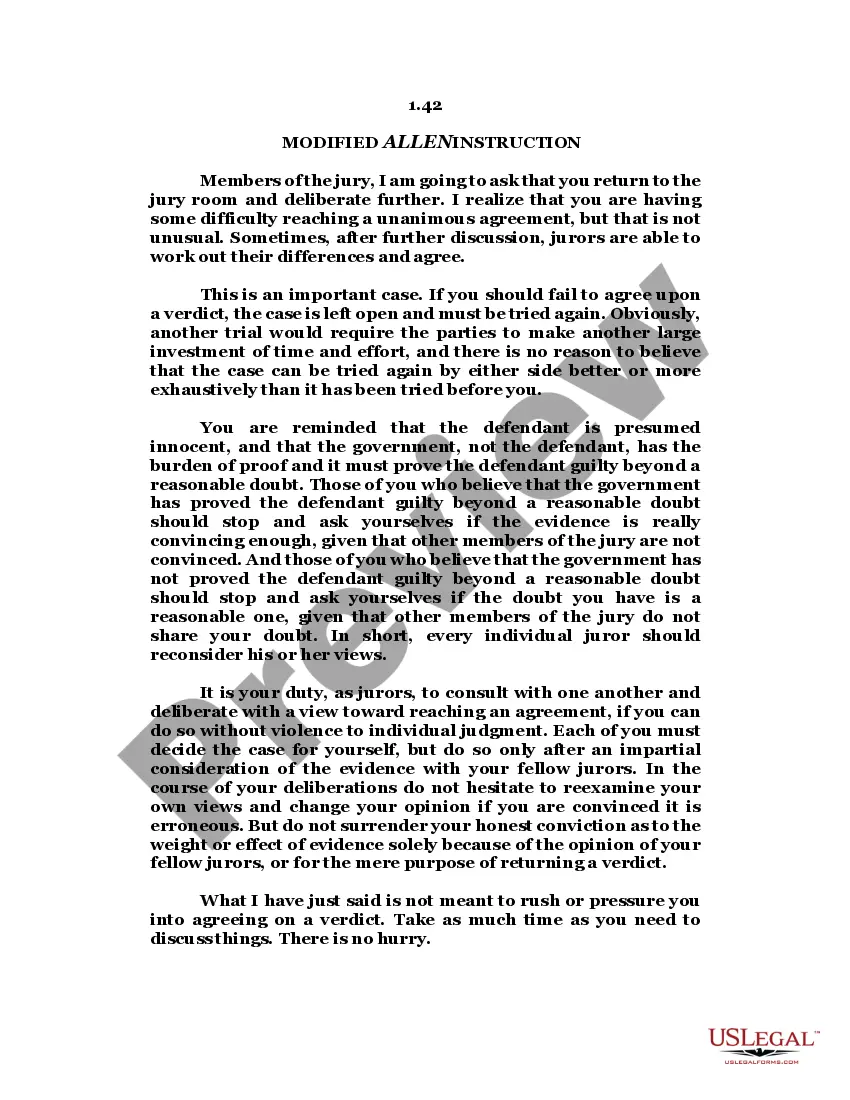
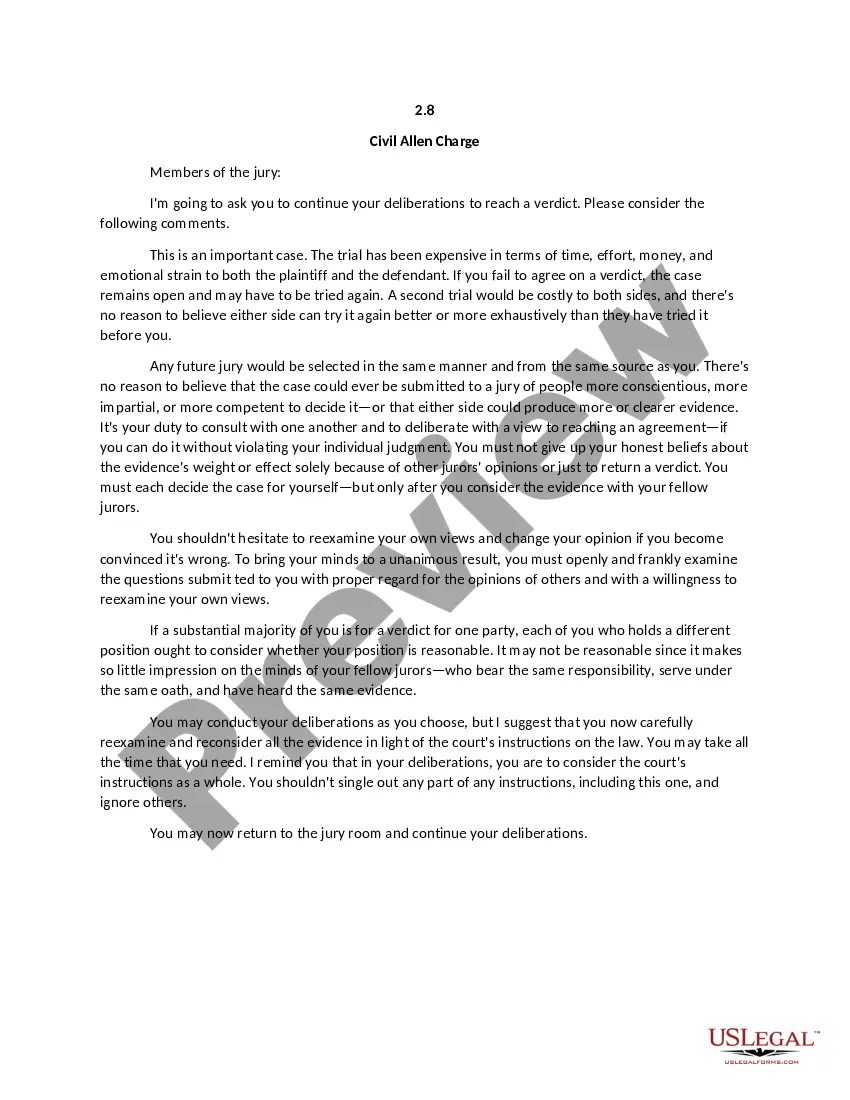
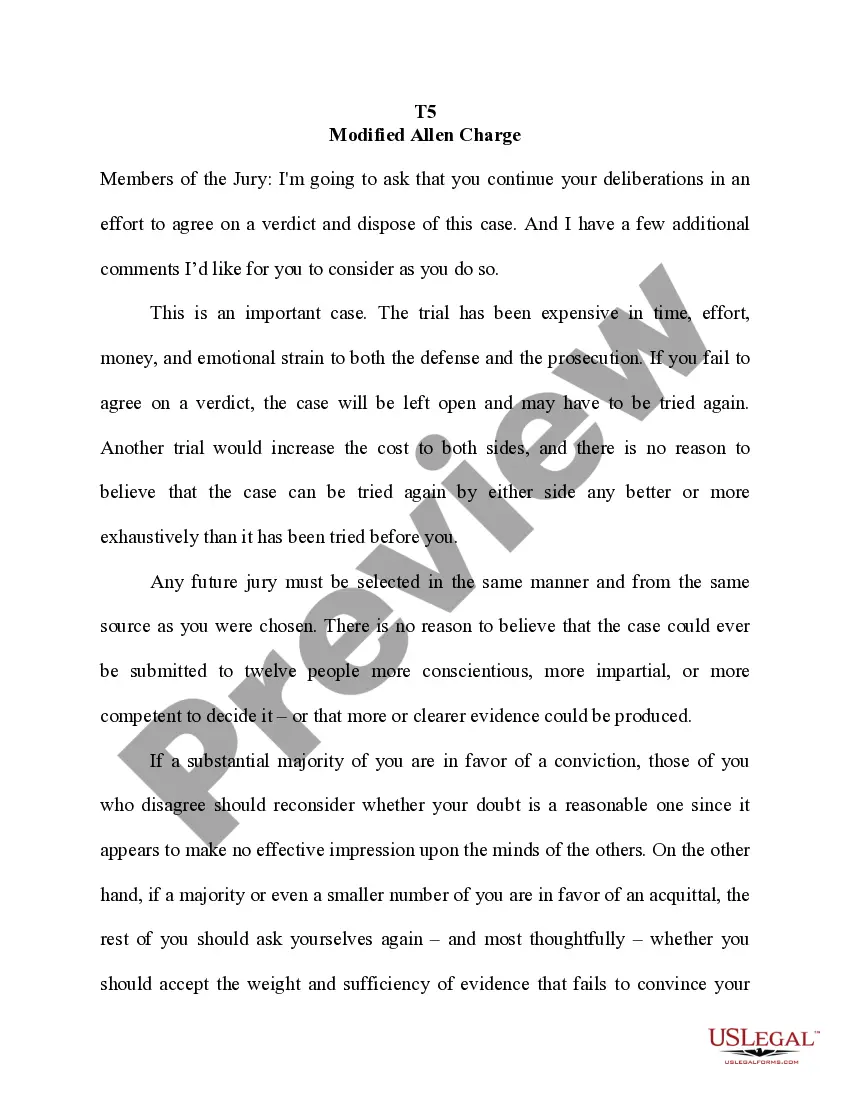
The Modified Allen Charge is a legal document provided to jurors by a judge when they are struggling to reach a unanimous verdict in a trial. This form contains a carefully crafted statement encouraging jurors to continue deliberating while emphasizing the importance of the case and the necessity of achieving a verdict. It differs from standard jury instructions by specifically addressing the dynamics of jury discussions and the potential consequences of a hung jury.
Key parts of this document
- Encouragement to continue deliberating toward a verdict.
- Emphasis on the expenses and emotional toll of the trial for all parties involved.
- Comments on the potential for a retrial and its implications.
- Guidance for jurors to reconsider their positions if a substantial majority favors a specific verdict.
- Clarification that jurors should not feel pressured to abandon honest beliefs about the evidence.

When to use this document
This form is used when jurors indicate they are unable to reach a consensus on a verdict. It serves to refocus their discussions, reminding them of the importance of completing their duty. The Allen Charge is especially relevant in cases where the stakes are high, such as criminal trials, where a hung jury may lead to a retrial, resulting in additional costs and uncertainties for all parties involved.
Who can use this document
- Judges presiding over jury trials facing potential hung juries.
- Legal professionals seeking to formalize jury instructions in complex cases.
- Jurors needing a clearer understanding of their responsibilities and the implications of their deliberations.
Completing this form step by step
- Read the form thoroughly to understand its components and intent.
- Customize any jurisdiction-specific elements reflecting local court rules as necessary.
- Prepare to present the form to the jury after confirming their difficulties in reaching a verdict.
- Deliver the instruction clearly and ensure jurors acknowledge their understanding.
- Follow up with the jury to await their decision after providing the instruction.
Is notarization required?
This form does not typically require notarization to be legally valid. However, some jurisdictions or document types may still require it. US Legal Forms provides secure online notarization powered by Notarize, available 24/7 for added convenience.
Get your form ready online
Our built-in tools help you complete, sign, share, and store your documents in one place.
Make edits, fill in missing information, and update formatting in US Legal Forms—just like you would in MS Word.
Download a copy, print it, send it by email, or mail it via USPS—whatever works best for your next step.
Sign and collect signatures with our SignNow integration. Send to multiple recipients, set reminders, and more. Go Premium to unlock E-Sign.
If this form requires notarization, complete it online through a secure video call—no need to meet a notary in person or wait for an appointment.
We protect your documents and personal data by following strict security and privacy standards.

Make edits, fill in missing information, and update formatting in US Legal Forms—just like you would in MS Word.

Download a copy, print it, send it by email, or mail it via USPS—whatever works best for your next step.

Sign and collect signatures with our SignNow integration. Send to multiple recipients, set reminders, and more. Go Premium to unlock E-Sign.

If this form requires notarization, complete it online through a secure video call—no need to meet a notary in person or wait for an appointment.

We protect your documents and personal data by following strict security and privacy standards.
Typical mistakes to avoid
- Failing to clarify the importance of a unanimous verdict.
- Not addressing the emotional impact on the jury during lengthy deliberations.
- Using overly complex legal language that confuses jurors.
- Neglecting to remind jurors of the potential consequences of a retrial.
Why complete this form online
- Convenience of instant access and download from any device.
- Editability to tailor the instructions to specific trial circumstances.
- Reliability with templates prepared by licensed attorneys, ensuring legal compliance.
What to keep in mind
- The Modified Allen Charge helps jurors focus on reaching a consensus on their verdict.
- It emphasizes the importance of the trial and the implications of a hung jury.
- This form is applicable in various jurisdictions, with adherence to local rules advised.
Looking for another form?
Form popularity
FAQ
With an Allen charge, the judge overseeing the case will recommend that the jury deliberate for an extended period of time and ask the minority to rethink their decision. If they still cannot reach an agreement, it will result in a mistrial.
The judge reads the instructions to the jury. This is commonly referred to as the judge's charge to the jury. In giving the instructions, the judge will state the issues in the case and define any terms or words that may not be familiar to the jurors.
When there is no jury ("bench trial"), the judge makes rulings on both questions of law and of fact. In most continental European jurisdictions, judges have more power in a trial and the role and powers of a jury are often restricted.
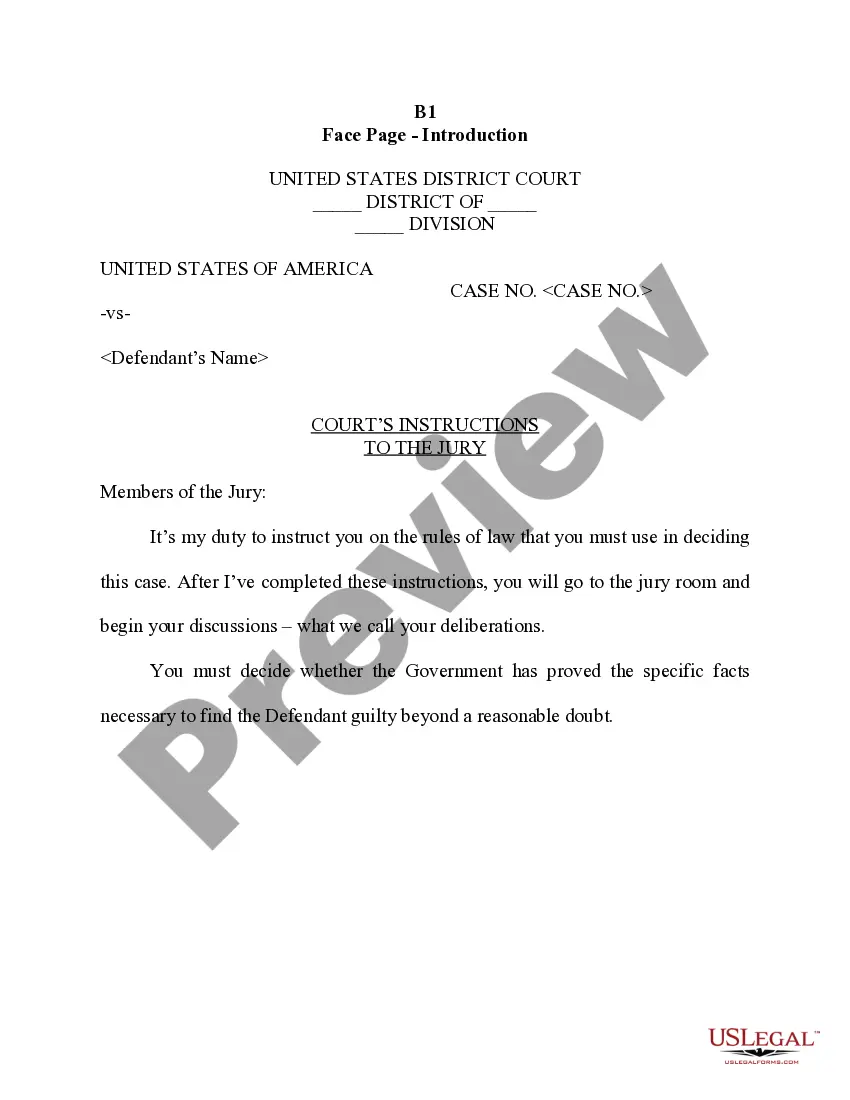
Jury instructions are instructions for jury deliberation that are written by the judge and given to the jury.
Definition. An instruction given by a court to a deadlocked jury to encourage it to continue deliberating until it reaches a verdict. Some states prohibit Allen charges, because they deem them coercive, but the U.S. Supreme Court upheld their use in Allen v. U.S., 164 U.S. 492 (1896).
In short, it is not legal to punish a juror for their verdict. This well-established principle of trial by jury has been the case in the American legal system since its inception and, preceding it, English common law since Bushel's case in 1670.
United States, 164 U.S. 492 (1896), was a United States Supreme Court case that, amongst other things, approved the use of a jury instruction intended to prevent a hung jury by encouraging jurors in the minority to reconsider.
The Federal Rules of Criminal Procedure state, "The verdict must be unanimous. . . .If the jury cannot agree on a verdict on one or more counts, the court may declare a mistrial on those counts. A hung jury does not imply either the defendant's guilt or innocence.
Definition. An instruction given by a court to a deadlocked jury to encourage it to continue deliberating until it reaches a verdict. Some states prohibit Allen charges, because they deem them coercive, but the U.S. Supreme Court upheld their use in Allen v. U.S., 164 U.S. 492 (1896).