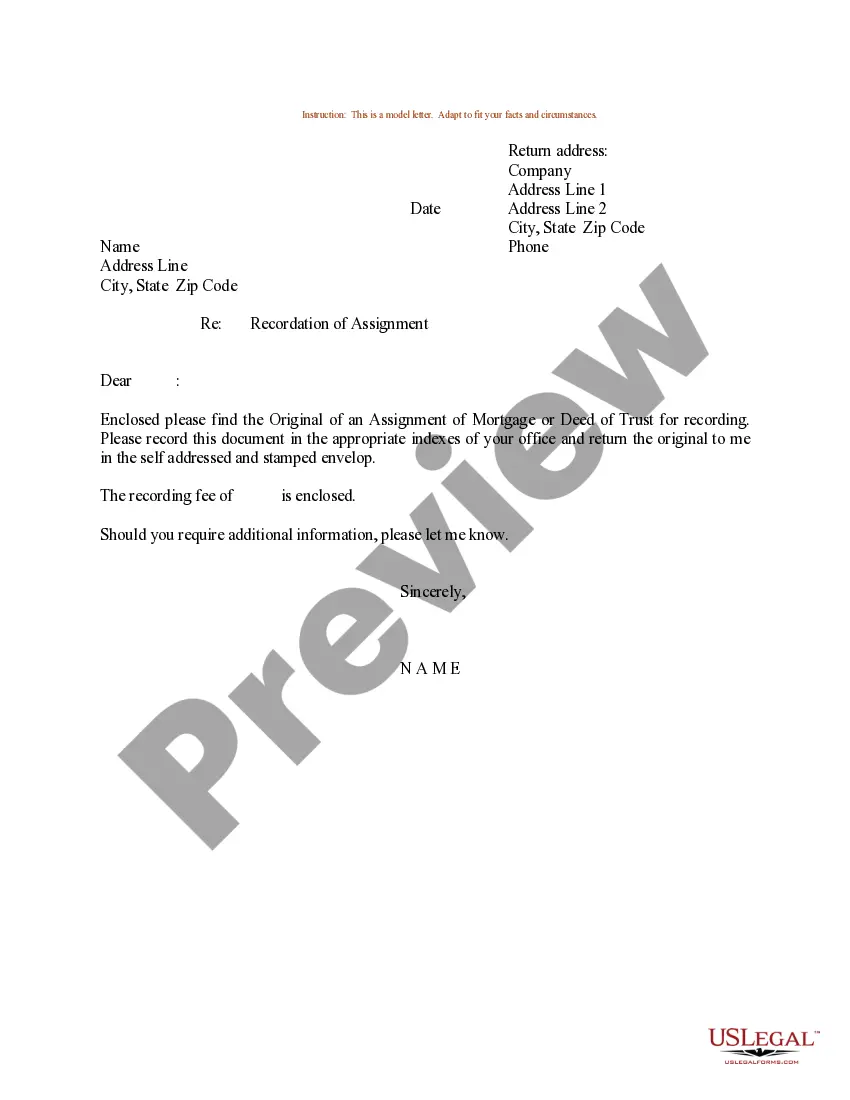
Letter to Recording Office for Recording Assignment of Mortgage
What this document covers
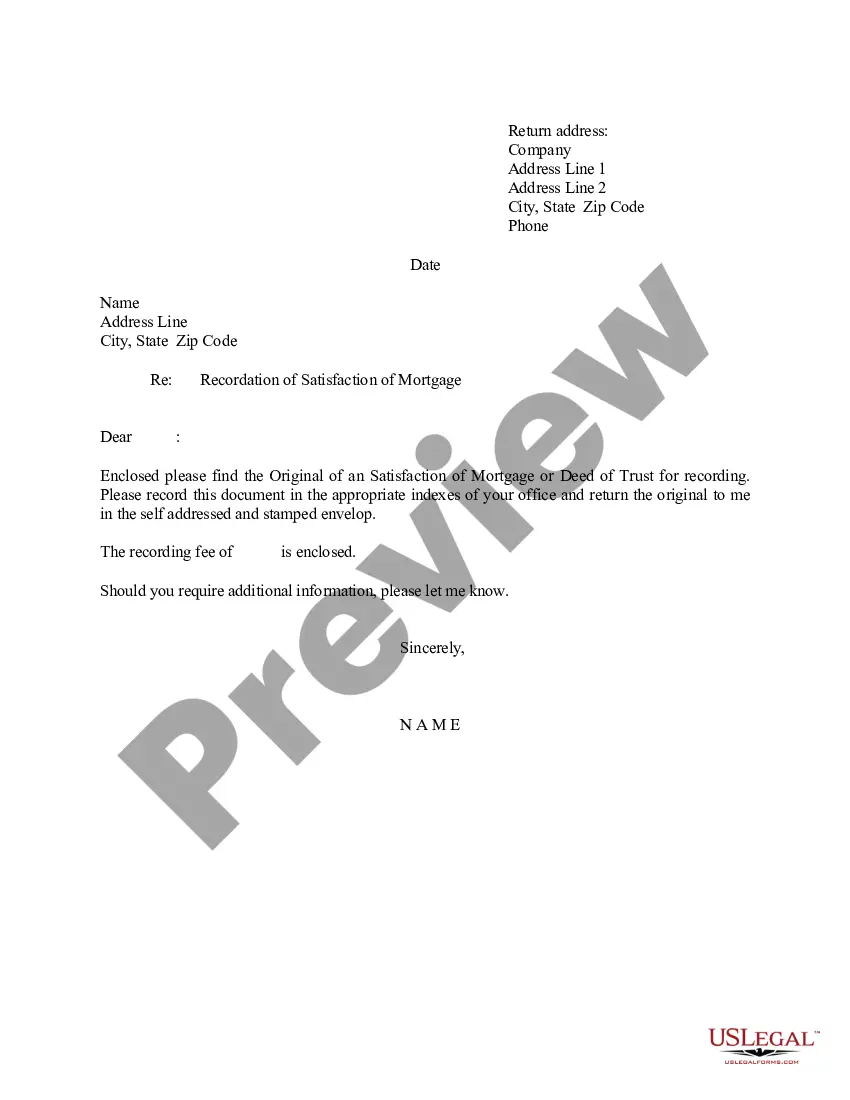
The Letter to Recording Office for Recording Assignment of Mortgage is a legal document used to formally request the recording of an assignment of mortgage. This letter is essential when a lender or mortgage servicer transfers the mortgage, ensuring that the change is recognized by the local recording office. Unlike other mortgage-related forms, this letter specifically serves the purpose of notifying the recording office of the assignment, thereby protecting the rights and interests of all parties involved.
Key components of this form
- Return address: Specifies where to send correspondence.
- Date: The date when the letter is prepared.
- Recipient information: Includes the name and address of the recording office.
- Subject line: Clearly states the purpose of the letter regarding the recordation of assignment.
- Signature: The letter must be signed by the authorized party.

When to use this document
Who should use this form
This form is intended for:
- Lenders and mortgage servicers involved in the assignment of mortgage.
- Homeowners or property owners who receive notice of an assignment and need to verify proper recording.
- Real estate attorneys assisting clients with mortgage assignments.
How to prepare this document
- Identify the parties involved: Include the names and addresses of the original mortgage holder and the party to whom the mortgage is being assigned.
- Specify the property: Clearly describe the property that is associated with the mortgage assignment.
- Enter the date: Write the date on which you are preparing the letter.
- Include the return address: This is the address where any correspondence should be sent.
- Sign the letter: Make sure the letter is signed by an authorized representative.
Is notarization required?
This form needs to be notarized to ensure legal validity. US Legal Forms provides secure online notarization powered by Notarize, allowing you to complete the process through a verified video call, available anytime.
Get your form ready online
Our built-in tools help you complete, sign, share, and store your documents in one place.
Make edits, fill in missing information, and update formatting in US Legal Forms—just like you would in MS Word.
Download a copy, print it, send it by email, or mail it via USPS—whatever works best for your next step.
Sign and collect signatures with our SignNow integration. Send to multiple recipients, set reminders, and more. Go Premium to unlock E-Sign.
If this form requires notarization, complete it online through a secure video call—no need to meet a notary in person or wait for an appointment.
We protect your documents and personal data by following strict security and privacy standards.

Make edits, fill in missing information, and update formatting in US Legal Forms—just like you would in MS Word.

Download a copy, print it, send it by email, or mail it via USPS—whatever works best for your next step.

Sign and collect signatures with our SignNow integration. Send to multiple recipients, set reminders, and more. Go Premium to unlock E-Sign.

If this form requires notarization, complete it online through a secure video call—no need to meet a notary in person or wait for an appointment.

We protect your documents and personal data by following strict security and privacy standards.
Typical mistakes to avoid
- Failing to include the correct recipient address for the recording office.
- Omitting important information such as the property description.
- Not signing the letter, which may render it invalid.
- Using outdated forms or formats inconsistent with state requirements.
Benefits of completing this form online
- Convenience: Easily access and download necessary forms at any time.
- Editability: Customize the letter to suit your specific situation without hassle.
- Reliability: Ensure that you are using forms drafted by licensed attorneys, increasing legal compliance.
Legal use & context
- This form is essential for ensuring the assignment of mortgage is legally recognized.
- Recording the assignment protects the rights of the new lender and informs the public of the change in mortgage ownership.
Looking for another form?
Form popularity
FAQ
Although recording statutes vary between U.S. states, they virtually all require that an interest in real property be formally recorded in the appropriate county office in order to be valid.If your deed has not been recorded, you are not recognized as the legal owner of your property.
It requires County Recorders throughout California to charge an additional $75 fee at the time of recording every real estate instrument, paper, or notice, except those expressly exempted from payment of recording fees, per each transaction per parcel of real property, not to exceed $225 per single transaction.
To have a document recorded, it must comply with state and local requirements and be accompanied by a fee. A recorder's office will index it and assign a unique ID code. The original document is returned to the document submitter and archived in the recorder's office and assessable to the public.
Any document affecting title to real property that is authorized or required by law to be recorded. This includes, but is not limited to, Grant Deeds, Deeds of Trust, Mechanic's Liens, Tax Liens, and Reconveyances. The recording requirements for documents are established by the codes for the State of California.
A properly recorded deed provides constructive notice of its contents, which means that all parties concerned are considered to have notice of the deed whether or not they actually saw it.
Mortgages are interests in property, and so can and should be recorded as soon as possible after the closing. Most states have recording statutes that impose restrictions on when and how a document conveying property rights can be legally created.
Real Estate Recording Systems In any case, it is the responsibility of the local county or state to make sure that these official documents are kept on file.In the case of mortgage liens, courts use the date of a recording to determine the priority for which liens should receive payment first.
Key Takeaways. Recording is the act of putting a document into official county records, especially for real estate and property transactions, that provides a traceable chain of title. Recorded documents do not establish who owns a property.
As a general rule, all recorded documents should be notarized.