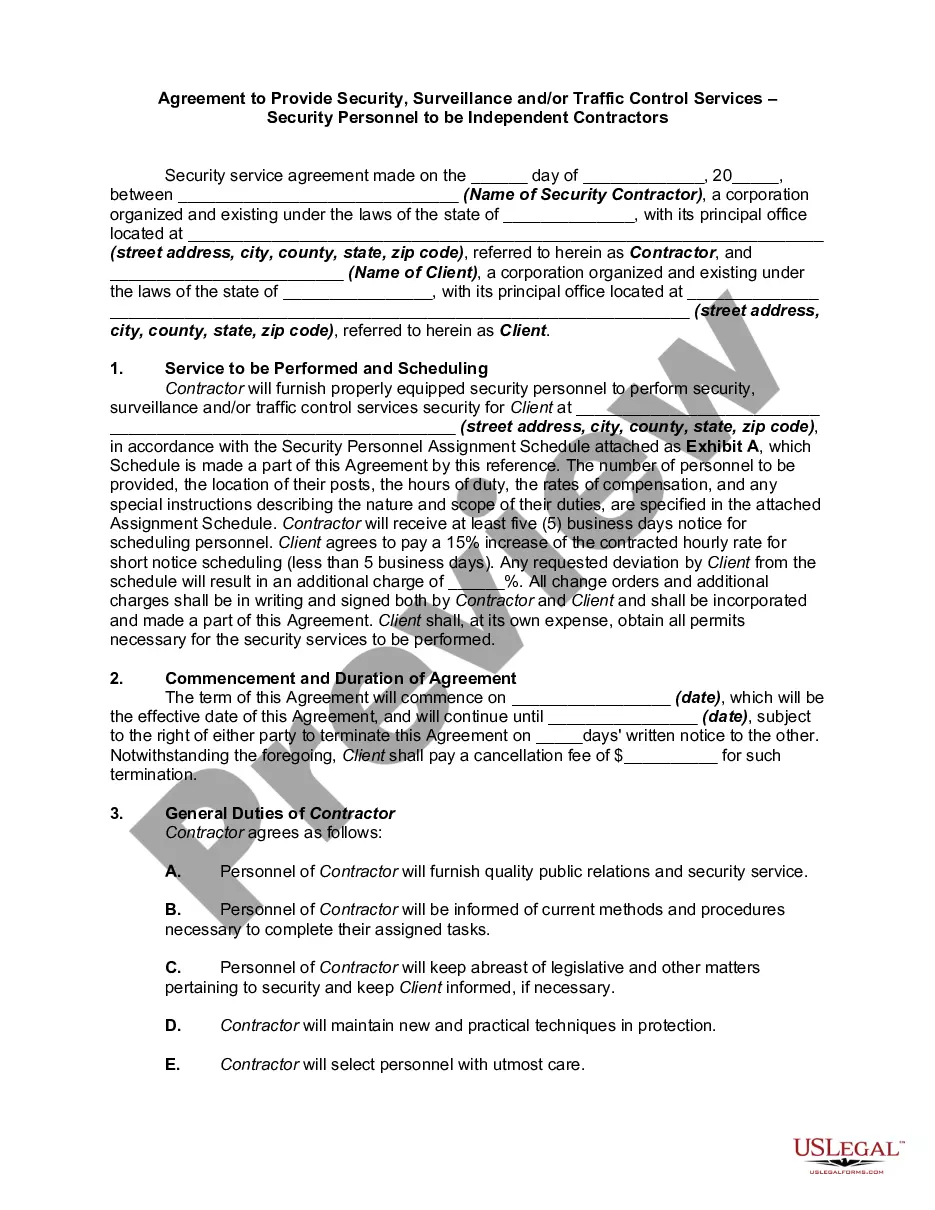
Agreement to Provide Security, Surveillance and/or Traffic Control Services Security Personnel to be Independent Contractors
Overview of this form
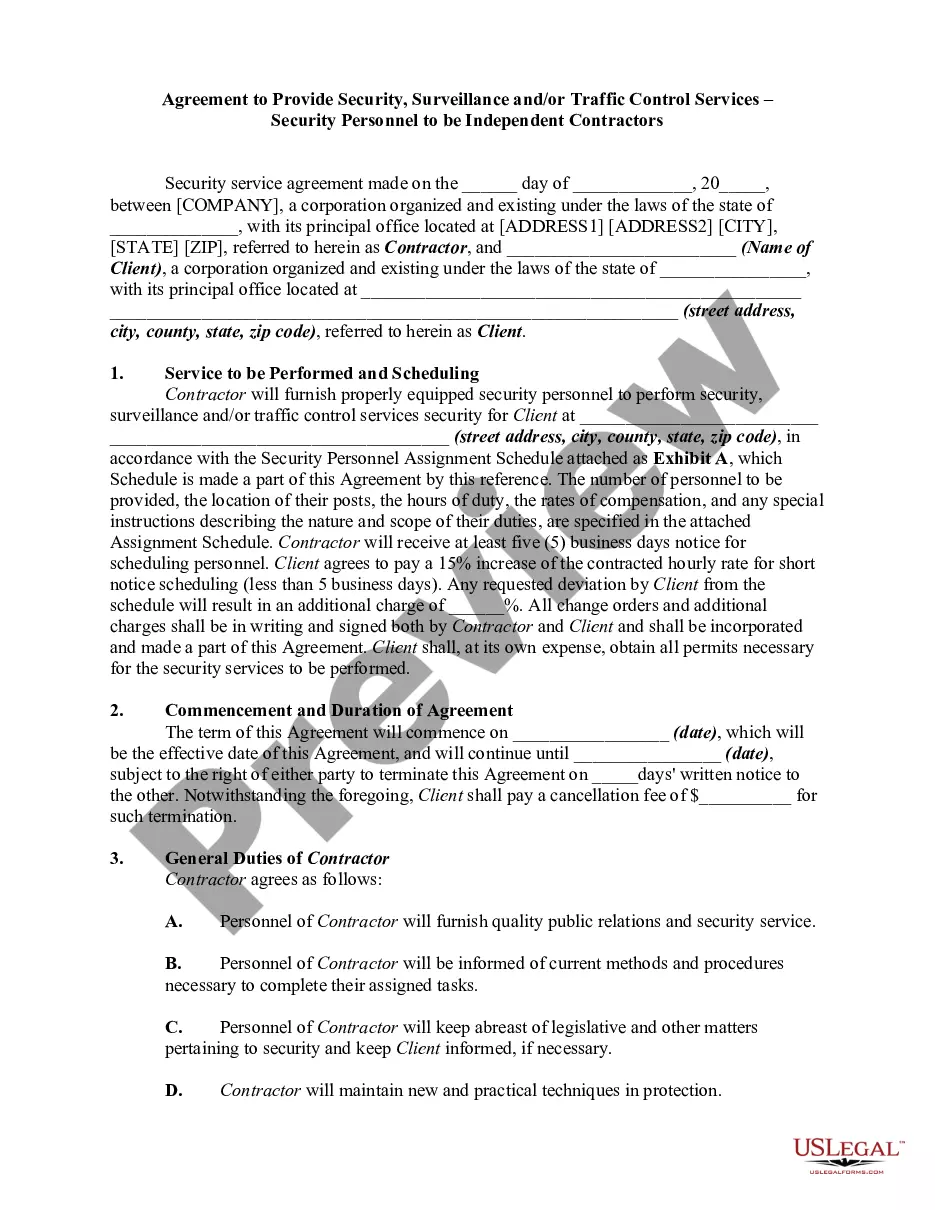
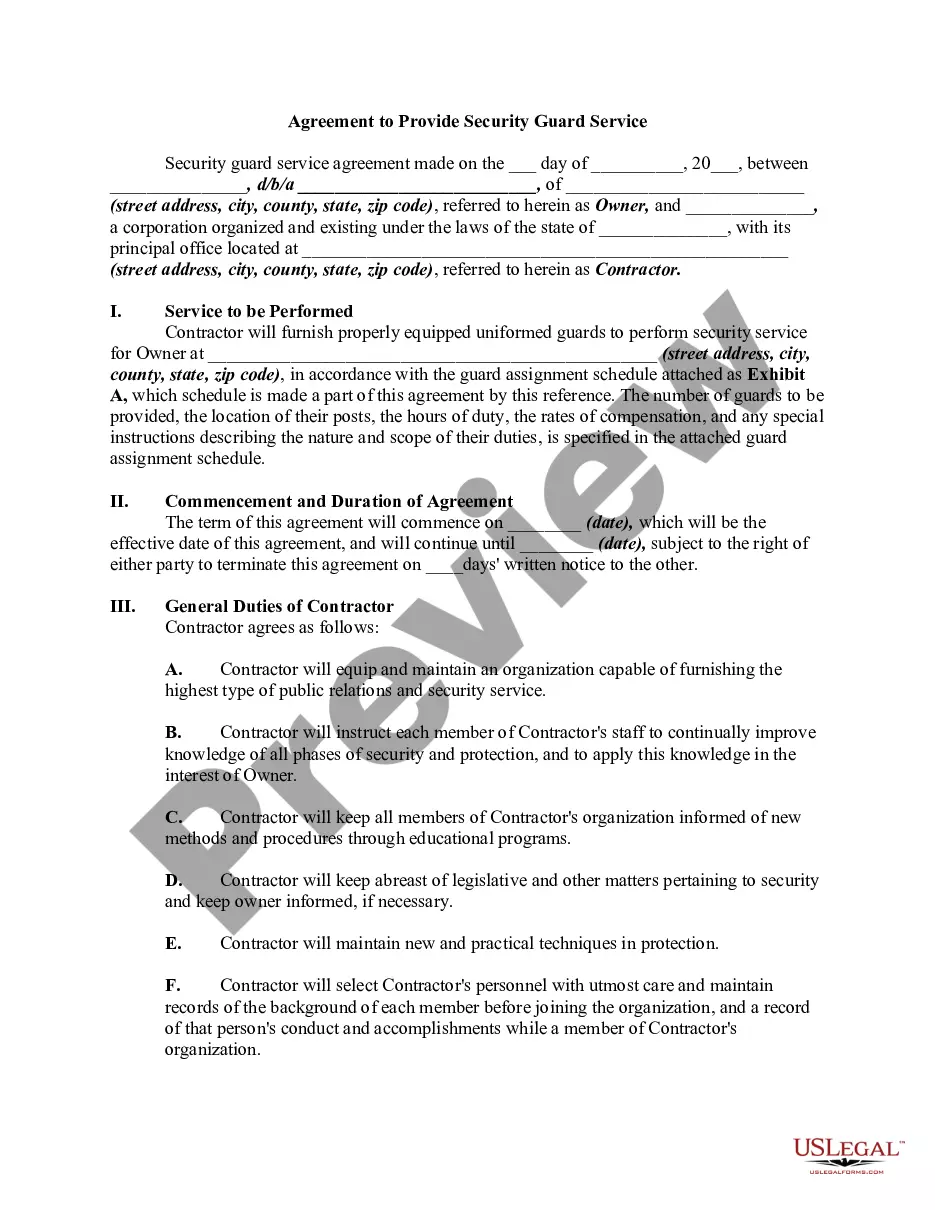
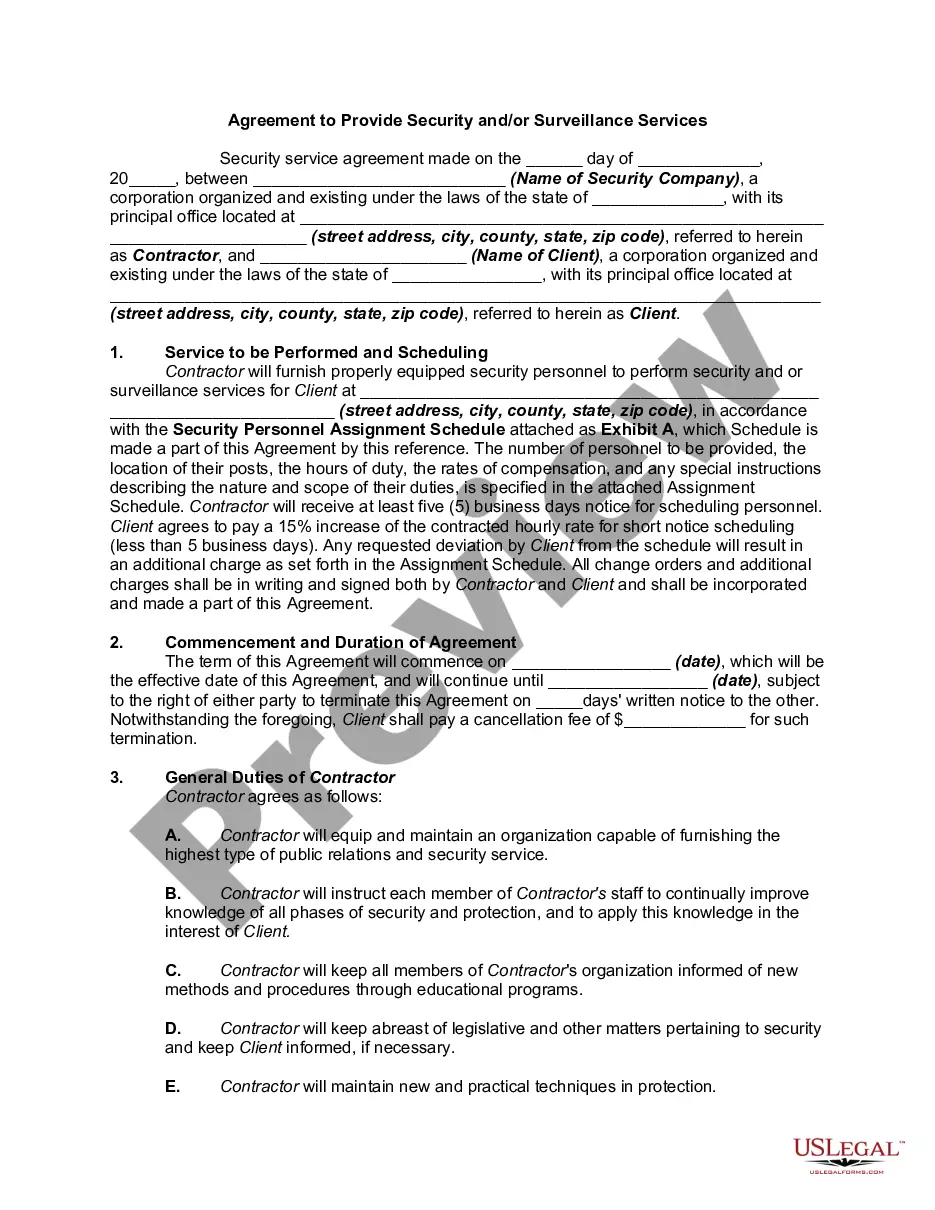
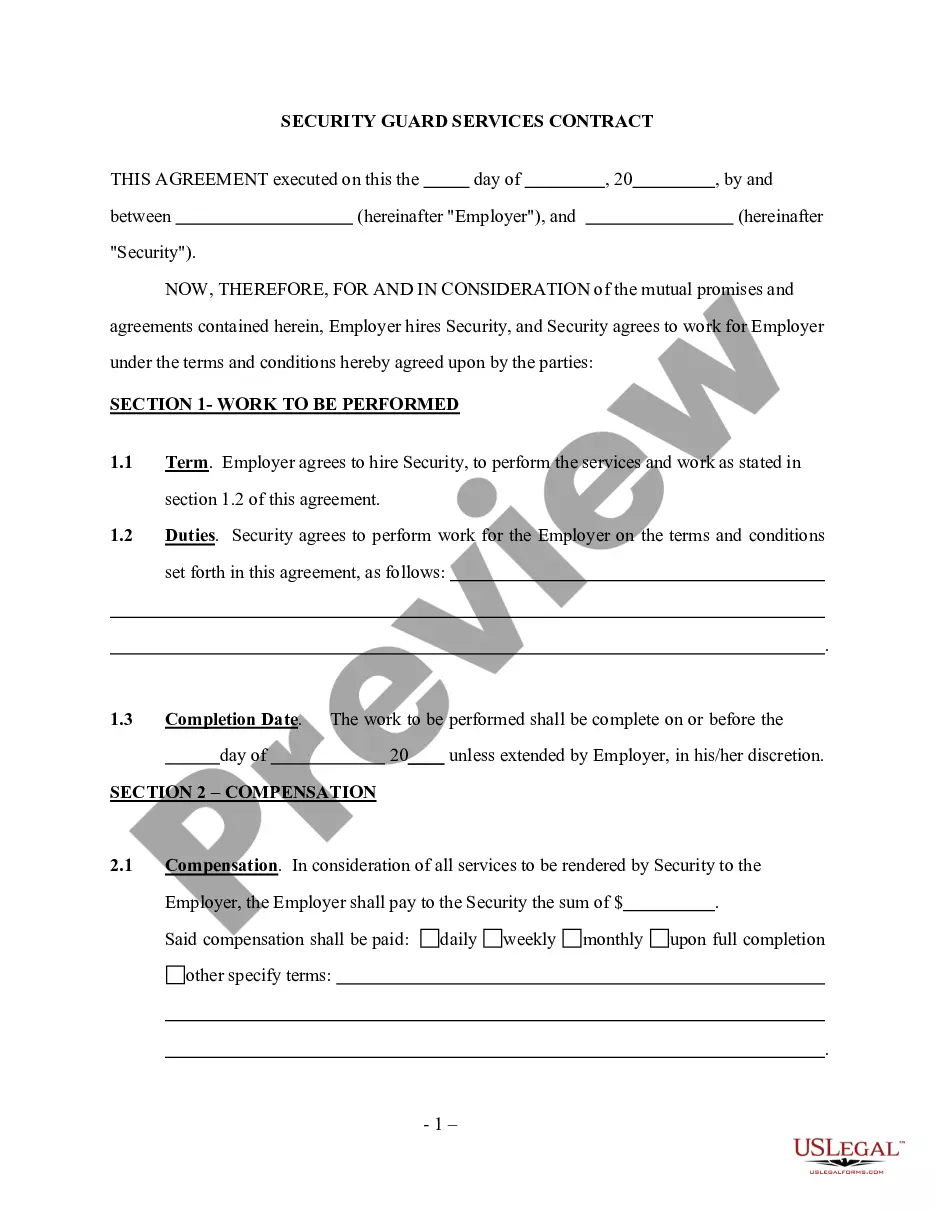
The Agreement to Provide Security, Surveillance and/or Traffic Control Services is a legal document outlining the terms under which a contractor will supply independent security personnel. This form is essential for businesses or organizations seeking to engage professional security services while ensuring that the personnel remain independent contractors, rather than employees. By doing so, it distinguishes the operational responsibilities and liabilities of each party involved.
Main sections of this form
- Parties involved: Identifies the contractor and client, including their addresses.
- Services provided: Details the specific security, surveillance, or traffic control services to be performed.
- Scheduling: Outlines the scheduling requirements and fees for short notice requests.
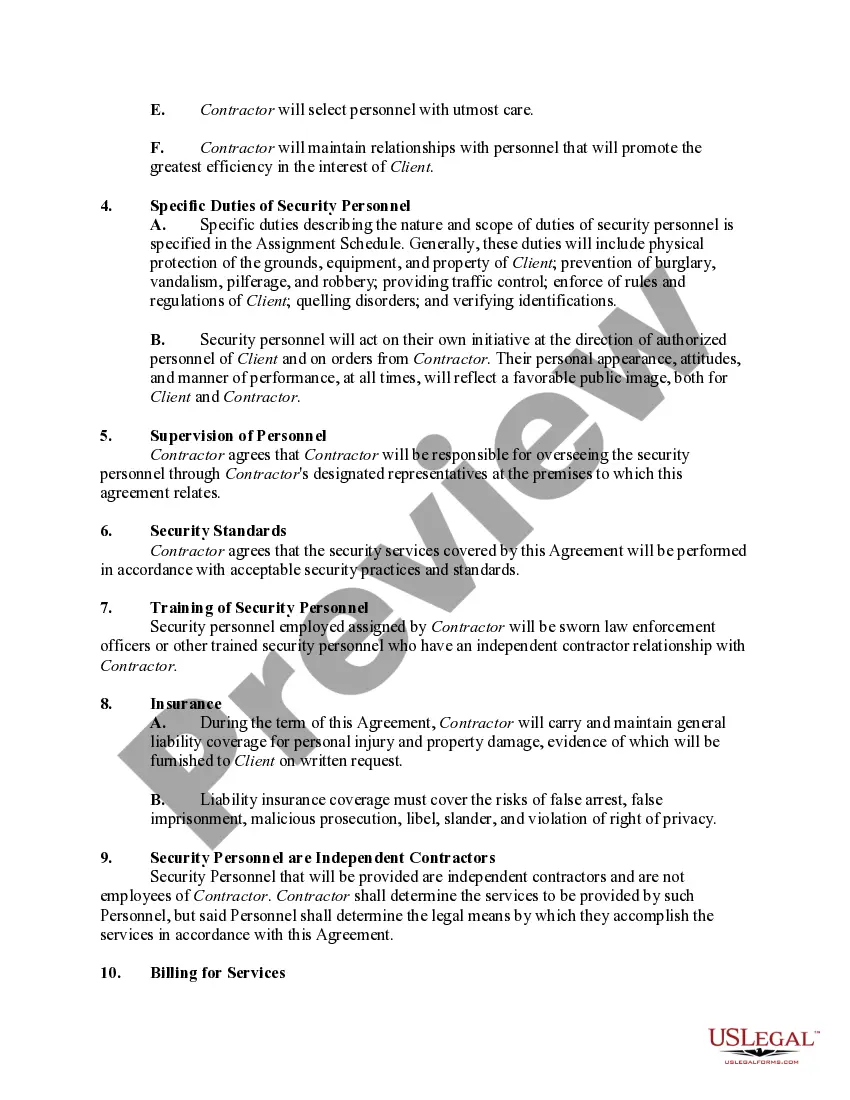
- Insurance requirements: Specifies the type of insurance coverage the contractor must maintain.
- Independent contractor status: Clarifies that security personnel are not employees but independent contractors.
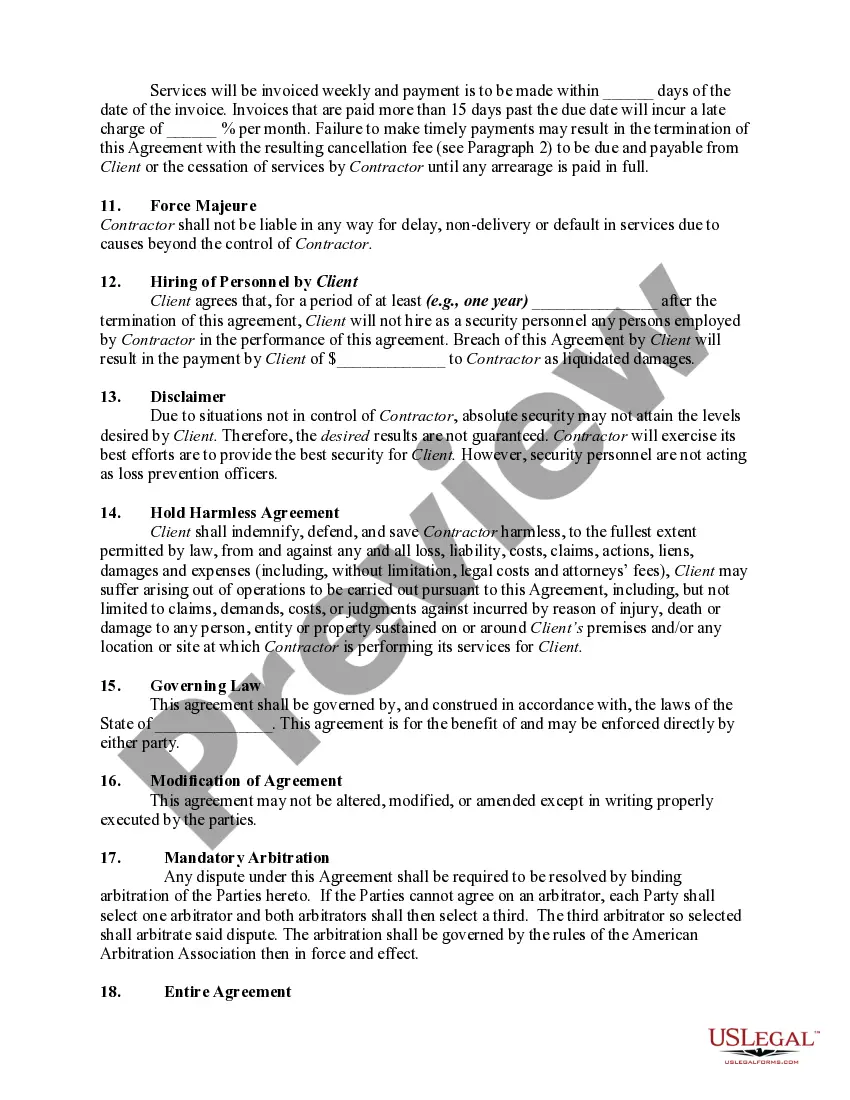
- Termination and cancellation: Conditions under which the agreement can be terminated and related fees.

When to use this form
This agreement is useful in various situations where a company or organization requires security personnel for events, property protection, or ongoing surveillance. It is particularly relevant when engaging personnel during high-traffic events or when additional security measures are needed for safety and compliance reasons.
Who should use this form
- Businesses looking for contracted security services.
- Event organizers who require temporary security personnel for specific occasions.
- Property managers needing ongoing surveillance or traffic control personnel.
- Corporations concerned about protecting their assets and ensuring safety.
How to complete this form
- Identify the parties: Fill in the names and addresses of both the contractor and client.
- Specify services: Clearly describe the type of security services and scheduling requirements.
- Fill in dates: Enter the commencement and termination dates of the agreement.
- Detail payment terms: Indicate the payment schedule and any conditions for late payments.
- Obtain signatures: Ensure both parties sign and date the form to make it legally binding.
Does this form need to be notarized?
Notarization is not commonly needed for this form. However, certain documents or local rules may make it necessary. Our notarization service, powered by Notarize, allows you to finalize it securely online anytime, day or night.
Get your form ready online
Our built-in tools help you complete, sign, share, and store your documents in one place.
Make edits, fill in missing information, and update formatting in US Legal Forms—just like you would in MS Word.
Download a copy, print it, send it by email, or mail it via USPS—whatever works best for your next step.
Sign and collect signatures with our SignNow integration. Send to multiple recipients, set reminders, and more. Go Premium to unlock E-Sign.
If this form requires notarization, complete it online through a secure video call—no need to meet a notary in person or wait for an appointment.
We protect your documents and personal data by following strict security and privacy standards.

Make edits, fill in missing information, and update formatting in US Legal Forms—just like you would in MS Word.

Download a copy, print it, send it by email, or mail it via USPS—whatever works best for your next step.

Sign and collect signatures with our SignNow integration. Send to multiple recipients, set reminders, and more. Go Premium to unlock E-Sign.

If this form requires notarization, complete it online through a secure video call—no need to meet a notary in person or wait for an appointment.

We protect your documents and personal data by following strict security and privacy standards.
Common mistakes
- Failing to specify the services in detail, leading to misunderstandings.
- Not including the correct payment terms or conditions for late payment.
- Neglecting to have both parties sign the agreement, which can invalidate it.
- Overlooking necessary insurance requirements which could lead to liability issues.
Benefits of completing this form online
- Easy download and customization to suit specific needs.
- Access to professionally drafted templates, ensuring legal compliance.
- Convenience of completing the document online without the need for physical visits.
- Ability to securely store and retrieve documents anytime, reducing paperwork clutter.
What to keep in mind
- This agreement outlines the relationship between the contractor and the client regarding security services.
- Independence in contractor status protects both parties from certain liabilities.
- Clear terms regarding scheduling, payments, and termination are vital for smooth operations.
- Take care to complete all sections accurately to avoid legal complications.
Looking for another form?
Form popularity
FAQ
The general rule is that an individual is an independent contractor if the payer has the right to control or direct only the result of the work and not what will be done and how it will be done. If you are an independent contractor, then you are self-employed.
This clause states that: If the employee or freelancer has a conflict of interest, it must be disclosed. Should a conflict of interest develop over the course of the employment or project, it will be disclosed. The employee or freelancer will avoid taking on any conflicts of interest while working for the company.
An employee has her job description dictated by the employer. She acts under the strict direction of the employer. An independent contractor is a separate person from the business and works independently by having a business arrangement with the individual/company that for instance provides a service.
Independent contractors typically invest in and maintain their own work facilities. In contrast, most employees rely on their employer to provide work facilities. Workers who receive predetermined earnings and have little chance to realize significant profit or loss through their work generally are employees.
For the employee, the company withholds income tax, Social Security, and Medicare from wages paid. For the independent contractor, the company does not withhold taxes. Employment and labor laws also do not apply to independent contractors.
The law further states that independent contractor status is evidenced if the worker: (1) has a substantial investment in the business other than personal services, (2) purports to be in business for himself or herself, (3) receives compensation by project rather than by time, (4) has control over the time and place
The general rule is that an individual is an independent contractor if the payer has the right to control or direct only the result of the work and not what will be done and how it will be done.