Issues-Agent or Independent Contractor-Burden of Proof
What this document covers
The Issues-Agent or Independent Contractor-Burden of Proof form is a legal document outlining the responsibility of a plaintiff to demonstrate the validity of their claims in a legal dispute involving agency or independent contractor relationships. This form is crucial for setting the standards of evidence required for the court to favor one party over another, differing from other forms that focus on different aspects of legal proof or relationships. It specifies that the plaintiff must prove their case by a preponderance of the evidence, meaning that the facts must be more likely true than not.
Key components of this form
- Burden of proof clause stating the plaintiff must prove their case.
- Explanation of "preponderance of the evidence" standard.
- Field for plaintiff's name.

When to use this form
This form is utilized in scenarios where a legal dispute arises over the classification of individuals as agents or independent contractors. It is particularly relevant in cases where one party claims that the other has failed to meet their responsibilities or obligations within such roles and needs to demonstrate this in court.
Who can use this document
- Plaintiffs involved in legal disputes regarding agency or contractor relationships.
- Individuals or organizations needing to assert claims about the burden of proof in their case.
- Legal representatives handling cases related to independent contractors or agents.
How to prepare this document
- Identify and enter the name of the plaintiff.
- Clearly state the claims being made against the agent or independent contractor.
- Review the definition of "preponderance of the evidence" and ensure your claims meet this standard.
- Compile any necessary evidence or documentation to support your case.
- Sign and date the form according to your jurisdictionâs requirements.
Does this form need to be notarized?
This form does not typically require notarization unless specified by local law.
Get your form ready online
Our built-in tools help you complete, sign, share, and store your documents in one place.
Make edits, fill in missing information, and update formatting in US Legal Forms—just like you would in MS Word.
Download a copy, print it, send it by email, or mail it via USPS—whatever works best for your next step.
Sign and collect signatures with our SignNow integration. Send to multiple recipients, set reminders, and more. Go Premium to unlock E-Sign.
If this form requires notarization, complete it online through a secure video call—no need to meet a notary in person or wait for an appointment.
We protect your documents and personal data by following strict security and privacy standards.

Make edits, fill in missing information, and update formatting in US Legal Forms—just like you would in MS Word.

Download a copy, print it, send it by email, or mail it via USPS—whatever works best for your next step.

Sign and collect signatures with our SignNow integration. Send to multiple recipients, set reminders, and more. Go Premium to unlock E-Sign.

If this form requires notarization, complete it online through a secure video call—no need to meet a notary in person or wait for an appointment.

We protect your documents and personal data by following strict security and privacy standards.
Common mistakes
- Not clearly defining the claims against the agent or independent contractor.
- Failing to provide necessary supporting evidence for the claims made.
- Misunderstanding the standard of "preponderance of the evidence."
Benefits of completing this form online
- Convenience of downloading the form instantly.
- Editability to tailor the document to specific needs.
- Reliability of forms drafted by licensed attorneys.
Looking for another form?
Form popularity
FAQ
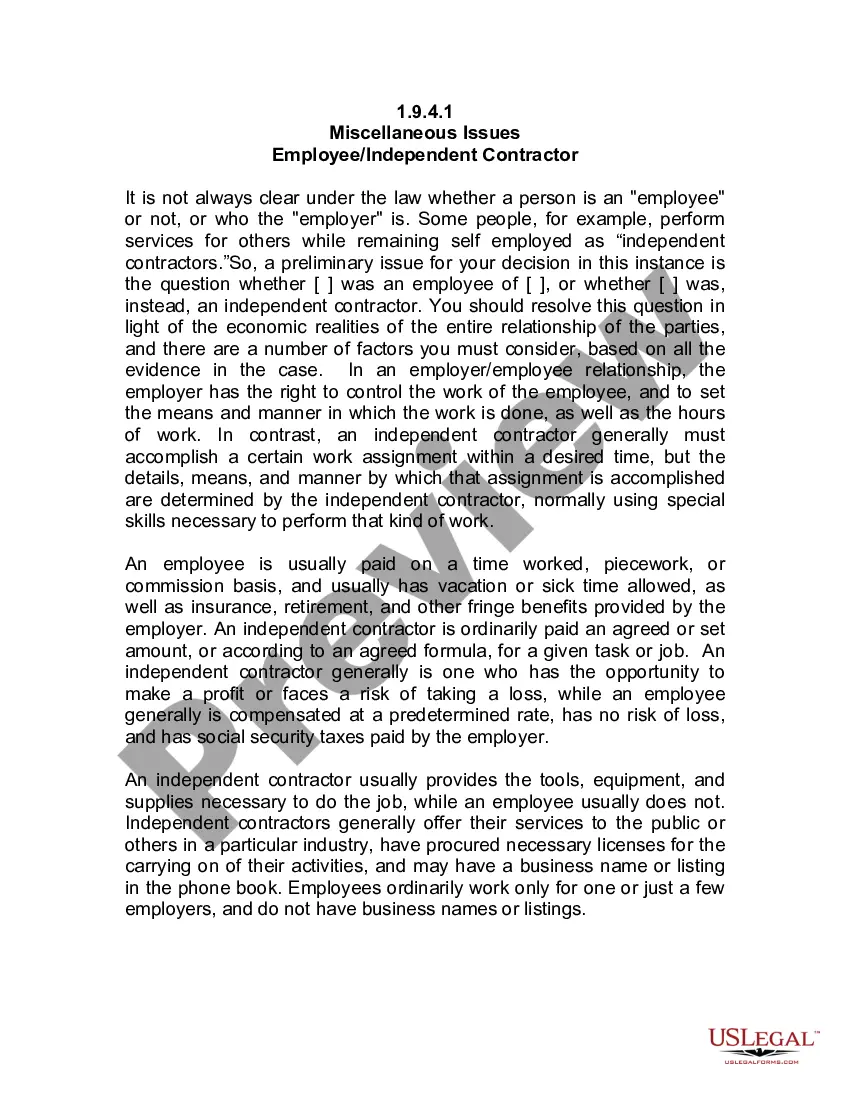
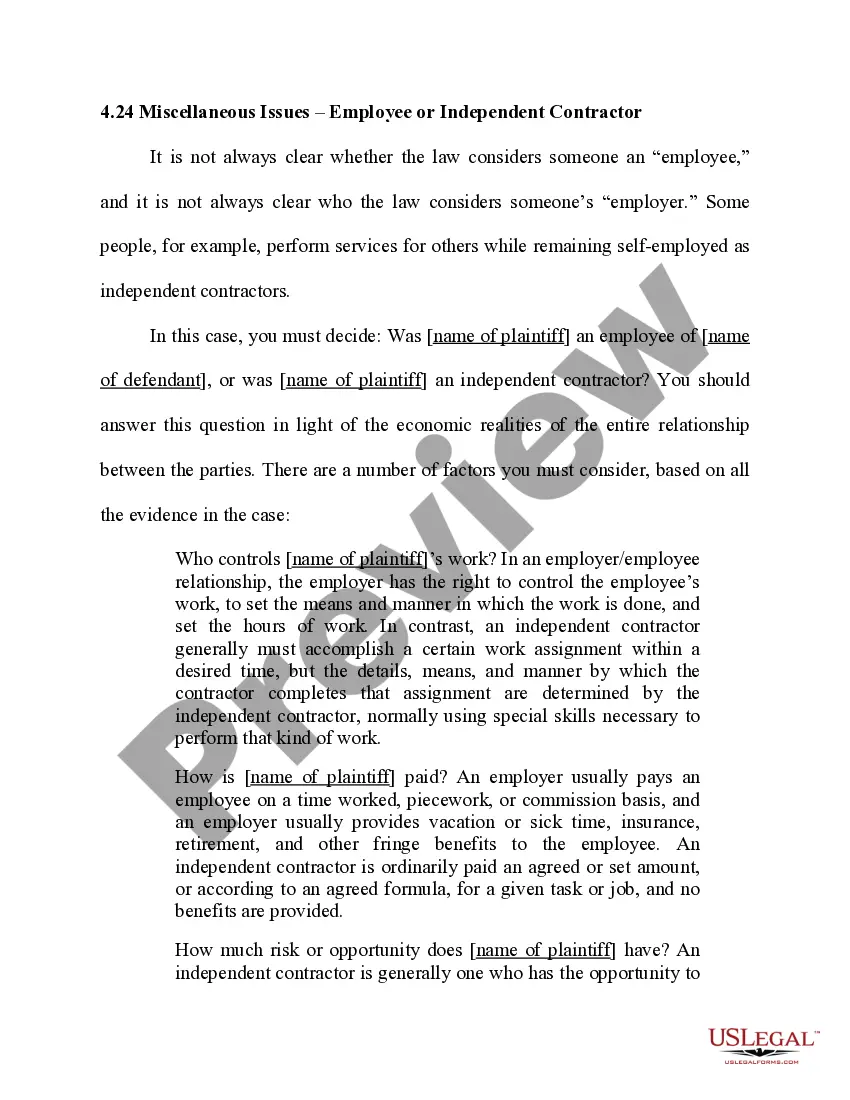
The basic test for determining whether a worker is an independent contractor or an employee is whether the principal has the right to control the manner and means by which the work is performed.
A worker is considered an independent contractor if they meet all three of the following conditions: The person is independent of the hiring organization in connection with the performance of the work. The person performs work outside the course of business for the hiring organization.
Workers who perform most of their work using company-provided equipment, tools, and materials are more likely to be considered employees. Work largely done using independently obtained supplies or tools supports an independent contractor finding.
The law further states that independent contractor status is evidenced if the worker: (1) has a substantial investment in the business other than personal services, (2) purports to be in business for himself or herself, (3) receives compensation by project rather than by time, (4) has control over the time and place
For the employee, the company withholds income tax, Social Security, and Medicare from wages paid. For the independent contractor, the company does not withhold taxes. Employment and labor laws also do not apply to independent contractors.
In determining whether the person providing service is an employee or an independent contractor, all information that provides evidence of the degree of control and independence must be considered.
The Common-Law Test is a set of guidelines used by the IRS that classifies workers as either employees or independent contractors. The test measures how much behavioral and financial control an employer has over an individual and the type of relationship both parties share.
What does the IRS look at in determining whether the worker is an employee or an independent contractor? the degree of control you have over the worker.