Workforce Confidentiality Agreement for Medical Field
Overview of this form
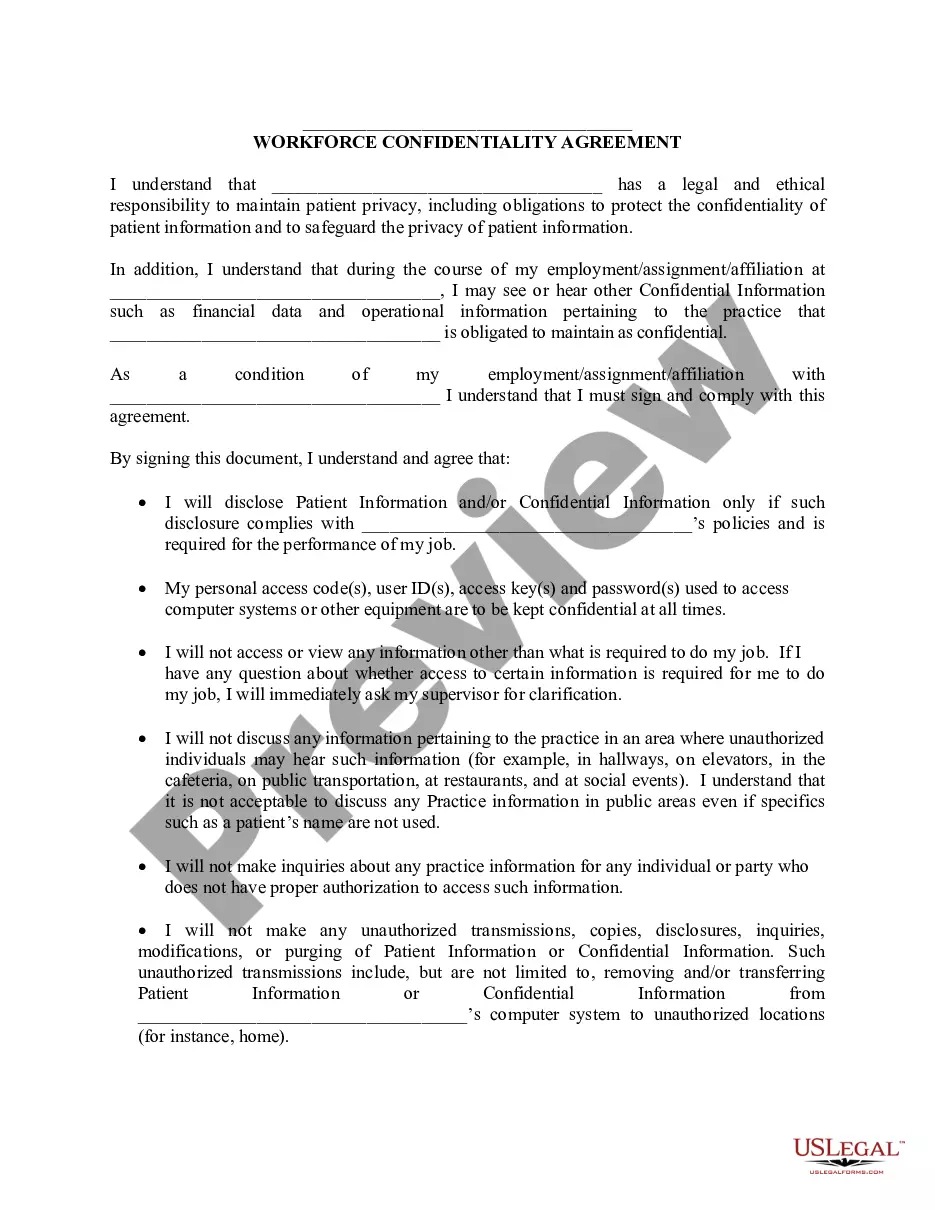
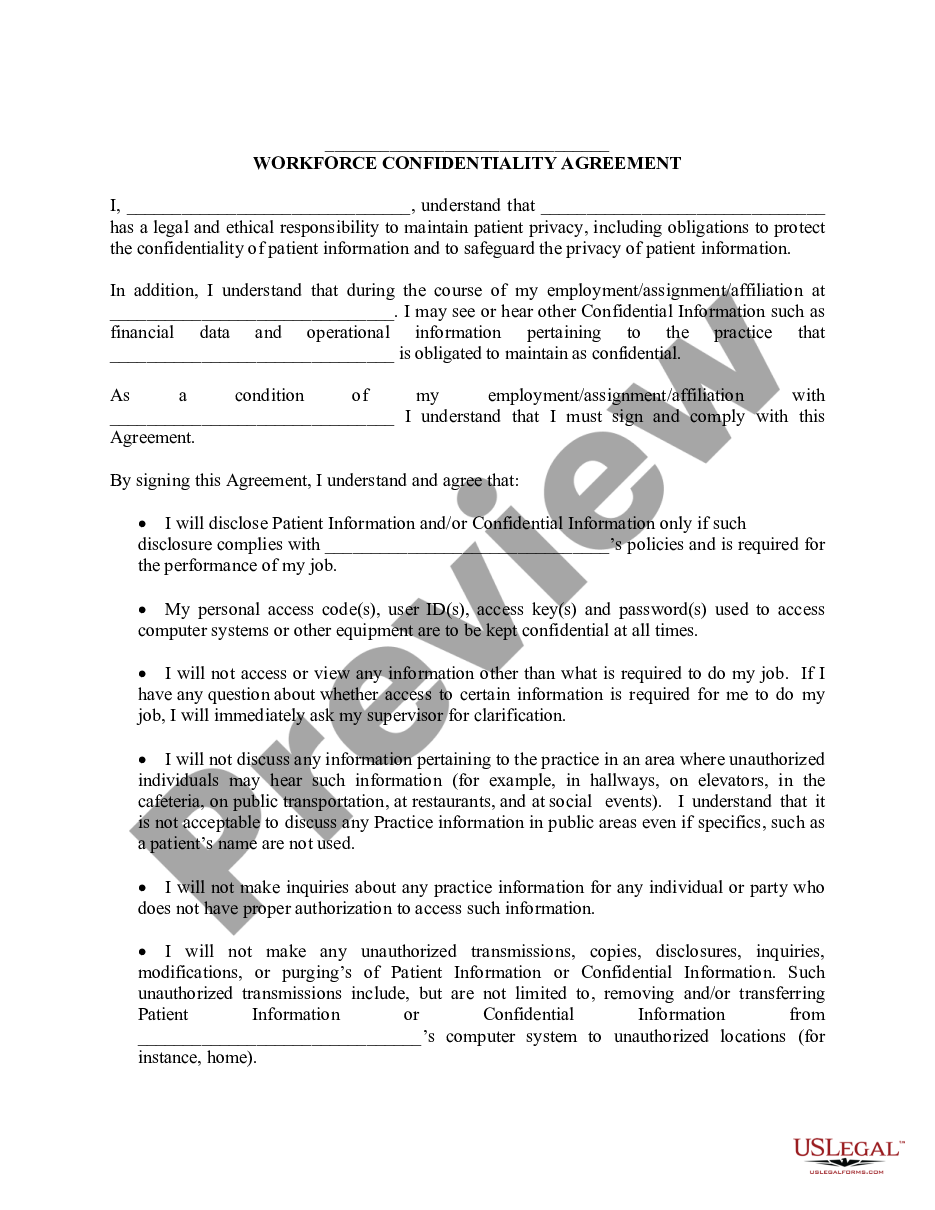
The Workforce Confidentiality Agreement for the Medical Field is a legal document designed to protect patient privacy and confidential information within medical practices. This agreement outlines the obligations of employees to safeguard sensitive information, distinguishing it from other confidentiality agreements by its specific focus on healthcare-related contexts and information handling protocols.
What’s included in this form
- Identification of the healthcare practice and employee.
- Obligation to maintain patient privacy and confidentiality.
- Guidelines for accessing and handling confidential information.
- Requirements for returning company property upon termination.
- Consequences of violating the agreement.

Situations where this form applies
This form should be utilized when hiring employees in the medical field who will handle sensitive patient information and other confidential data. It is essential during the onboarding process to ensure all employees understand their responsibility to maintain confidentiality throughout their employment and after their departure from the practice.
Intended users of this form
- Healthcare employers looking to establish confidentiality protocols for new hires.
- Employees working in medical settings, including doctors, nurses, and administrative staff.
- Contract workers or affiliates who will have access to patient information.
Steps to complete this form
- Enter the name of the healthcare practice and the employee.
- Review the confidentiality obligations outlined in the agreement.
- Ensure the employee reads the full document and understands its implications.
- Have the employee sign and date the agreement.
- File the signed agreement securely as part of the employeeâs record.
Notarization requirements for this form
This form does not typically require notarization unless specified by local law. Ensure compliance with any specific state requirements related to employment agreements in the medical field.
Get your form ready online
Our built-in tools help you complete, sign, share, and store your documents in one place.
Make edits, fill in missing information, and update formatting in US Legal Forms—just like you would in MS Word.
Download a copy, print it, send it by email, or mail it via USPS—whatever works best for your next step.
Sign and collect signatures with our SignNow integration. Send to multiple recipients, set reminders, and more. Go Premium to unlock E-Sign.
If this form requires notarization, complete it online through a secure video call—no need to meet a notary in person or wait for an appointment.
We protect your documents and personal data by following strict security and privacy standards.

Make edits, fill in missing information, and update formatting in US Legal Forms—just like you would in MS Word.

Download a copy, print it, send it by email, or mail it via USPS—whatever works best for your next step.

Sign and collect signatures with our SignNow integration. Send to multiple recipients, set reminders, and more. Go Premium to unlock E-Sign.

If this form requires notarization, complete it online through a secure video call—no need to meet a notary in person or wait for an appointment.

We protect your documents and personal data by following strict security and privacy standards.
Common mistakes
- Failing to provide a copy of the signed agreement to the employee.
- Not updating the agreement to reflect any changes in policies or procedures.
- Assuming verbal agreements are sufficient without a written contract.
Benefits of completing this form online
- Convenience of downloading and printing from home or the office.
- Ability to customize the document to fit specific organizational needs.
- Reliable format, ensuring that all necessary legal requirements are met.
Looking for another form?
Form popularity
FAQ
A HIPAA employee confidentiality agreement requires an employee with access to protected health information (PHI) to not share that information with a third party. This is used when an employee will have access to a database or any health records of individuals.
The purpose of a confidentiality clause in an employment contract is to ensure that the employee does not share confidential information/business secrets with others, such as a competitor for instance. This obligation applies both during and after the termination of employment.
A Confidential Disclosure Agreement (CDA), also referred to as non-disclosure agreement (NDA) or secrecy agreement, is a legal agreement between a minimum of two parties which outlines information the parties wish to share with one another for certain evaluation purposes, but wish to restrict from wider use and
An employee non-disclosure agreement allows an employer to prohibit an employee from revealing proprietary information. Proprietary information commonly refers to trade secrets, customer lists, and any other protected data.
A HIPAA employee confidentiality agreement is an agreement between an employer and its employee, under which the employee agrees to: Not access, use or disclose PHI or ePHI, except when necessary to perform job duties.
Ingly, to protect the Confidential Information that will be disclosed during employment, the Employee agrees as follows: Employee will hold the Confidential Information received from Company Name in strict confidence and will exercise a reasonable degree of care to prevent disclosure to others.
A non disclosure agreement for medical office protects against the unethical and professional disclosure of patients' personal and medical information gathered in the process of treatment or research.
The Employee shall protect the Confidential Information by using the same degree of care, but no less than reasonable care, to prevent the unauthorized use, dissemination or publication of the Confidential Information as the Employee uses to protect its own Confidential Information.