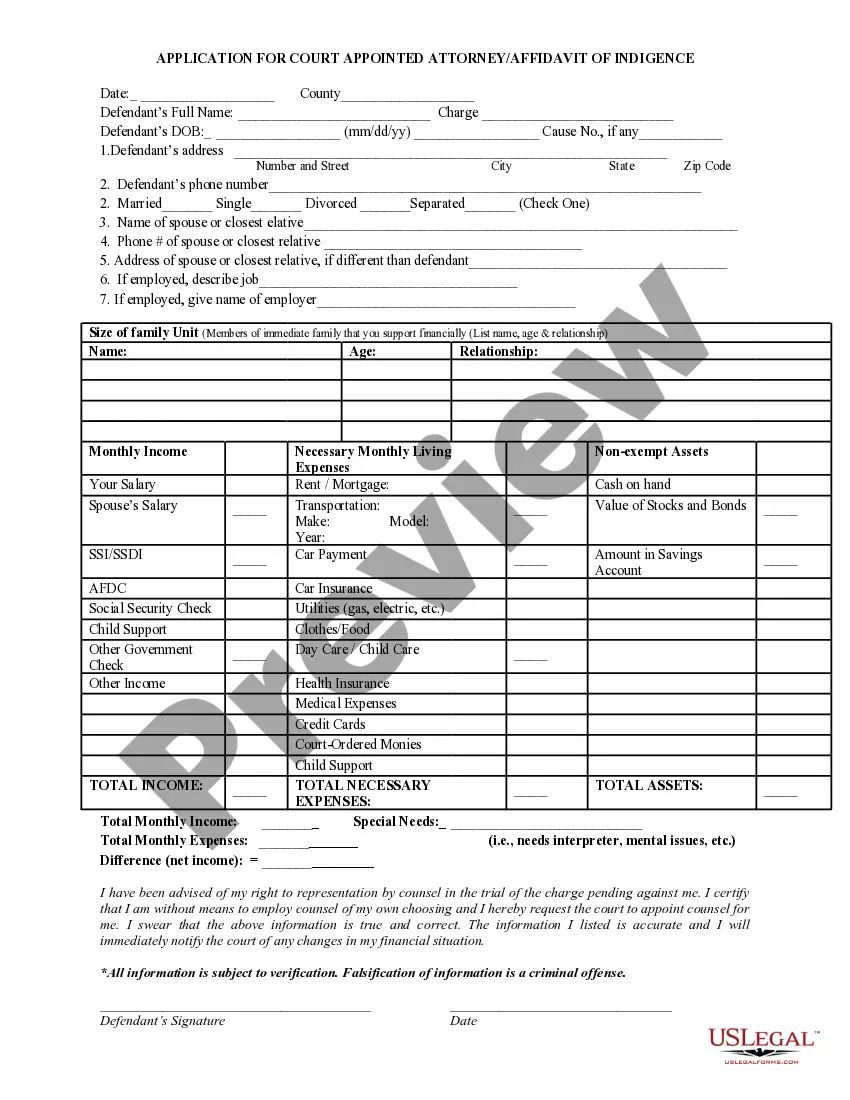
Application For Court Appointed Attorney/Affidavit of Indigence
Understanding this form
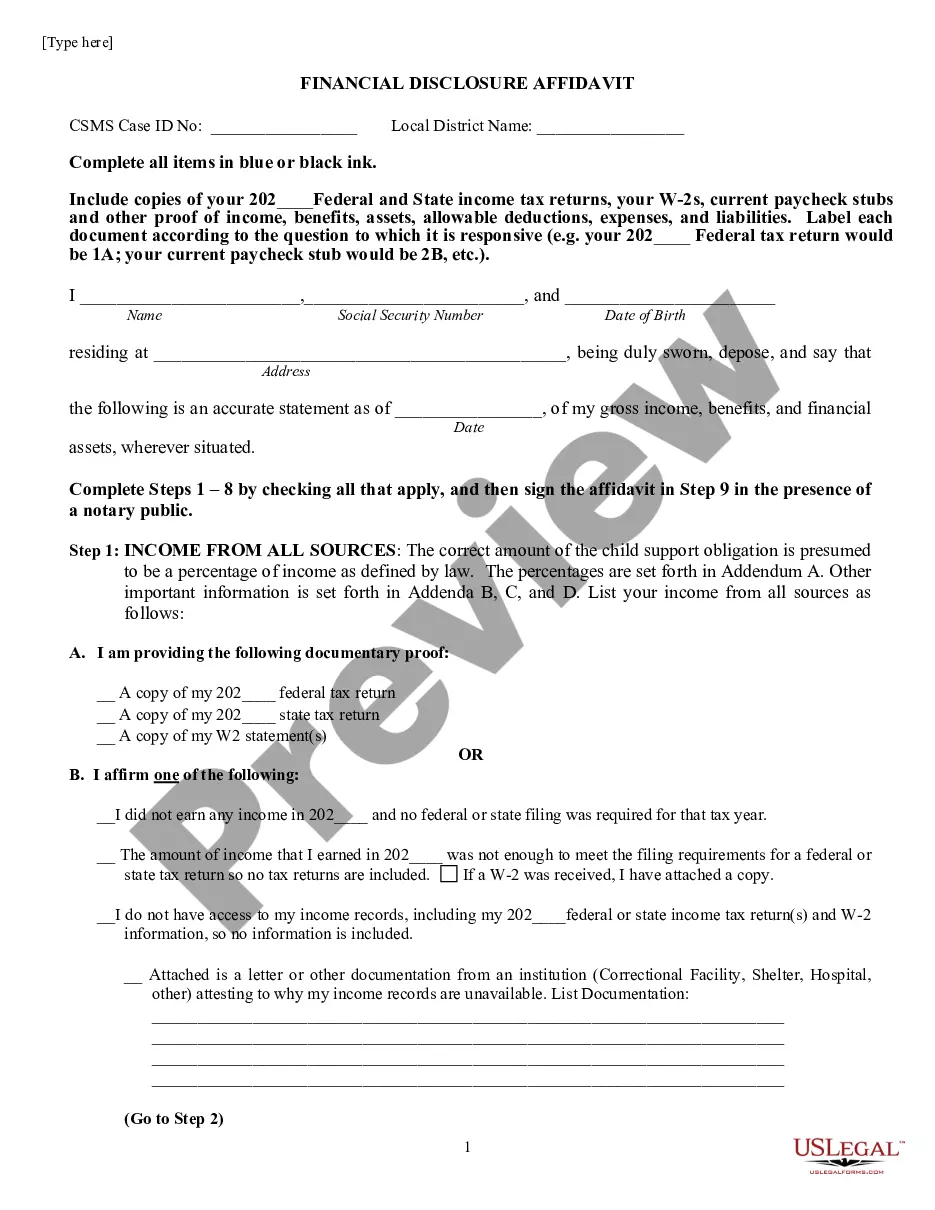
The Application for Court Appointed Attorney/Affidavit of Indigence is a legal document used by individuals seeking representation by a court-appointed attorney due to financial hardship. This form outlines the applicant's financial circumstances, asserting their inability to afford legal counsel. It differs from other affidavits as it specifically addresses the need for legal assistance in criminal cases and confirms the applicant's indigence.
Key components of this form
- Date and county of filing
- Defendant's full name and personal details
- Information about family size and financial obligations
- Monthly income and necessary living expenses
- Certification of indigence and signature of the defendant
When this form is needed
This form should be used when a defendant in a criminal case believes they cannot afford an attorney and requires the court to appoint one for their defense. It is essential to provide an accurate representation of your financial situation to support your request for a court-appointed attorney.
Who this form is for
This form is intended for individuals who meet the following criteria:
- Individuals facing criminal charges
- Those who lack the financial means to hire private legal counsel
- Defendants who wish to have legal representation provided by the court
Completing this form step by step
- Enter the date and county where the application is being filed.
- Provide the defendant's full name, address, date of birth, and any pending charge details.
- List all sources of income and monthly living expenses to demonstrate financial need.
- Include personal details about your family size and any dependents you financially support.
- Sign and date the affidavit to certify the accuracy of the information provided.
Notarization guidance
Yes, this form must be notarized to be legally valid. This ensures the authenticity of the signature and the accuracy of the statements made within the affidavit. US Legal Forms offers integrated online notarization services, allowing for secure video calls and convenient completion without the need to travel.
Get your form ready online
Our built-in tools help you complete, sign, share, and store your documents in one place.
Make edits, fill in missing information, and update formatting in US Legal Forms—just like you would in MS Word.
Download a copy, print it, send it by email, or mail it via USPS—whatever works best for your next step.
Sign and collect signatures with our SignNow integration. Send to multiple recipients, set reminders, and more. Go Premium to unlock E-Sign.
If this form requires notarization, complete it online through a secure video call—no need to meet a notary in person or wait for an appointment.
We protect your documents and personal data by following strict security and privacy standards.

Make edits, fill in missing information, and update formatting in US Legal Forms—just like you would in MS Word.

Download a copy, print it, send it by email, or mail it via USPS—whatever works best for your next step.

Sign and collect signatures with our SignNow integration. Send to multiple recipients, set reminders, and more. Go Premium to unlock E-Sign.

If this form requires notarization, complete it online through a secure video call—no need to meet a notary in person or wait for an appointment.

We protect your documents and personal data by following strict security and privacy standards.
Common mistakes to avoid
- Failing to provide complete financial details and documentation.
- Not signing the affidavit before a notary or official witness.
- Providing inaccurate information regarding income or expenses.
Advantages of online completion
- Convenient access to the form anytime and anywhere.
- Edit and customize the form to suit your specific situation.
- Reliable and legally drafted templates created by licensed attorneys.
Main things to remember
- The Application for Court Appointed Attorney/Affidavit of Indigence is essential for those needing legal defense but lacking financial resources.
- Accurate financial disclosure is critical for the successful appointment of a counsel.
- Notarization is required to validate the form.
Looking for another form?

Form popularity
FAQ
Eligibility. Persons who are charged with a crime and who cannot afford to hire an attorney may request the court appoint an attorney at state expense. In addition, a court appointed attorney may be requested in a juvenile dependency (abuse or neglect), termination of parental rights, or juvenile delinquency proceeding
Under California law, every person who is represented by a court-appointed attorney, including the Public Defender's Office, may be asked to pay a registration fee of up to $25 to the County of Napa. You will not be forced to pay anything if you cannot afford to pay the registration fee.
The Court-Appointed Counsel (CAC) Program fulfills the constitutional mandate of providing adequate representation for indigent appellants in the Courts of Appeal on noncapital cases.
In Oregon, you must be at least 18 years old and of sound mind to make a will. If you are married or emancipated, you can make a will before you turn 18. Your will must be in writing and must be signed by you and two witnesses. Some people cannot serve as witnesses to your will.
In Oregon, a power of attorney is durable, which means that it continues to be effective if you become financially incapable. The agent's authority ends when you die. However, you can always revoke a power of attorney, as long as you understand what you are doing when you revoke it.
The Office of the Federal Public Defender, District of Oregon, operates under authority of the Criminal Justice Act of 1964 (CJA), 18 U.S.C. § 3006A.
Steps for Making a Financial Power of Attorney in Oregon Create the POA Using a Form, Software or an Attorney.Sign the POA in the Presence of a Notary Public.Store the Original POA in a Safe Place.Give a Copy to Your Agent or Attorney-in-Fact.File a Copy With the Recorder's Office.
Indigent defense is then typically provided through one or a combination of three methods: a public defender office, an assigned counsel system, or a contract system.