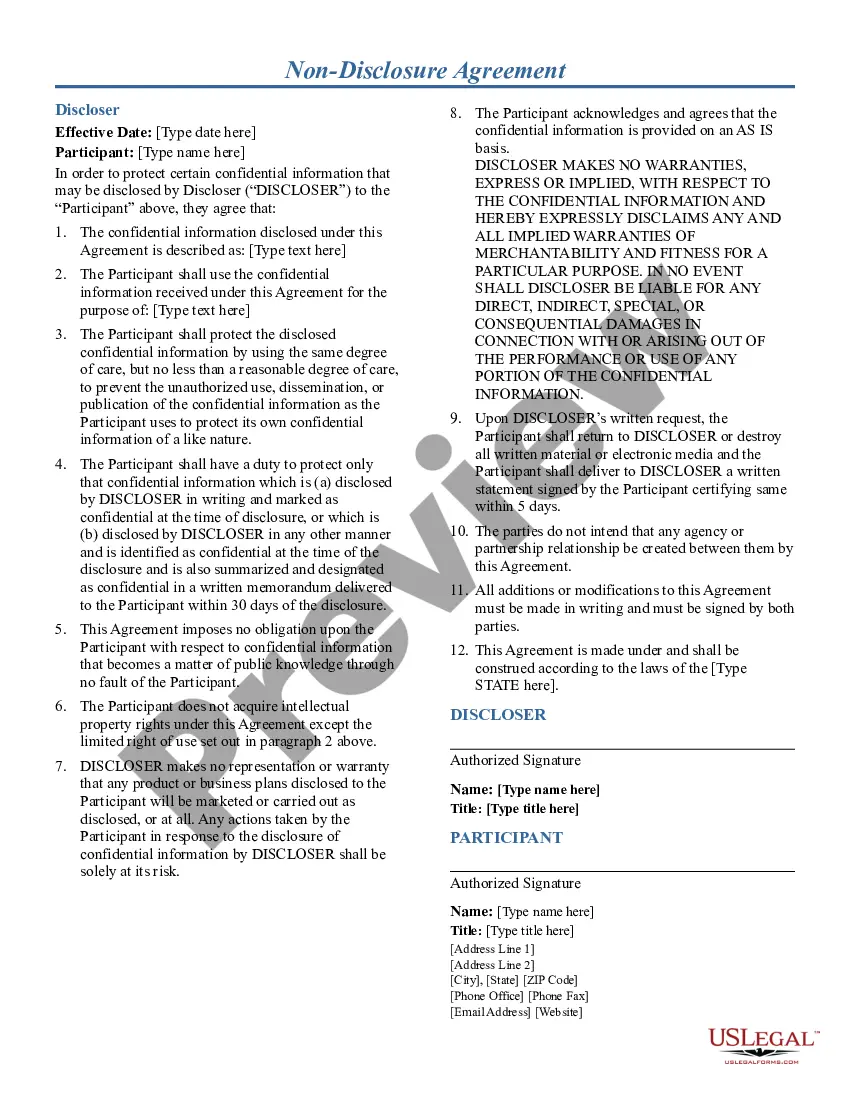
Non-Disclosure Agreement - One Page Form
Overview of this form
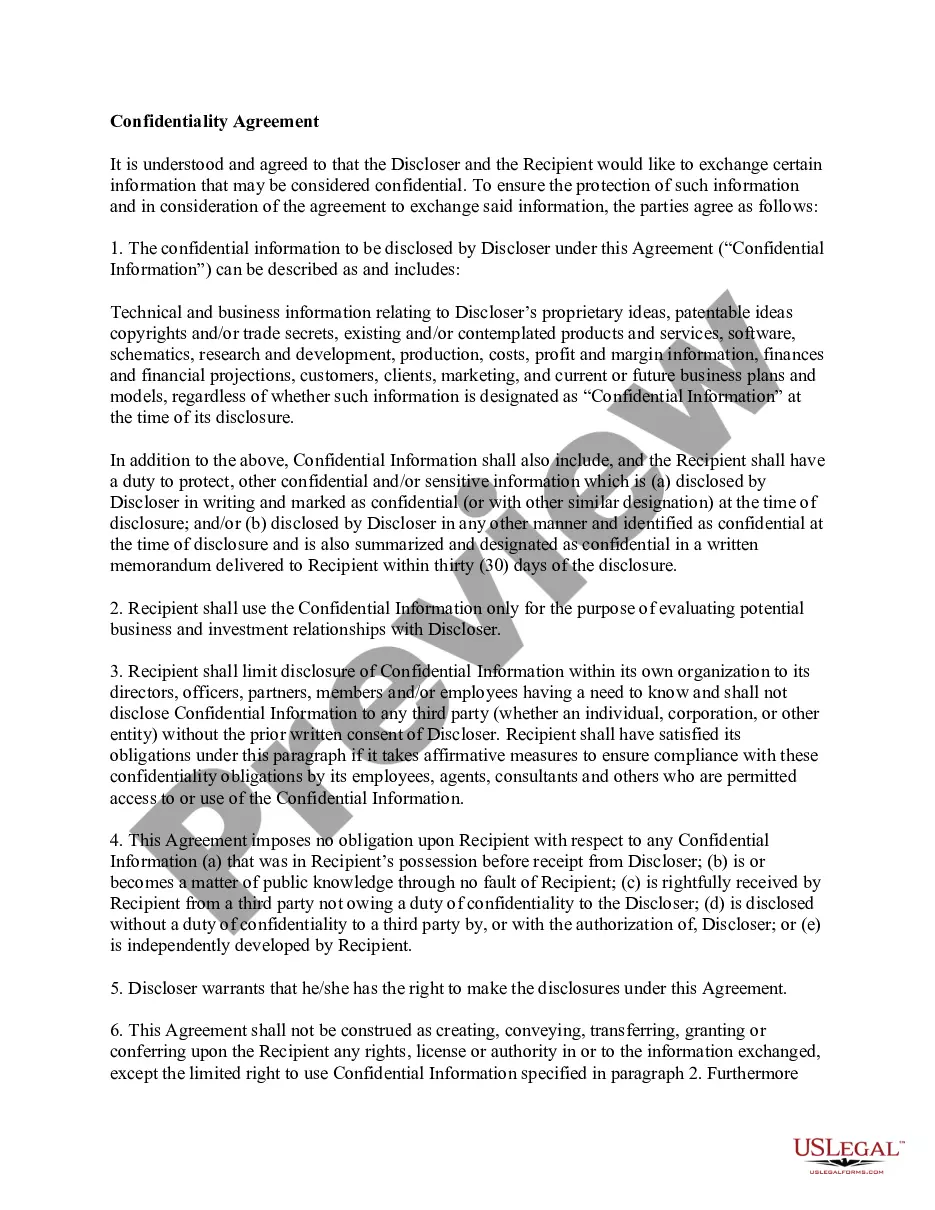
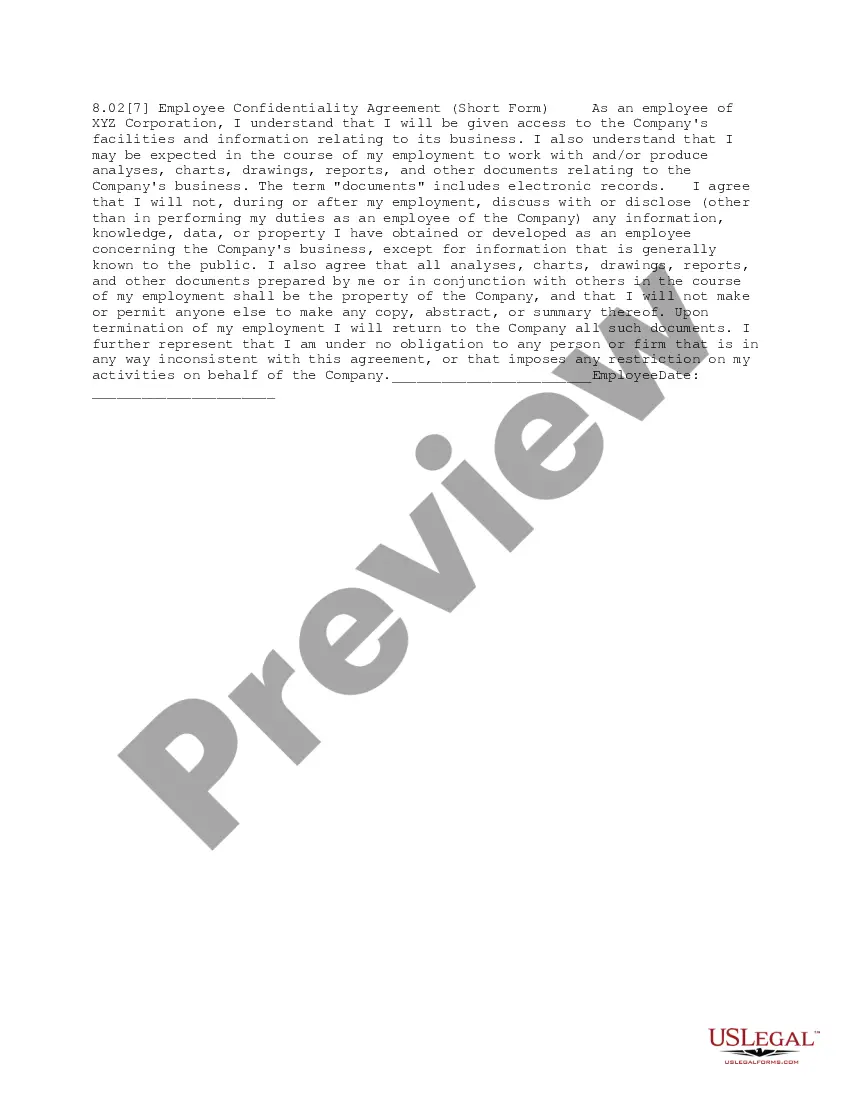
A Non-Disclosure Agreement (NDA) is a legally binding document used to protect confidential information shared between parties. This one-page form allows a discloser to specify what information must remain private and what its intended use is. By clearly delineating the terms, it prevents unauthorized disclosure while establishing trust between the discloser and the participant.
Key parts of this document
- Effective Date: The date the agreement becomes effective.
- Discloser Information: Details of the party sharing the confidential information.
- Participant Information: Details of the party receiving the confidential information.
- Description of Confidential Information: An outline of what information is considered confidential.
- Purpose of Disclosure: Reason for sharing the confidential information with the participant.
- Protection Obligations: Specifies the care the participant must take to keep the information confidential.
Situations where this form applies
This Non-Disclosure Agreement should be used when a discloser needs to protect sensitive information, such as business plans, trade secrets, or proprietary data, from being shared without permission. It is commonly used in business negotiations, hiring processes, or any situation where confidential data is exchanged.
Who this form is for
- Business owners looking to share proprietary information with potential partners or employees.
- Individuals who need to disclose sensitive information in professional contexts.
- Contractors or consultants working with companies who require confidentiality regarding their operations.
How to complete this form
- Identify the parties by entering the names of the Discloser and Participant.
- Specify the effective date of the agreement.
- Describe the confidential information that will be shared.
- Detail the purpose for which the participant will use the confidential information.
- Both parties should sign and date the agreement to make it legally binding.
Notarization requirements for this form
This form does not typically require notarization unless specified by local law. However, having it notarized can add an extra layer of authenticity to your agreement.
Get your form ready online
Our built-in tools help you complete, sign, share, and store your documents in one place.
Make edits, fill in missing information, and update formatting in US Legal Forms—just like you would in MS Word.
Download a copy, print it, send it by email, or mail it via USPS—whatever works best for your next step.
Sign and collect signatures with our SignNow integration. Send to multiple recipients, set reminders, and more. Go Premium to unlock E-Sign.
If this form requires notarization, complete it online through a secure video call—no need to meet a notary in person or wait for an appointment.
We protect your documents and personal data by following strict security and privacy standards.

Make edits, fill in missing information, and update formatting in US Legal Forms—just like you would in MS Word.

Download a copy, print it, send it by email, or mail it via USPS—whatever works best for your next step.

Sign and collect signatures with our SignNow integration. Send to multiple recipients, set reminders, and more. Go Premium to unlock E-Sign.

If this form requires notarization, complete it online through a secure video call—no need to meet a notary in person or wait for an appointment.

We protect your documents and personal data by following strict security and privacy standards.
Avoid these common issues
- Failing to clearly describe the confidential information.
- Not specifying the permitted uses of the confidential information.
- Omitting signatures or dates, rendering the agreement invalid.
Why complete this form online
- Convenience of downloading and filling the form at your own pace.
- Editability to customize the agreement to meet your specific needs.
- Reliability of getting a legally sound template drafted by licensed attorneys.
Looking for another form?
Form popularity
FAQ
Boilerplate refers to a set of common clauses or provisions found in contracts and other legal documents. In the context of non-disclosure agreements (NDAs), boilerplate NDA is a standardized non-disclosure agreement typically used by companies when sharing confidential information with third parties.
How to write a non-disclosure agreement: What's included? Introduction. Definition of confidential information. How to handle confidential information. Exclusions from confidential information. Obligations of receiving party. Duration of agreement. Resolving disputes. Integration.
See, the length of an NDA , as with any legal contract, is irrelevant. It's the content of the agreement that matters. Personally, I have seen NDAs as short as one page while others were upwards of 10+ pages.
You do not need a lawyer to create and sign a non-disclosure agreement. However, if the information you are trying to protect is important enough to warrant an NDA, you may want to have the document reviewed by someone with legal expertise.
You do not need a lawyer to create and sign a non-disclosure agreement. However, if the information you are trying to protect is important enough to warrant an NDA, you may want to have the document reviewed by someone with legal expertise.
Besides naming all parties to the NDA, five essential elements every NDA should include are: Description Of The Confidential Information.Requirements And Obligations Of The Parties.Exclusions To The Confidentiality Agreement.Term Of The Non-Disclosure Agreement.Consequences Of Breach Of The NDA.
I hereby agree that I will not discuss with or reveal to any representative of any governmental entity, business organization, other entity, or any individual person (except persons specifically authorized by the Procuring Contracting Officer (PCO)), either within or outside the U.S. Government, any aspect of the
To create a Non-Disclosure Agreement, include the following information: The parties' names and contact information. The length of the non-disclosure period. The scope and definition of the confidential information. The obligations of the Non-Disclosure Agreement. The ownership and return information.