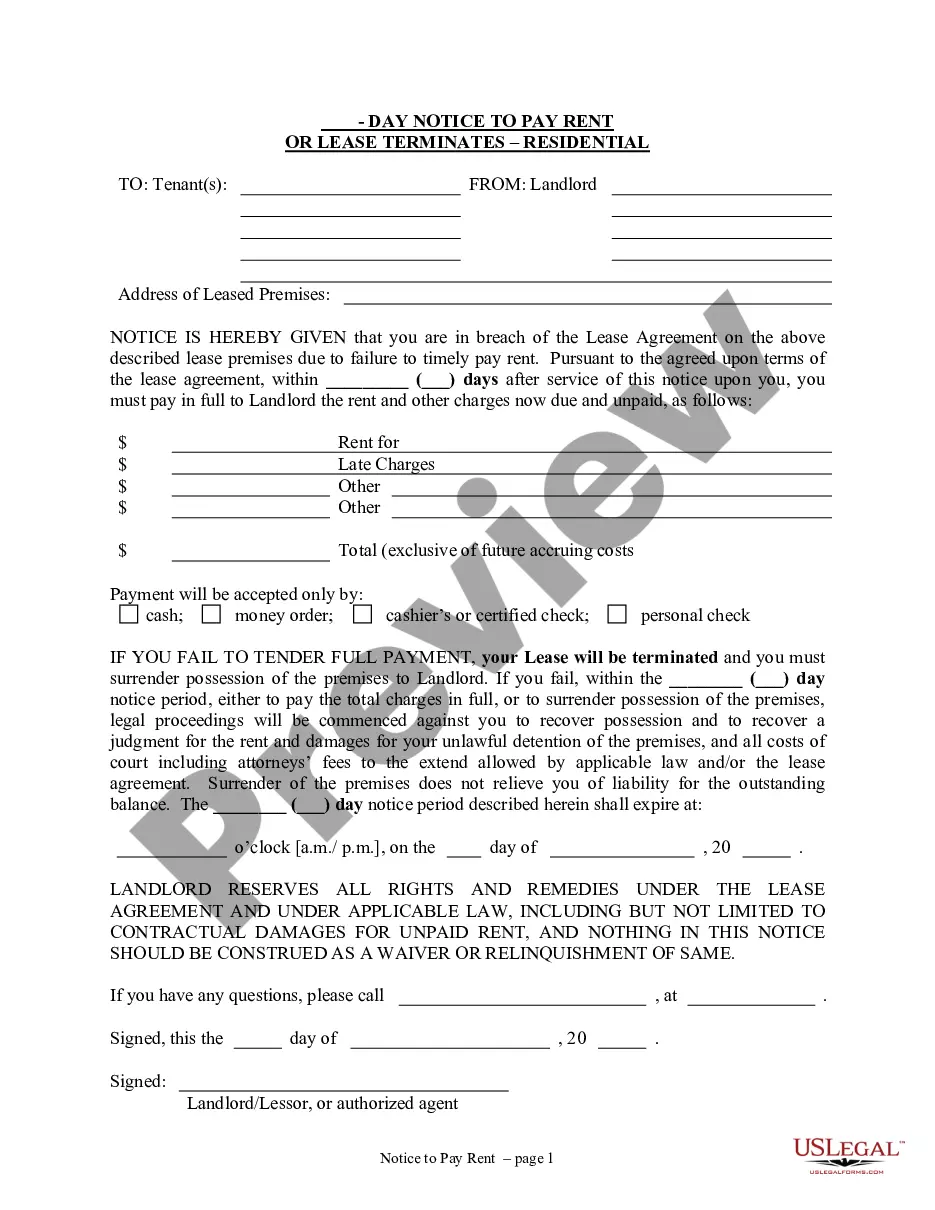
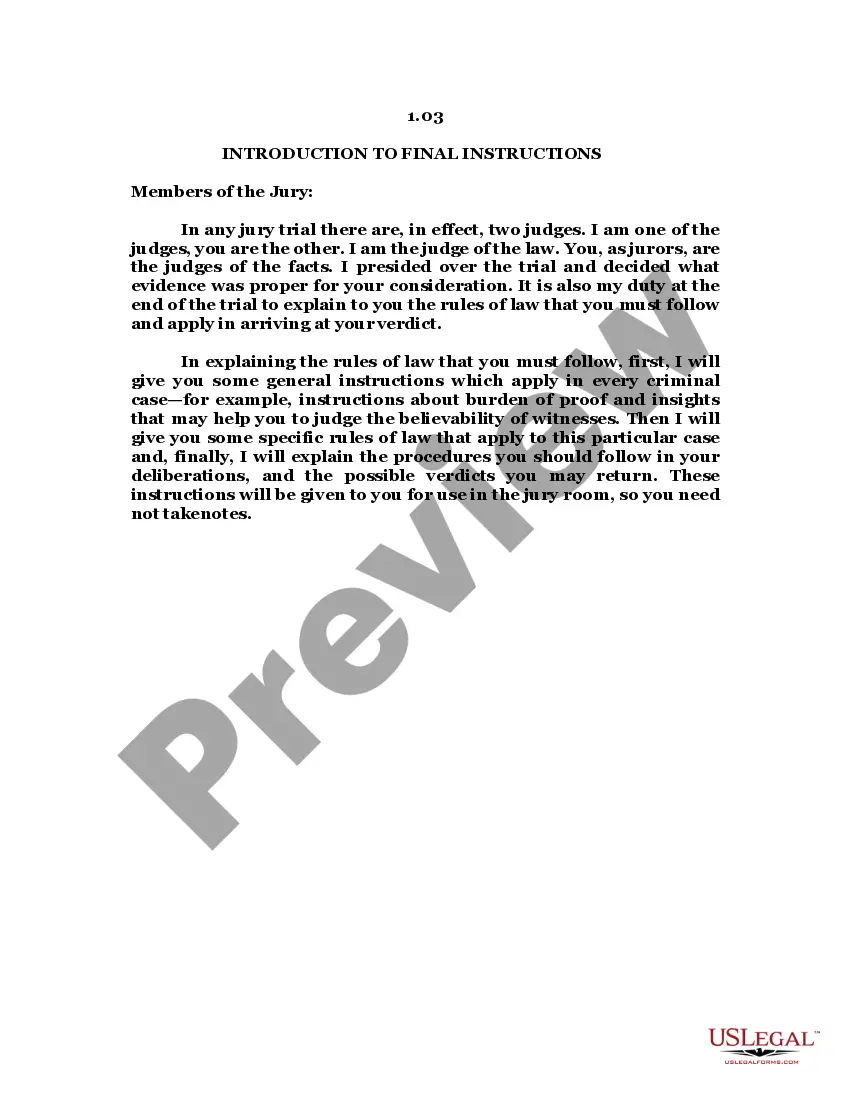
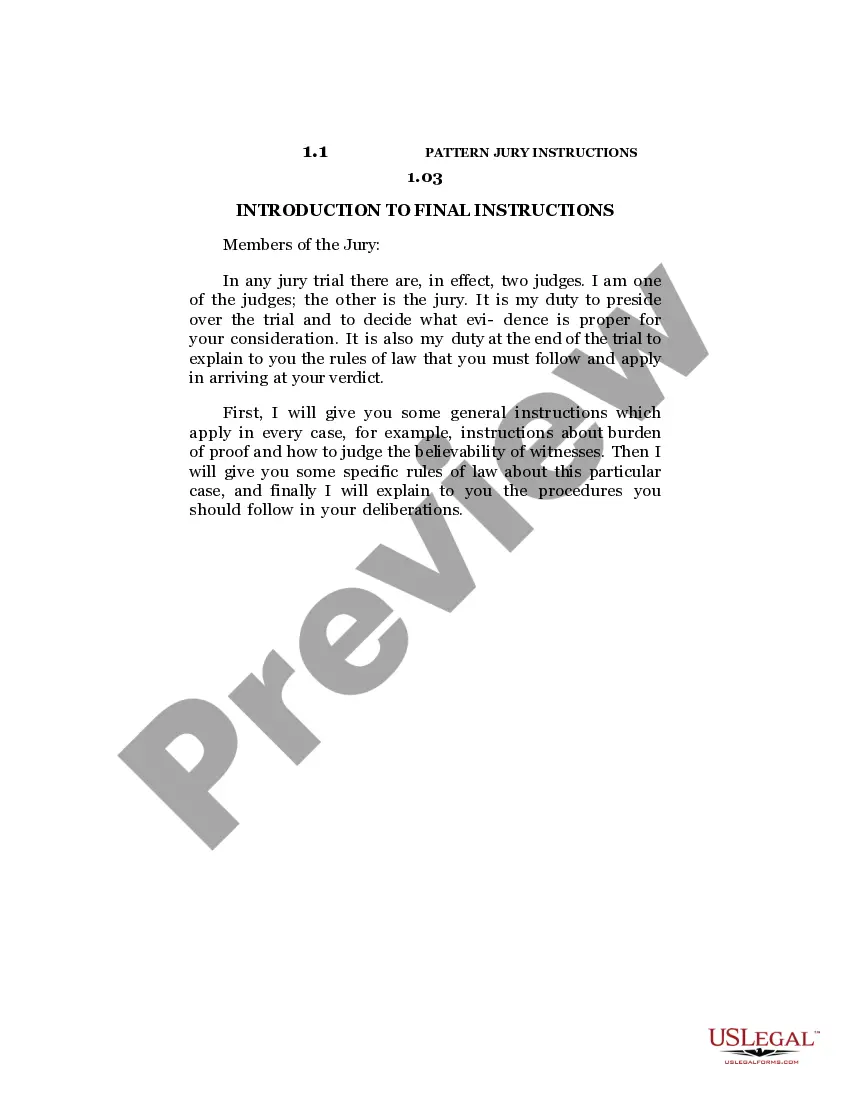
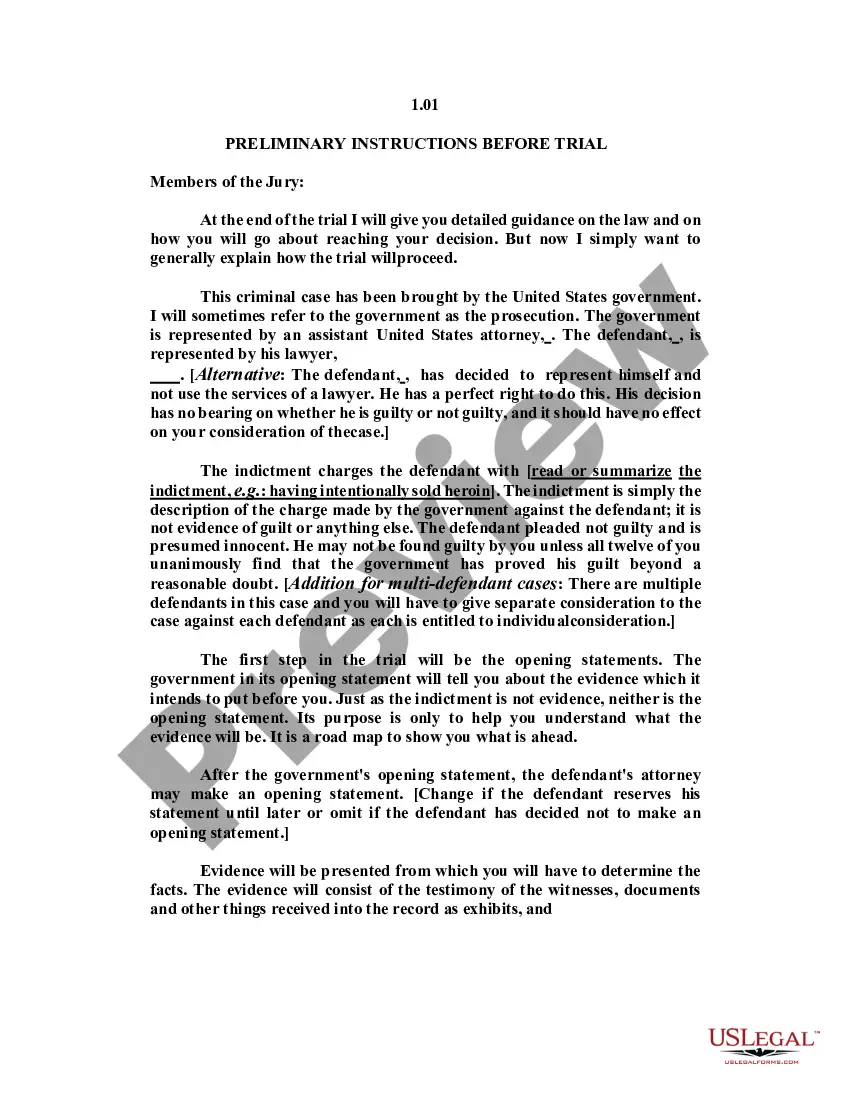
INTRODUCTION TO FINAL INSTRUCTIONS
Overview of this form
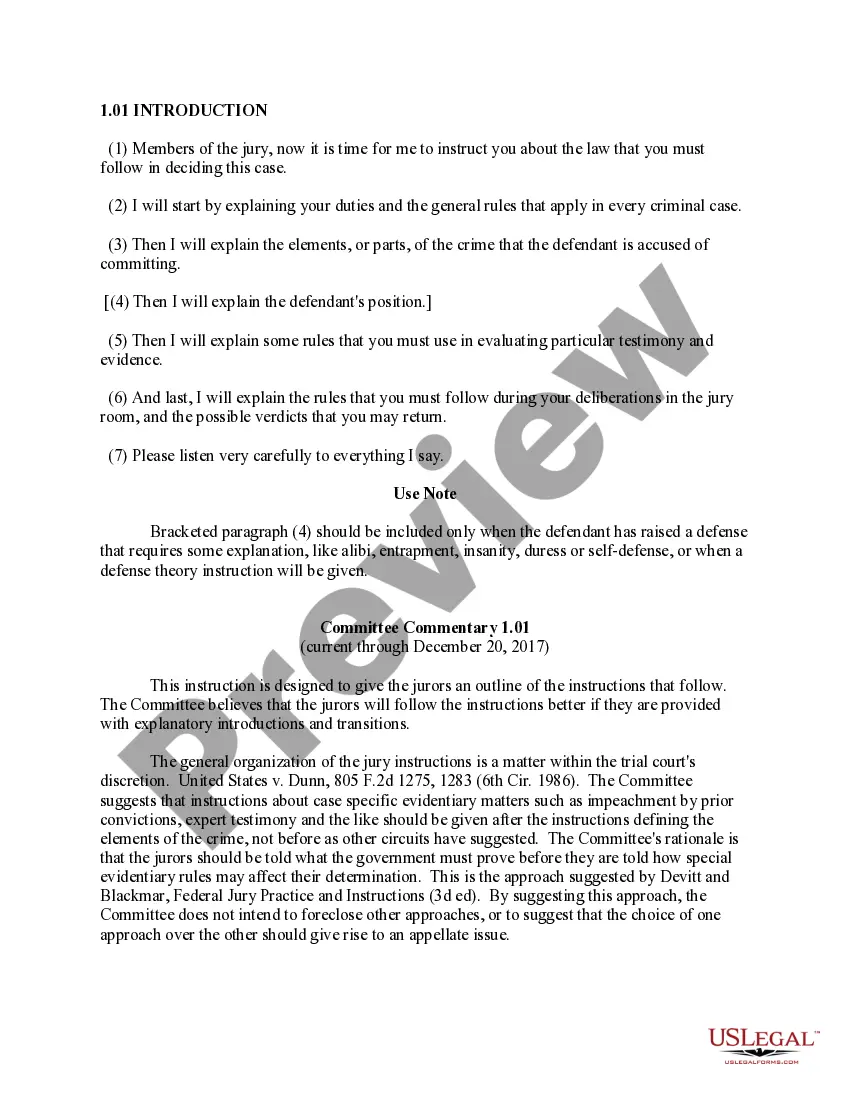
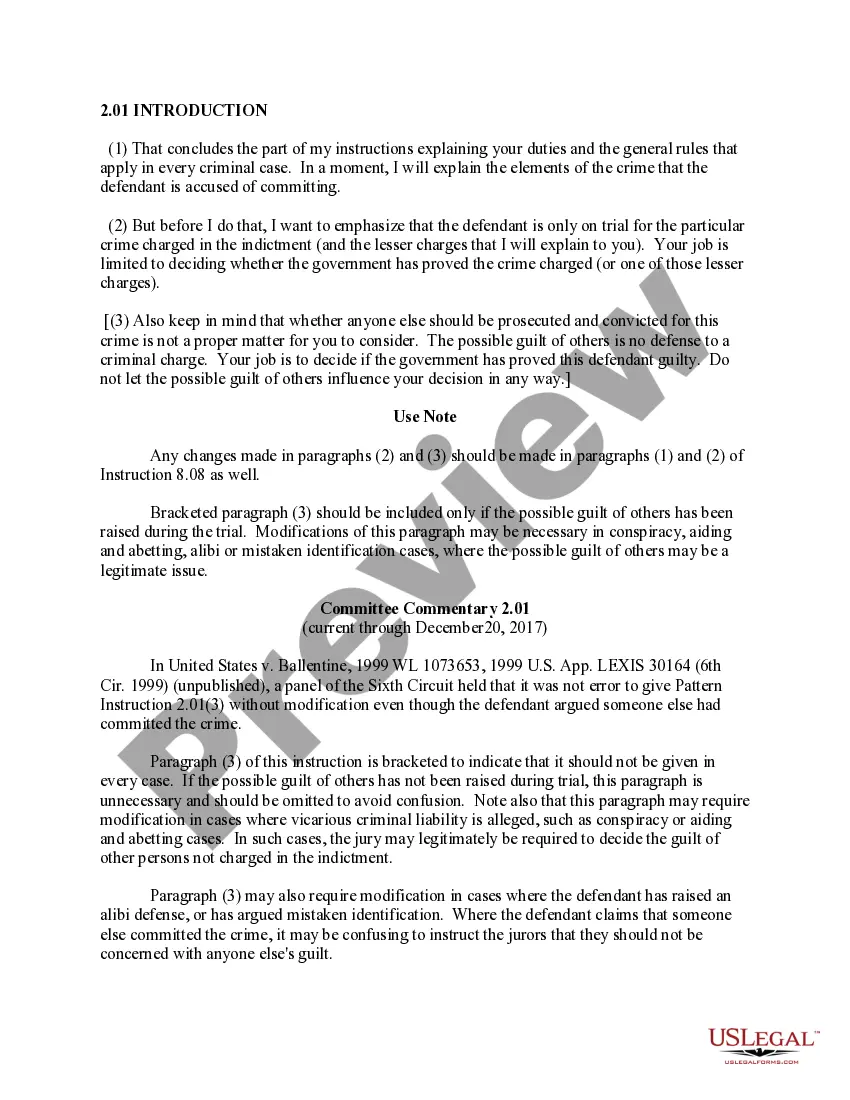
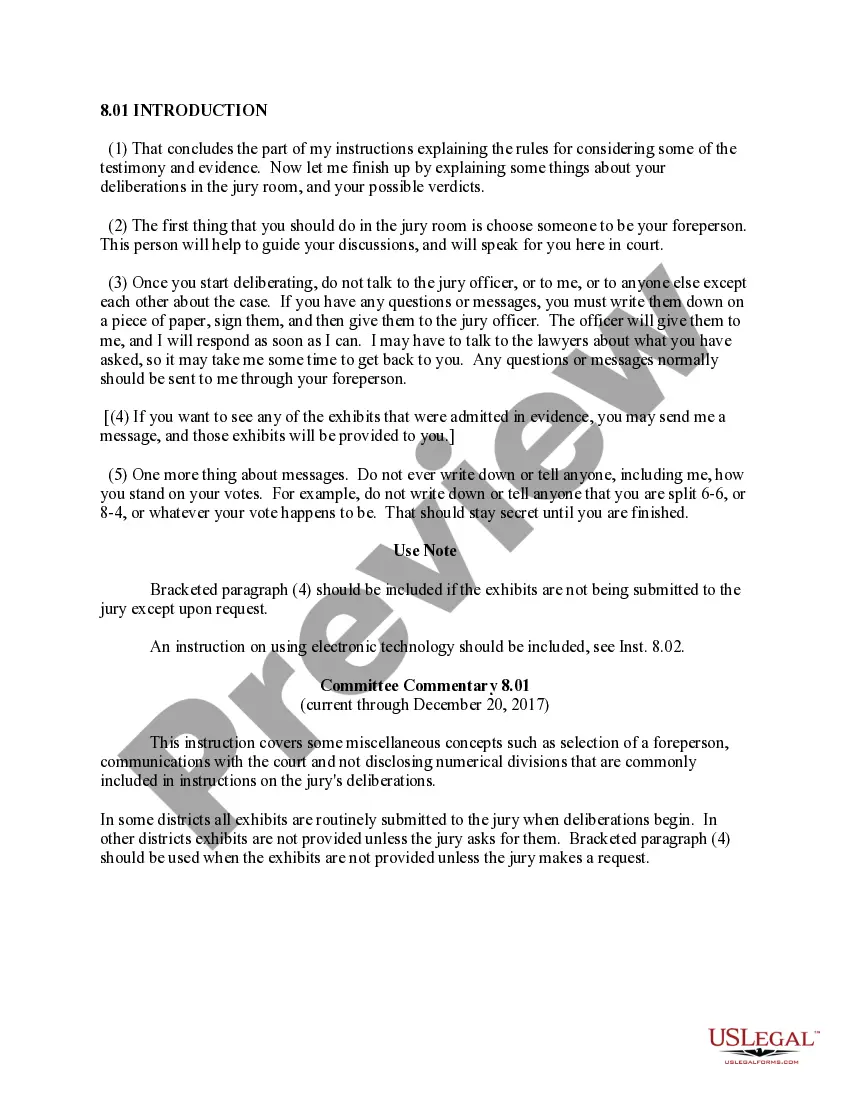
The Introduction to Final Instructions is a legal guideline provided to jurors at the conclusion of a trial. This form helps jurors understand their roles in the decision-making process, clarifying the law and procedures they must follow to reach a verdict. Unlike other legal forms, this document specifically addresses the instructional elements necessary for jury deliberation and reflects the dual roles of judges and jurors in a trial setting.
Main sections of this form
- Judicial roles clarification: Outlines the difference between the judge's and jurors' responsibilities.
- General instructions: Covers fundamental legal principles such as burden of proof and witness credibility.
- Specific legal rules: Tailored instructions pertinent to the particular case being decided.
- Deliberation procedures: Guidelines for conducting jury discussions and reaching a verdict.
- Verdict options: Describes the possible decisions jurors may consider.
When this form is needed
This form is utilized at the end of a jury trial when jurors must be instructed on the applicable laws and procedures. It is essential during the jury's deliberation phase, ensuring that they make informed decisions based on legal standards and the evidence presented in court.
Who can use this document
- Jury members in a trial setting.
- Judges preparing jurors for their deliberation process.
- Court clerks and legal assistants involved in jury management.
Steps to complete this form
- Review the general principles provided, focusing on roles and responsibilities.
- Examine the specific legal rules that apply to your case.
- Follow the outlined procedures for deliberation carefully.
- Discuss the possible verdicts with fellow jurors as per the instructions.
- Use the provided instructions without taking notes, as they will be accessible in the jury room.
Does this form need to be notarized?
Notarization is not commonly needed for this form. However, certain documents or local rules may make it necessary. Our notarization service, powered by Notarize, allows you to finalize it securely online anytime, day or night.
Get your form ready online
Our built-in tools help you complete, sign, share, and store your documents in one place.
Make edits, fill in missing information, and update formatting in US Legal Forms—just like you would in MS Word.
Download a copy, print it, send it by email, or mail it via USPS—whatever works best for your next step.
Sign and collect signatures with our SignNow integration. Send to multiple recipients, set reminders, and more. Go Premium to unlock E-Sign.
If this form requires notarization, complete it online through a secure video call—no need to meet a notary in person or wait for an appointment.
We protect your documents and personal data by following strict security and privacy standards.

Make edits, fill in missing information, and update formatting in US Legal Forms—just like you would in MS Word.

Download a copy, print it, send it by email, or mail it via USPS—whatever works best for your next step.

Sign and collect signatures with our SignNow integration. Send to multiple recipients, set reminders, and more. Go Premium to unlock E-Sign.

If this form requires notarization, complete it online through a secure video call—no need to meet a notary in person or wait for an appointment.

We protect your documents and personal data by following strict security and privacy standards.
Common mistakes
- Ignoring general principles when evaluating case-specific facts.
- Misunderstanding the burden of proof and its implications on deliberation.
- Failing to follow the procedural guidelines for deliberating and reaching a verdict.
Benefits of completing this form online
- Convenience of access: Complete the form at your own pace, anytime, from any device.
- Editability: Customize instructions as needed to fit the unique aspects of your trial.
- Reliability: Access trusted legal guidelines prepared by licensed attorneys.
Legal use & context
- The Introduction to Final Instructions is essential for lawful jury deliberation.
- Improper use or misunderstanding of these instructions can affect the integrity of the verdict.
- Jurors are expected to follow these instructions strictly to ensure compliance with legal standards.
Looking for another form?


Form popularity
FAQ
12 Angry Men is a 1957 film and one of the most highly regarded movies of all time. Twelve jurors must decide the fate of a young man accused of killing his father.
Jury instructions should ideally be brief, concise, non-repetitive, relevant to the case's details, understandable to the average juror, and should correctly state the law without misleading the jury or inviting unnecessary speculation.
The judge reads the instructions to the jury. This is commonly referred to as the judge's charge to the jury. In giving the instructions, the judge will state the issues in the case and define any terms or words that may not be familiar to the jurors.
The judge will instruct the jury in each separate case as to the law of that case. For example, in each criminal case, the judge will tell the jury, among other things, that a defendant charged with a crime is presumed to be innocent and the burden of proving his guilt beyond a reasonable doubt is upon the Government.
One man is dead, another man's life is at stake, if there's a reasonable doubt in your minds as to the guilt of the accused, uh a reasonable doubt, then you must bring me a verdict of "Not Guilty". If, however, there's no reasonable doubt, then you must, in good conscience, find the accused "Guilty".
Your Final Instructions List everything the funeral director and family members who are handling your arrangements should know. It's also the place to detail what should happen with your pets and your most treasured personal effects.
If there is a reasonable doubt in your minds as to the guilt of the accused-then you must declare him not guilty. If-however-there is no reasonable doubt, then he must be found guilty. Whichever way you decide, the verdict must be unanimous.
The judge instructs the jury that their vote must be unanimous and that, if found guilty, the boy will face the death penalty. Cut to the jury room where the story takes place. An anonymous vote is taken where all the jurors vote guilty, save one...