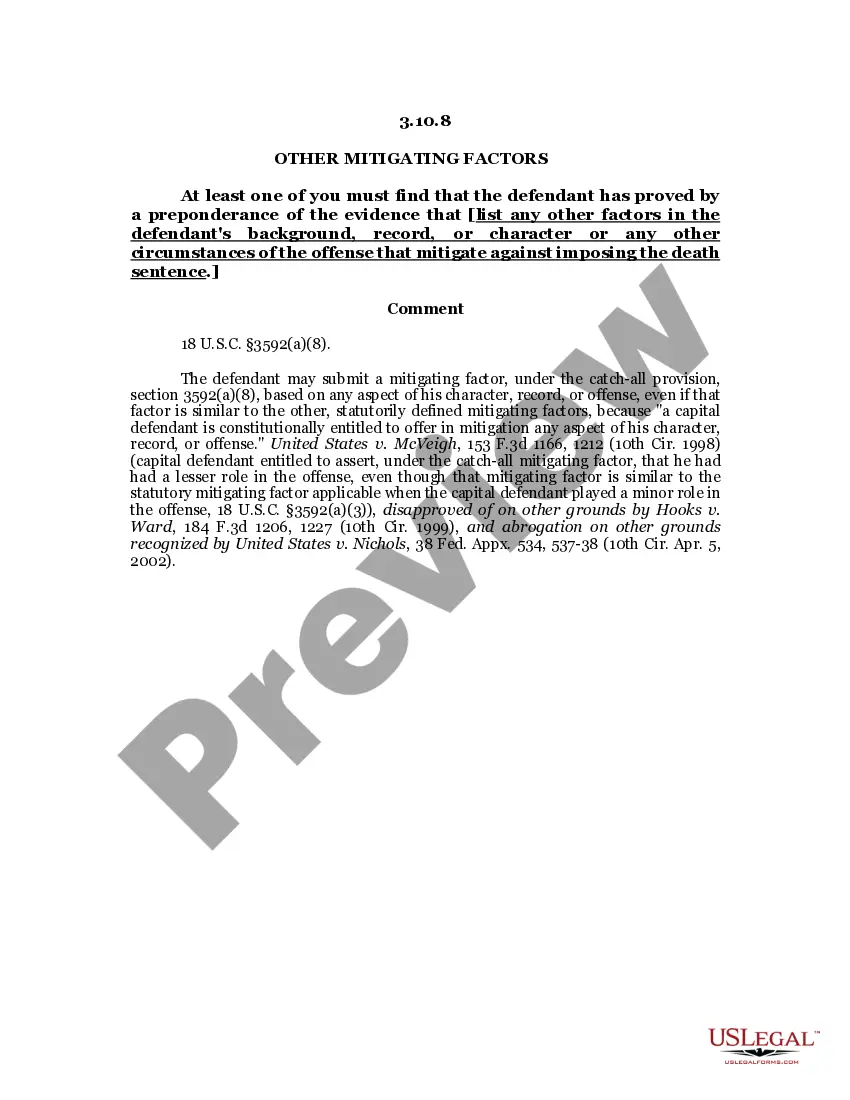
OTHER MITIGATING FACTORS
About this form
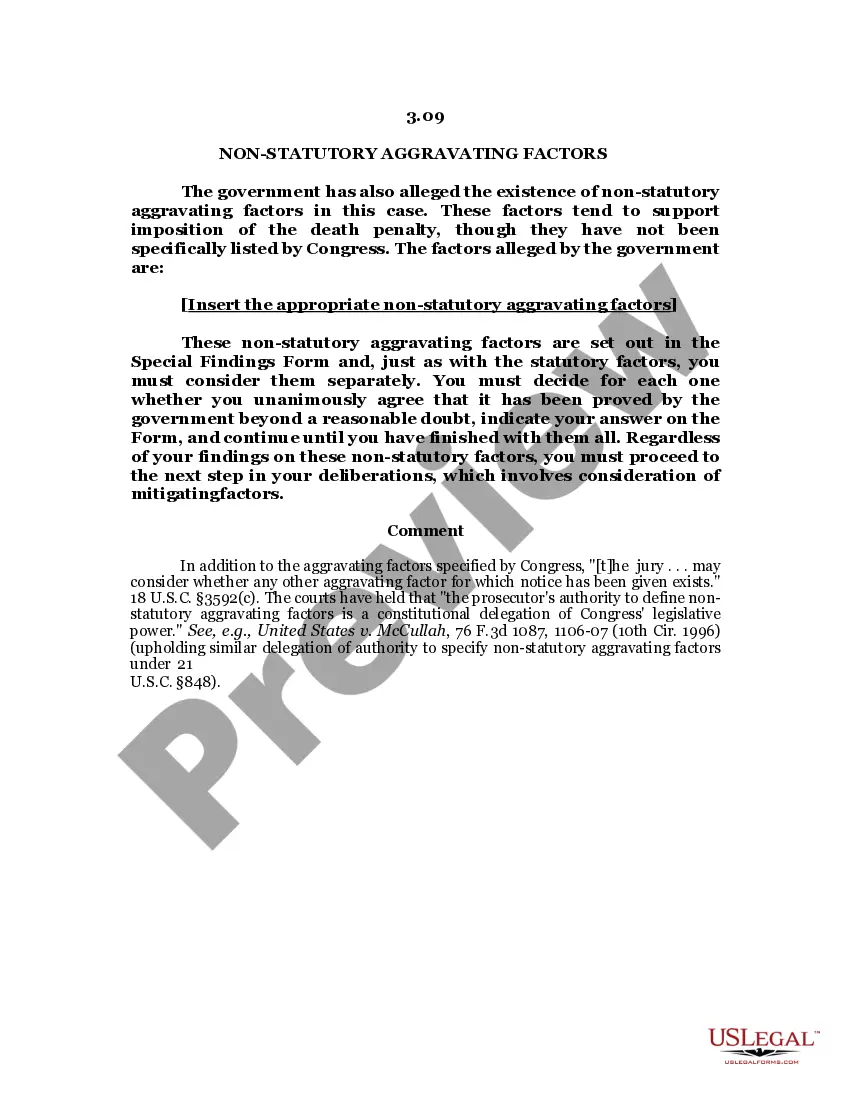
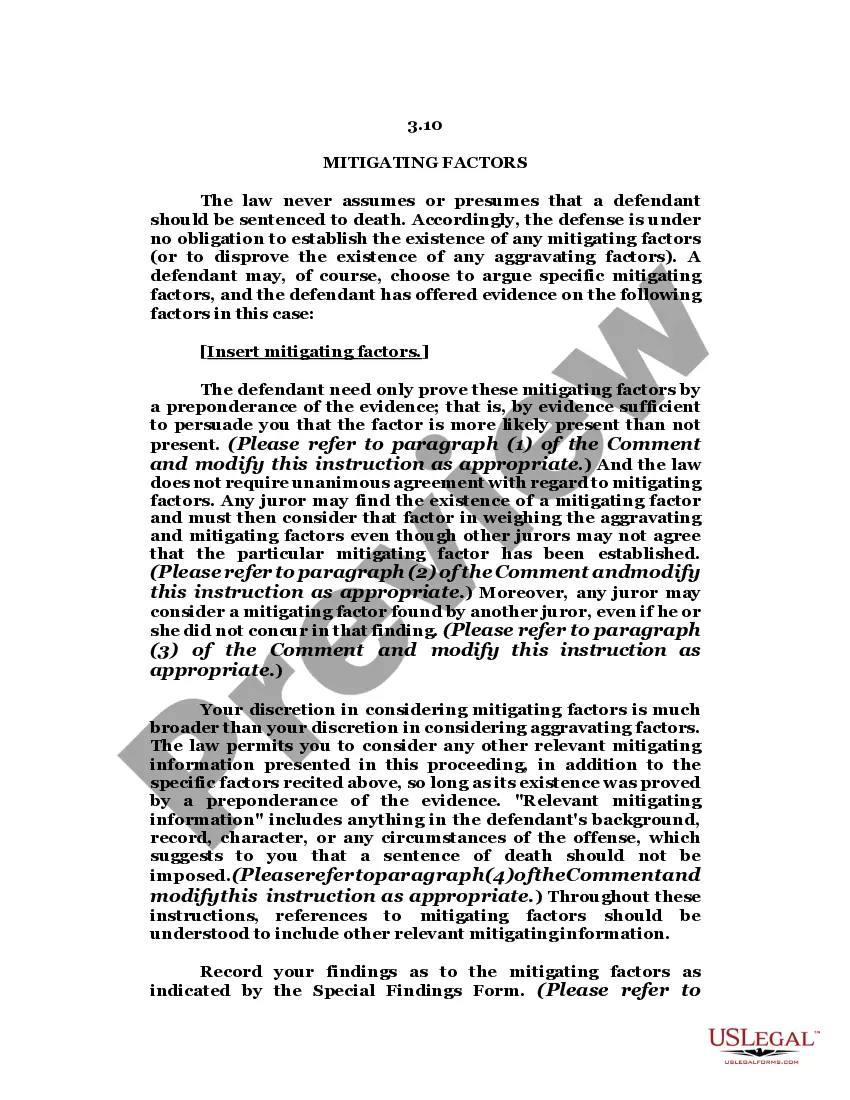
The Other Mitigating Factors form is used in capital cases to present evidence that could influence the penalty phase of a trial. This form allows defendants to introduce mitigating factors about their background, character, or specific circumstances of the offense. It differs from other forms as it applies broadly to any aspect that may argue against imposing the death sentence, beyond the statutorily defined factors.
Main sections of this form
- Identification of mitigating factors that may be relevant to the defendant's case.
- A requirement for at least one juror to find evidence supporting these factors.
- Reference to 18 U.S.C. §3592(a)(8), which allows for presenting various character and offense aspects.
- The standard of proof being a preponderance of the evidence.
When to use this document
This form should be used during the penalty phase of a capital trial where the defendant seeks to avoid the death penalty. It is particularly relevant when the defense wishes to highlight mitigating factors that may not be included in other statutory categories, aiming to show the jury why a death sentence is inappropriate based on the defendant's individual circumstances.
Who this form is for
- Defendants facing capital punishment seeking to present mitigating evidence.
- Defense attorneys representing clients in capital trials.
- Legal professionals involved in cases where mitigating factors may influence sentencing outcomes.
Instructions for completing this form
- Identify the defendant and the applicable case details.
- List any mitigating factors relevant to the defendant's character or background.
- Gather supporting evidence to establish the listed mitigating factors.
- Ensure that at least one juror can find these factors proven by a preponderance of the evidence.
- Submit the form as part of the defendant's case in the penalty phase of the trial.
Notarization guidance
This form usually doesn’t need to be notarized. However, local laws or specific transactions may require it. Our online notarization service, powered by Notarize, lets you complete it remotely through a secure video session, available 24/7.
Get your form ready online
Our built-in tools help you complete, sign, share, and store your documents in one place.
Make edits, fill in missing information, and update formatting in US Legal Forms—just like you would in MS Word.
Download a copy, print it, send it by email, or mail it via USPS—whatever works best for your next step.
Sign and collect signatures with our SignNow integration. Send to multiple recipients, set reminders, and more. Go Premium to unlock E-Sign.
If this form requires notarization, complete it online through a secure video call—no need to meet a notary in person or wait for an appointment.
We protect your documents and personal data by following strict security and privacy standards.

Make edits, fill in missing information, and update formatting in US Legal Forms—just like you would in MS Word.

Download a copy, print it, send it by email, or mail it via USPS—whatever works best for your next step.

Sign and collect signatures with our SignNow integration. Send to multiple recipients, set reminders, and more. Go Premium to unlock E-Sign.

If this form requires notarization, complete it online through a secure video call—no need to meet a notary in person or wait for an appointment.

We protect your documents and personal data by following strict security and privacy standards.
Avoid these common issues
- Failing to provide sufficient evidence to support listed mitigating factors.
- Listing factors that do not qualify under the legal definition of mitigating circumstances.
- Not ensuring that at least one juror can be convinced by the evidence presented.
Benefits of completing this form online
- Easy access to a professionally drafted template designed by attorneys.
- Editable format allows customization to fit specific cases.
- Convenient downloading process ensures immediate availability.
Legal use & context
- This form is legally significant in capital cases, allowing the defense to argue against the death sentence.
- The catch-all mitigating factor provision provides an avenue for various personal circumstances to be considered.
- Understanding and accurately utilizing this form can be critical in the outcome of a capital trial.
Key takeaways
- The Other Mitigating Factors form allows defendants to submit additional evidence for mitigation.
- It is crucial during sentencing in capital cases where the death penalty is considered.
- Accuracy and clarity are essential for the successful presentation of mitigating factors.
Looking for another form?

Form popularity
FAQ
Mitigating factors are extenuating circumstances that might lead to a reduced sentence. Aggravating factors are circumstances that increase the defendant's culpability and could lead to an enhanced or maximum sentence.
Mitigating factors a greater degree of provocation than normally expected; mental illness or disability; youth or age, where it affects the responsibility of the individual defendant; the fact that the offender played only a minor role in the offence.
Mitigating Factors Lack of a prior criminal record. Minor role in the offense; Culpability of the victim; Past circumstances, such as abuse that resulted in criminal activity;
Mitigating factors include an ability for the criminal to reform, mental retardation, an addiction to illegal substances or alcohol that contributed to the criminal behavior, and past good deeds, among many others.
You committed no physical harm against another, and took measures to ensure the safety of others while the crime was being committed. You mistakenly believed your conduct was legal. Your crime was for the purpose of providing life necessities for yourself or others; and/or.
Mitigating factors a greater degree of provocation than normally expected; mental illness or disability; youth or age, where it affects the responsibility of the individual defendant; the fact that the offender played only a minor role in the offence.
What are the 5 mitigating circumstances? Five mitigating circumstances include age, mental state, history of abuse, level of involvement in the crime and lack of criminal record of the defendant. Each of these categories of circumstances can contain many specific factors that result in different levels of mitigation.