ABANDONMENT OR RENUNCIATION
What this document covers
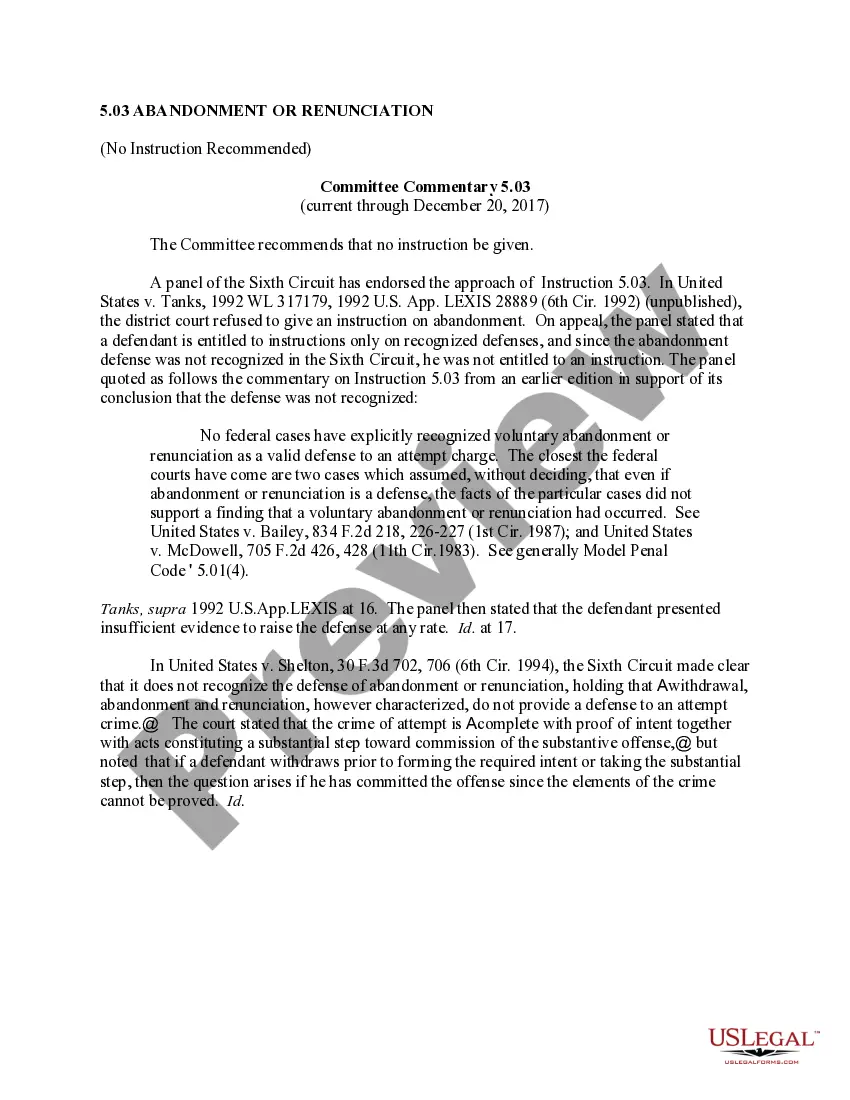
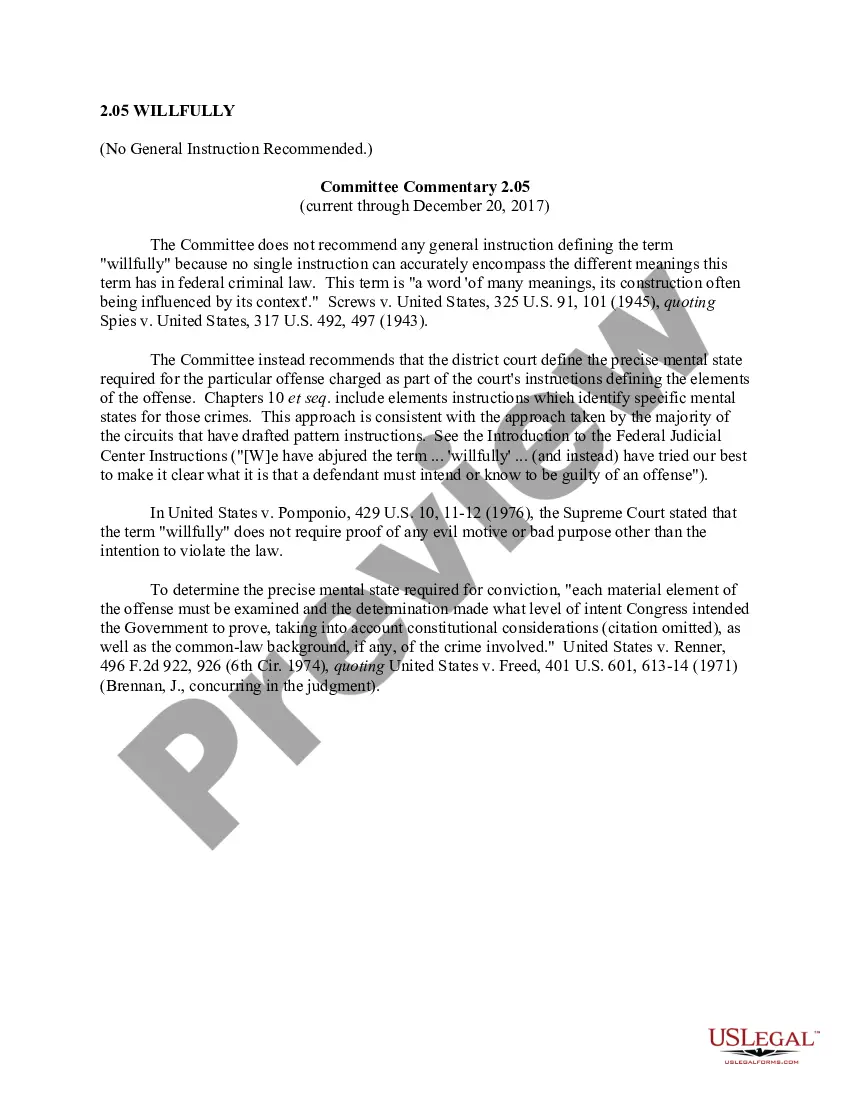
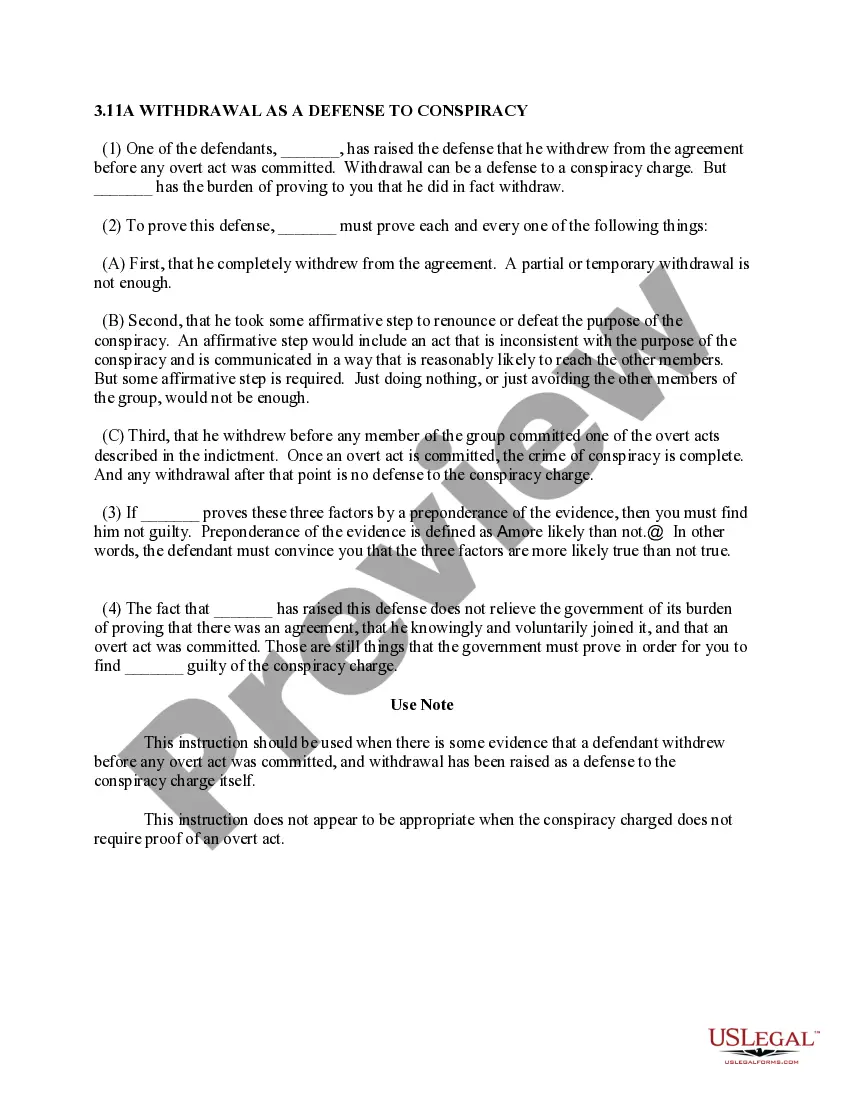
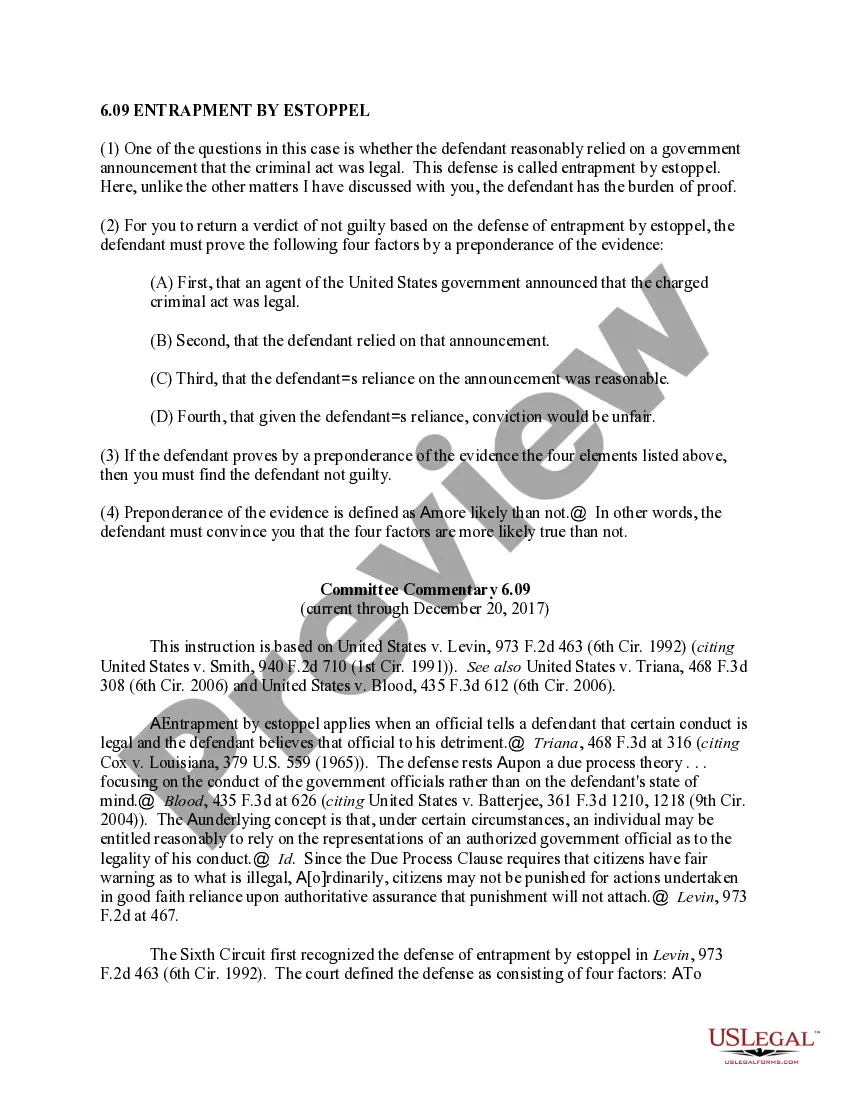
The Abandonment or Renunciation form is a legal document used primarily in the context of criminal law, specifically concerning defenses against attempt charges. This form is designed to clarify the circumstances under which an individual may abandon or renounce their criminal intent. Unlike other legal forms related to criminal defense, this one focuses specifically on the lack of legal recognition for abandonment or renunciation as valid defenses in certain jurisdictions, including the Sixth Circuit of the United States Court of Appeals.
Key parts of this document
- Definition of abandonment and renunciation in a criminal context.
- Overview of relevant case law concerning the recognition of this defense.
- Criteria demonstrating insufficient evidence to support abandonment or renunciation.
- Notes on jurisdictional limitations regarding the defense of abandonment.
- Legal commentary providing insights on the defense's status in various circuits.
Situations where this form applies
This form should be utilized in scenarios where an individual is charged with an attempt crime and wishes to assert that they abandoned their criminal intent or renounced their actions. It serves to document and clarify their position, although it is important to note that this defense is not widely recognized in many jurisdictions, such as the Sixth Circuit, where it may not be applicable.
Who should use this form
This form is intended for:
- Defendants facing attempt charges in jurisdictions where abandonment or renunciation defenses are considered.
- Legal professionals advising clients on potential defenses in criminal cases.
- Individuals seeking to understand their options and the legal implications of abandoning or renouncing a criminal intent.
Instructions for completing this form
- Identify the details of the case including parties involved and charges faced.
- Clarify the circumstances surrounding the decision to abandon or renounce criminal intent.
- Document any supporting evidence or case law that pertains to the defense.
- Review the form for accuracy and completeness.
- Consult with a legal advisor if necessary to ensure proper use of the form.
Does this document require notarization?
In most cases, this form does not require notarization. However, some jurisdictions or signing circumstances might. US Legal Forms offers online notarization powered by Notarize, accessible 24/7 for a quick, remote process.
Get your form ready online
Our built-in tools help you complete, sign, share, and store your documents in one place.
Make edits, fill in missing information, and update formatting in US Legal Forms—just like you would in MS Word.
Download a copy, print it, send it by email, or mail it via USPS—whatever works best for your next step.
Sign and collect signatures with our SignNow integration. Send to multiple recipients, set reminders, and more. Go Premium to unlock E-Sign.
If this form requires notarization, complete it online through a secure video call—no need to meet a notary in person or wait for an appointment.
We protect your documents and personal data by following strict security and privacy standards.

Make edits, fill in missing information, and update formatting in US Legal Forms—just like you would in MS Word.

Download a copy, print it, send it by email, or mail it via USPS—whatever works best for your next step.

Sign and collect signatures with our SignNow integration. Send to multiple recipients, set reminders, and more. Go Premium to unlock E-Sign.

If this form requires notarization, complete it online through a secure video call—no need to meet a notary in person or wait for an appointment.

We protect your documents and personal data by following strict security and privacy standards.
Common mistakes to avoid
- Assuming the defense is recognized in all jurisdictions without verifying local laws.
- Failing to provide adequate evidence to support claims of abandonment or renunciation.
- Not reviewing relevant case law before completing the form.
- Leaving sections incomplete or unclear, which can hinder understanding by legal professionals.
Legal use & context
- The Abandonment or Renunciation form addresses a specific legal defense that is not widely accepted in many courts.
- It is crucial to recognize that while the form can articulate a defense, it may not hold legal weight in every jurisdiction.
What to keep in mind
- The form serves to document an attempt to abandon or renounce criminal activity, although its effectiveness is jurisdiction-dependent.
- Understanding relevant case laws is key to effectively using this form.
- Consultation with legal professionals is recommended for anyone considering this defense.
Looking for another form?
Form popularity
FAQ
Abandonment and withdrawal is an affirmative criminal defense that arises when a defendant asserts that he or she never completed, or was not involved in, a criminal act because he or she abandoned or withdrew from the act prior to it happening.
Two things must occur for property to be abandoned: (1) an act by the owner that clearly shows that he or she has given up rights to the property; and (2) an intention that demonstrates that the owner has knowingly relinquished control over it.
The one who abandons the marriage will not be forced to return, but they will be held financially responsible for things such as child support, spousal support, and property division via a divorce court order.
Marriage abandonment also called desertion, is when one spouse leaves the marriage without telling the other and with no intention of returning. In marriage abandonment, a spouse walks away from their financial obligations and all other contractual duties of marriage.
If the spouse leaves the family and is unreachable or refuses to take care of the family financially, this can be considered criminal spousal abandonment. In order to prove abandonment, the abandoned spouse must use direct or constructive evidence to demonstrate their claim.
Spouses who desert their families might also be charged with criminal nonsupport. Although this crime is sometimes referred to as abandonment or desertion, it's not just about leaving the family home. Instead, it's focused on the failure to provide needed support after leaving.
If the spouse leaves the family and is unreachable or refuses to take care of the family financially, this can be considered criminal spousal abandonment. In order to prove abandonment, the abandoned spouse must use direct or constructive evidence to demonstrate their claim.
When you drop a political party to become an independent, you mean it to be a renunciation of all the infighting, backstabbing, and finger pointing that have become "politics as usual." the act of renouncing; sacrificing or giving up or surrendering (a possession or right or title or privilege etc.)