Truancy Ordinance - Juvenile Truancy
About this form
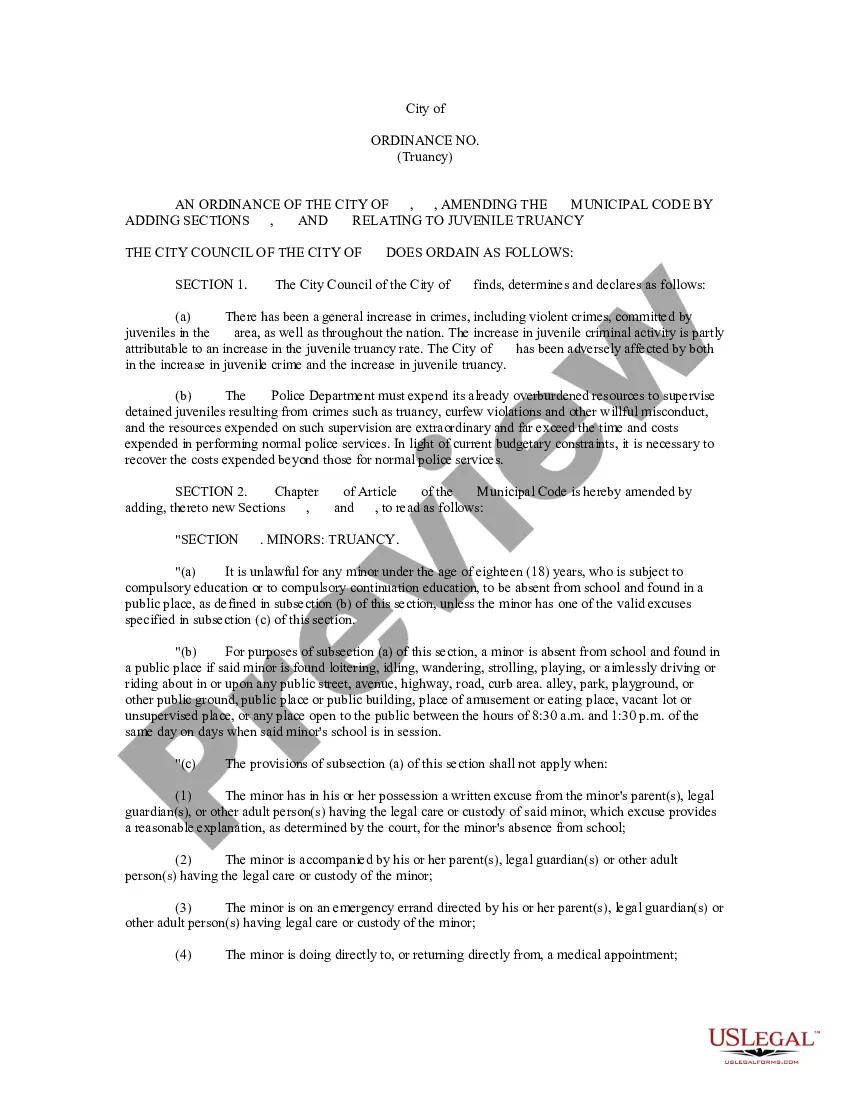
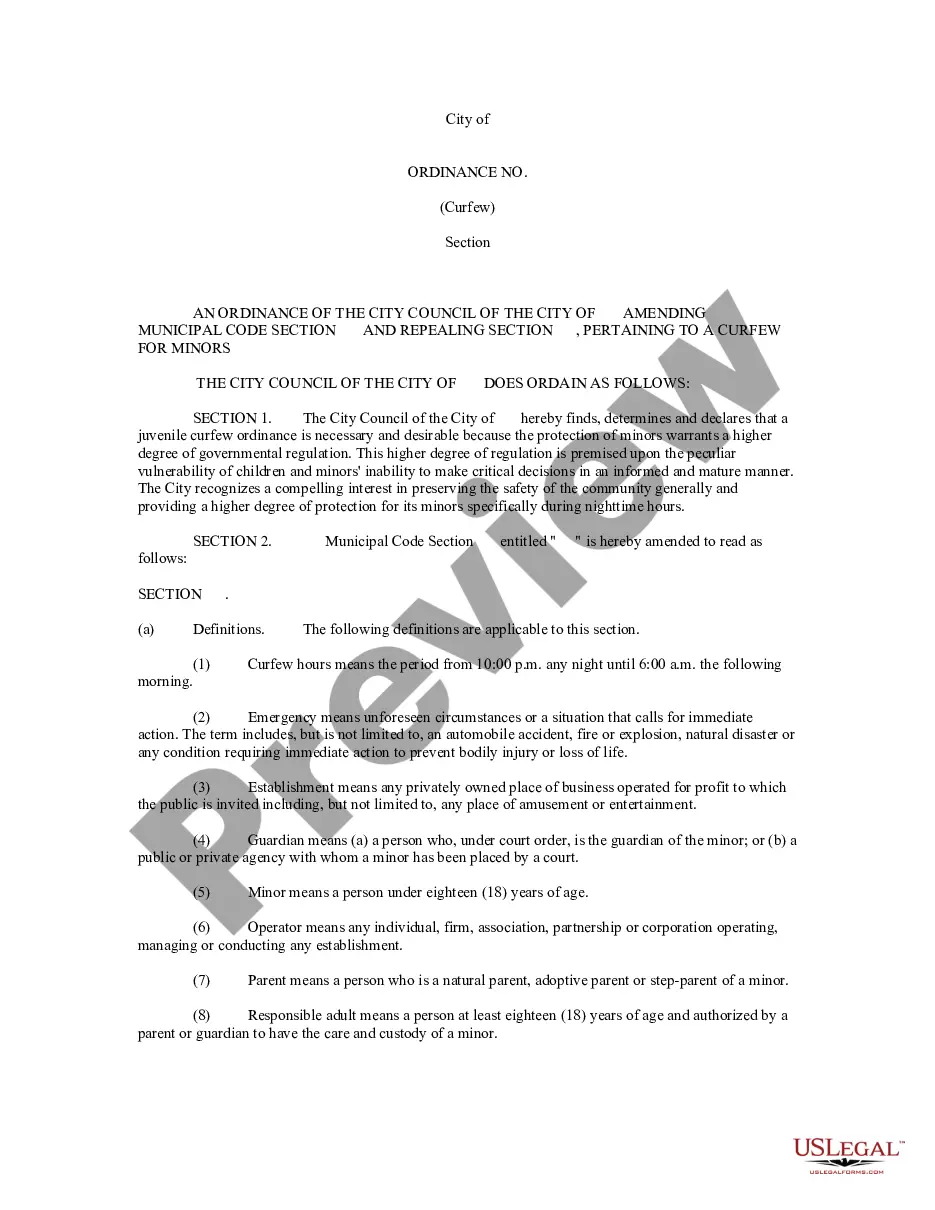
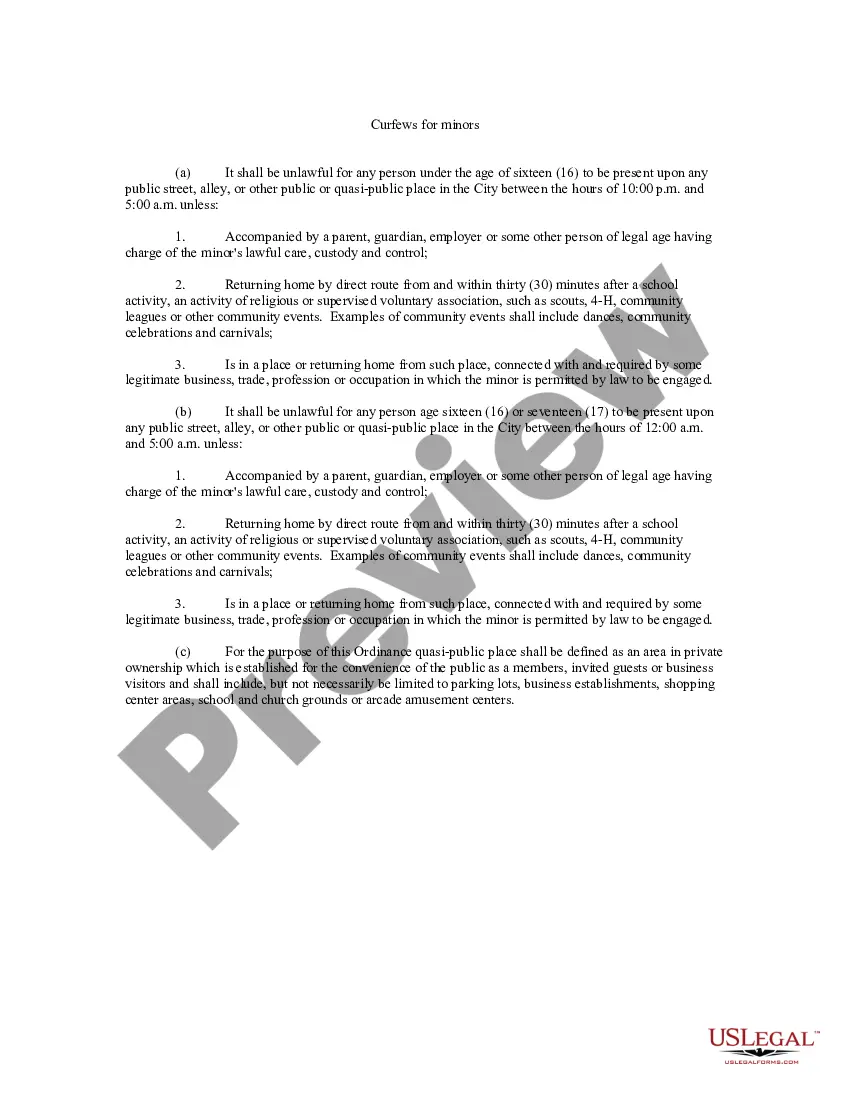
The Truancy Ordinance - Juvenile Truancy form is a municipal ordinance template designed to address issues related to juvenile truancy. This legal document outlines the responsibilities of minors and their guardians regarding school attendance and the consequences of noncompliance. Unlike general truancy laws, this ordinance specifically provides a framework for local municipalities to enforce attendance regulations and manage the associated costs of juvenile supervision effectively.
What’s included in this form
- Definition of unlawful absenteeism for minors under 18 from school sessions.
- Exceptions to the absenteeism rule, including valid excuses for absence.
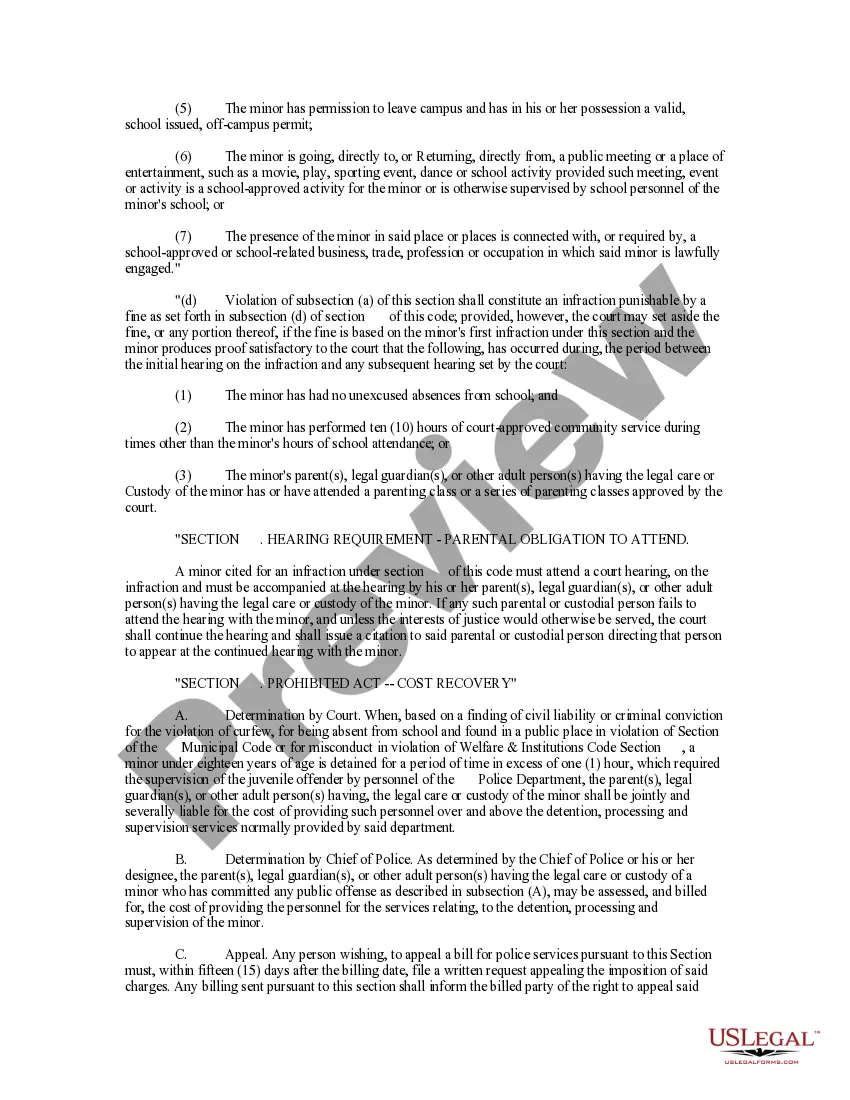
- Penalties for violations, including fines and community service requirements.
- Hearing requirements for minors and their guardians if cited for truancy.
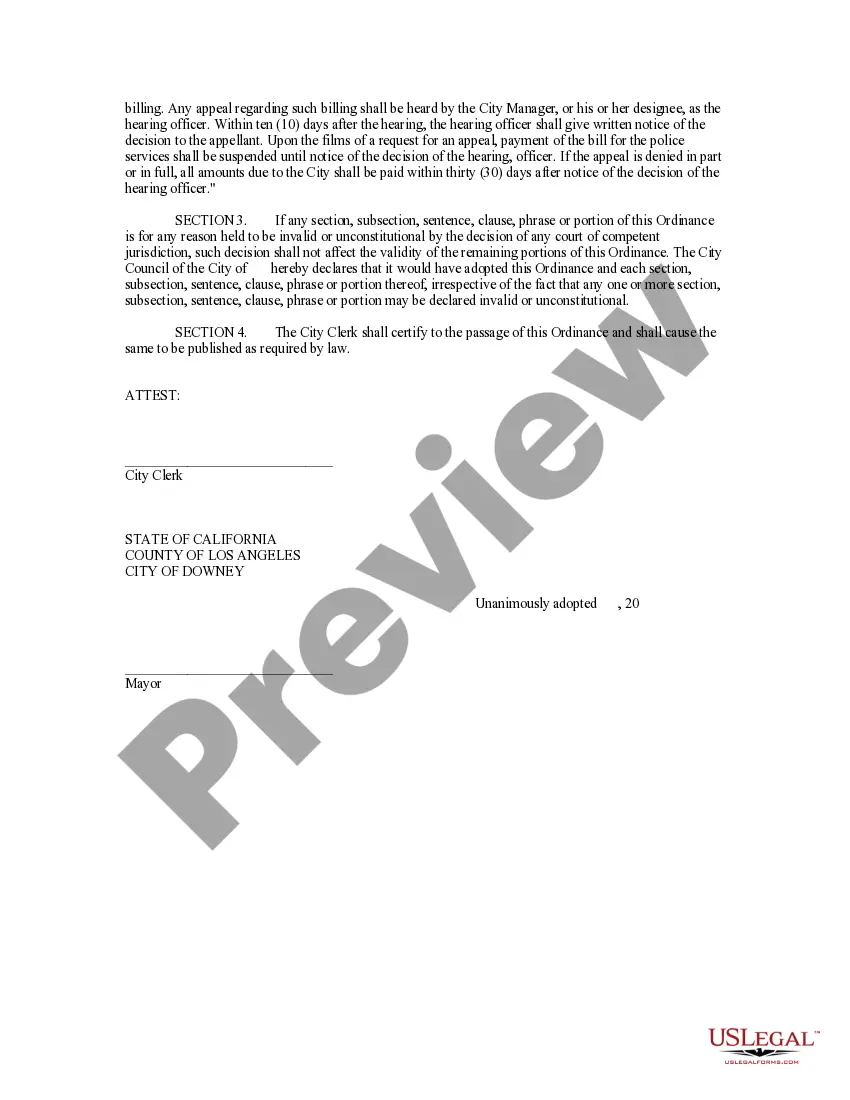
- Cost recovery provisions for municipalities in case of juvenile detentions.
Situations where this form applies
This form should be utilized by city councils when establishing or amending local laws regarding juvenile truancy. It is particularly important in areas experiencing increased juvenile crimes linked to higher truancy rates. Municipalities can use this ordinance to create a legal basis for addressing and managing the issue of minors not attending school while providing clear guidelines and consequences.
Intended users of this form
- City councils or local government officials intending to address juvenile truancy.
- Municipal legal advisors tasked with drafting or revising municipal codes.
- Community organizations advocating for youth education and well-being.
- Parents and guardians of minors who may need to understand their rights and responsibilities related to school attendance.
How to complete this form
- Identify the city and state where the ordinance will be enacted.
- Fill in the specific municipal code sections that will be amended or added.
- Outline the findings that support the need for this ordinance.
- Specify the rules regarding truancy, including exceptions for minors.
- Include penalties and procedures for enforcement, including court and hearing requirements.
Does this form need to be notarized?
This form does not typically require notarization to be legally valid. However, some jurisdictions or document types may still require it. US Legal Forms provides secure online notarization powered by Notarize, available 24/7 for added convenience.
Get your form ready online
Our built-in tools help you complete, sign, share, and store your documents in one place.
Make edits, fill in missing information, and update formatting in US Legal Forms—just like you would in MS Word.
Download a copy, print it, send it by email, or mail it via USPS—whatever works best for your next step.
Sign and collect signatures with our SignNow integration. Send to multiple recipients, set reminders, and more. Go Premium to unlock E-Sign.
If this form requires notarization, complete it online through a secure video call—no need to meet a notary in person or wait for an appointment.
We protect your documents and personal data by following strict security and privacy standards.

Make edits, fill in missing information, and update formatting in US Legal Forms—just like you would in MS Word.

Download a copy, print it, send it by email, or mail it via USPS—whatever works best for your next step.

Sign and collect signatures with our SignNow integration. Send to multiple recipients, set reminders, and more. Go Premium to unlock E-Sign.

If this form requires notarization, complete it online through a secure video call—no need to meet a notary in person or wait for an appointment.

We protect your documents and personal data by following strict security and privacy standards.
Typical mistakes to avoid
- Failing to specify valid excuses for school absence, leading to confusion.
- Omitting the enforcement and penalty provisions, which could weaken the ordinance.
- Neglecting to ensure that the ordinance aligns with state laws on truancy.
- Not providing clear procedures for appeals related to enforcement actions.
Benefits of completing this form online
- Convenient access to a legally vetted ordinance template that can be customized as needed.
- Editability allows local governments to adjust the content according to specific municipal requirements.
- Reliability in terms of ensuring compliance with current legal standards and practices.
Legal use & context
- Enforcement of truancy ordinances can provide a structured approach to combating juvenile delinquency.
- Such ordinances are generally enforceable when properly adopted according to local governmental procedures.
- Understanding the implications of this ordinance can aid municipalities in budgeting for necessary resources and training for enforcement personnel.
Main things to remember
- The Truancy Ordinance - Juvenile Truancy form supports municipalities in addressing school absenteeism effectively.
- Clearly defined sections help ensure compliance and understanding among minors and guardians.
- Utilizing this form may assist local authorities in improving community safety and promoting educational attendance.
Looking for another form?
Form popularity
FAQ
Truant students who are referred to court are subject to more significant repercussions, including: Delay of the grant of driving privileges; Revocation or suspension of driving privileges; Mandatory educational courses; and/or.
Communicate attendance expectations. Form an attendance team. Intervene early. Track the positivity ratio. Create a more positive school culture. Make it easy to track and act on real-time data.
Create a positive classroom environment with hands-on activities, group discussions, and active participation. Build positive relationships with students and parents. Discuss truancies with parents or guardians. Implement incentives for attendance. Implement options for credit recovery.
Create a positive classroom environment with hands-on activities, group discussions, and active participation. Build positive relationships with students and parents. Discuss truancies with parents or guardians. Implement incentives for attendance. Implement options for credit recovery.
The consequences of too many absences are serious not only for students, but also for parents! Schools handle minor truancy with warning letters, parent-teacher conferences, and other means. However, in some states, parents can be fined when their kids miss too much school.
Jorge's truancy is a major problem, as he has already missed two weeks of school just because he didn't feel like going. In some states, truancy is actually a crime, so students should be careful about skipping class just for fun.
New Laws under Senate Bill 439 SB 439 states that California's juvenile court has jurisdiction over a minor when: The minor is between 12 and 17 years of age; and, The minor violates any law of California, or the United States, or a municipal ordinance.
In the law a juvenile is defined as a person who is not old enough to be held responsible for criminal acts. In most states and on the federal level, this age threshold is set at 18 years. In Wyoming a juvenile is a person under the age of 19.
A juvenile is a child or young person who is not yet old enough to be regarded as an adult.