Road and Utility Easement Agreement
Overview of this form
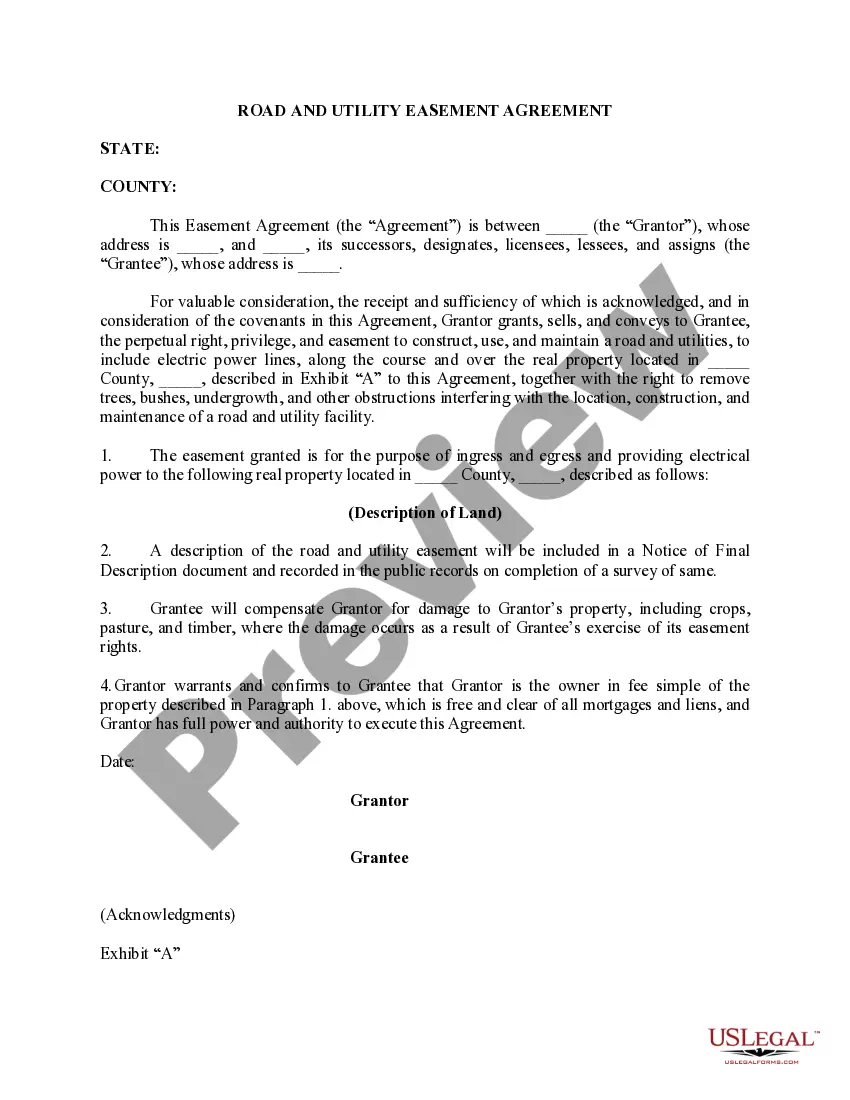
The Road and Utility Easement Agreement is a legal document that allows a party (the Grantee) to use a portion of another party's property (the Grantor) for the construction, maintenance, and operation of a road and utility services, such as electrical power lines. This agreement defines the rights and responsibilities of both parties and distinguishes it from other easement agreements by specifically addressing road access and utility installation on the specified property.
Key parts of this document
- Identification of parties involved: includes the Grantor and Grantee's names and addresses.
- Description of the easement area: details the specific property involved and the nature of the easement.
- Rights granted: outlines the rights to construct, use, and maintain the road and utilities.
- Compensation for damage: states the Grantee's obligation to compensate the Grantor for any property damage incurred.
- Warranties: confirms the Grantor's ownership and authority over the property in question.
Common use cases
This form is used when a property owner needs to grant access to another party for the installation and maintenance of utilities and roadways through their land. It is particularly useful for developers, utility companies, or municipalities that require legal rights to lay down infrastructure that crosses private property.
Who can use this document
- Property owners (Grantors) who wish to allow utility access on their land.
- Utility companies or developers (Grantees) that need to establish rights for roadways and utility lines.
- Attorneys representing either party in legal transactions involving property rights.
- Individuals or organizations involved in property development that requires easements for construction purposes.
How to complete this form
- Identify the parties: fill in the names and addresses of both the Grantor and Grantee.
- Specify the property: provide a detailed description of the property where the easement will be granted.
- Outline the rights: clearly state the scope of the easement, including what utilities will be installed and maintained.
- Include compensation terms: define any compensation for damages to the Grantor's property.
- Sign and date: both parties must sign the agreement and enter the date of execution.
Does this form need to be notarized?
This form must be notarized to be legally valid. US Legal Forms provides secure online notarization powered by Notarize, allowing you to complete the process through a verified video call.
Get your form ready online
Our built-in tools help you complete, sign, share, and store your documents in one place.
Make edits, fill in missing information, and update formatting in US Legal Forms—just like you would in MS Word.
Download a copy, print it, send it by email, or mail it via USPS—whatever works best for your next step.
Sign and collect signatures with our SignNow integration. Send to multiple recipients, set reminders, and more. Go Premium to unlock E-Sign.
If this form requires notarization, complete it online through a secure video call—no need to meet a notary in person or wait for an appointment.
We protect your documents and personal data by following strict security and privacy standards.
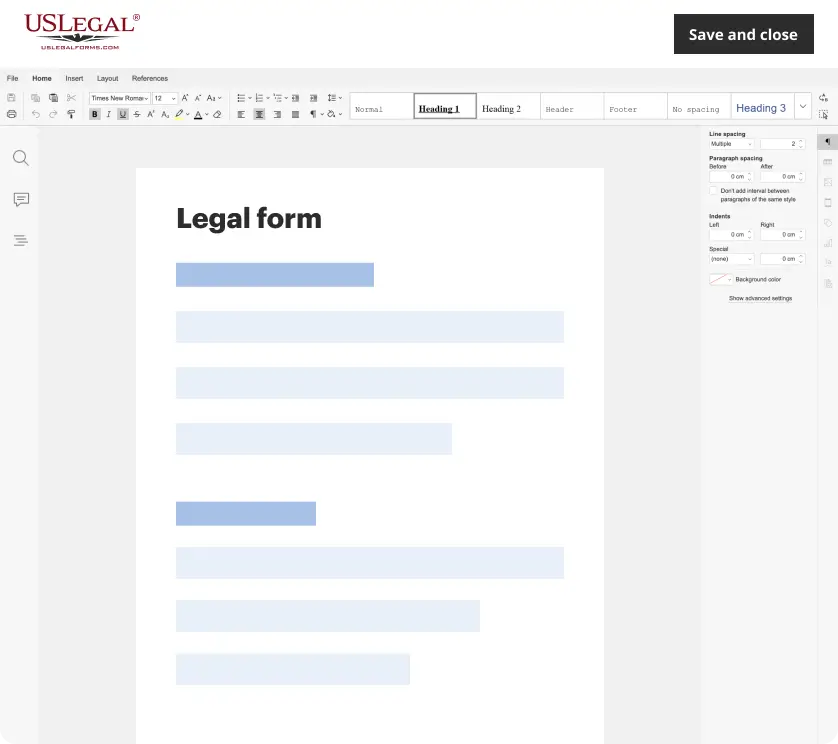
Make edits, fill in missing information, and update formatting in US Legal Forms—just like you would in MS Word.
Download a copy, print it, send it by email, or mail it via USPS—whatever works best for your next step.
Sign and collect signatures with our SignNow integration. Send to multiple recipients, set reminders, and more. Go Premium to unlock E-Sign.
If this form requires notarization, complete it online through a secure video call—no need to meet a notary in person or wait for an appointment.
We protect your documents and personal data by following strict security and privacy standards.
Avoid these common issues
- Failing to accurately describe the easement area, which can lead to disputes.
- Not specifying compensation terms, leaving ambiguity regarding property damage.
- Omitting signatures from both parties, which invalidates the agreement.
- Neglecting to confirm the Grantor's ownership of the property, which can affect enforceability.
Why use this form online
- Immediate access to legally vetted templates, saving you time and effort.
- Easy downloading and customization to fit your specific needs.
- Convenience of filling out forms from anywhere without scheduling appointments.
- Reliable language from licensed attorneys ensures compliance with current legal standards.
Looking for another form?
Form popularity
FAQ
Generally speaking, an easement is a more serious property right; it is the legal right to use someone else's land for a particular purpose. Easements are often recorded at the county clerk's office and encumber your property's title.Here, however, you probably do not need to take the step of granting an easement.
The bottom line is that developers and builders who are presented with utility company easement forms should not just sign them, but think about the kinds of issues they can present. It is easier to negotiate these concessions up front before the lines go in, than to ask the utility company to amend its easement later.
An easement is a nonpossessory right to use and/or enter onto the real property of another without possessing it. It is "best typified in the right of way which one landowner, A, may enjoy over the land of another, B".
Nine Essential Property Easement Agreement Considerations. Legal Description of Properties. Depiction of the Easement Area. Covenant Not to Disturb the Use of the Easement. Determination of Maintenance Obligations. Payment of Property Taxes.
An easement can decrease the value of a real estate, increase the value of the real estate or it can have no impact on the value of the real estate at all. The most important fact is that each property and situation should be evaluated on individual basis, taking into account all the circumstances.
An easement deed allows a party that is not the owner to use a portion of the land. It is a written agreement between two parties that spells out what part of the property is available for access and how it may be used. Since you are granting an easement to your land, you can set any terms and conditions you like.
When termed as a utility easement, it means a utility company's right to access and control the portion of another person's land that is located near utility facilities and structures (i.e. utility poles, transformers, overhead or underground electrical lines).
An easement is a limited right to use another person's land for a stated purpose. Examples of easements include the use of private roads and paths, or the use of a landowner's property to lay railroad tracks or electrical wires.
Give the document a simple title: Grant of Easement is sufficient. Identify the parties. You need to explain who the parties are to the agreement. The person granting the easement to his property is the Grantor and the person gaining access to the property is the Grantee.