Small Business Startup Package for S-Corporation
Understanding this form package
The Small Business Startup Package for S-Corporation includes essential legal forms designed to support the operation of an S corporation. This package provides a comprehensive selection of commonly used documents at a significantly reduced price, ensuring that a business can efficiently manage its affairs while minimizing legal risks. With savings of over 75% compared to purchasing forms individually, this package stands out as a valuable resource for small business owners.
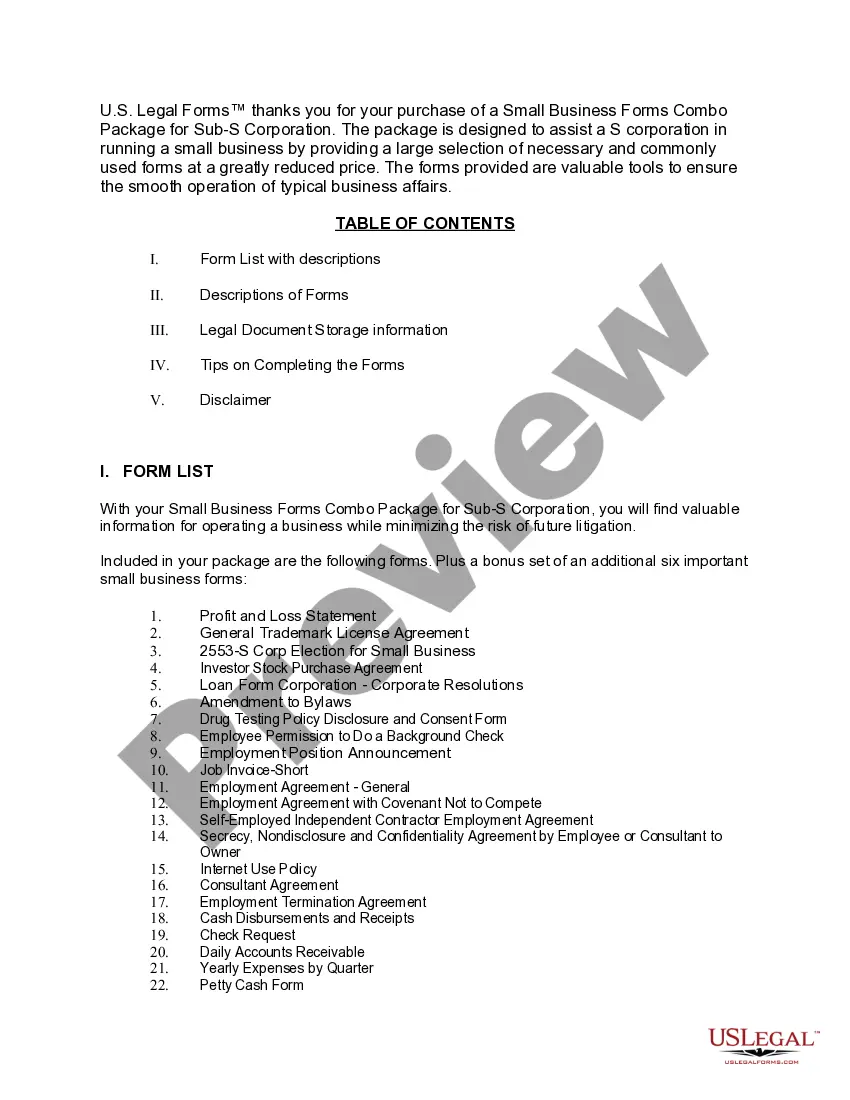
Forms included in this package
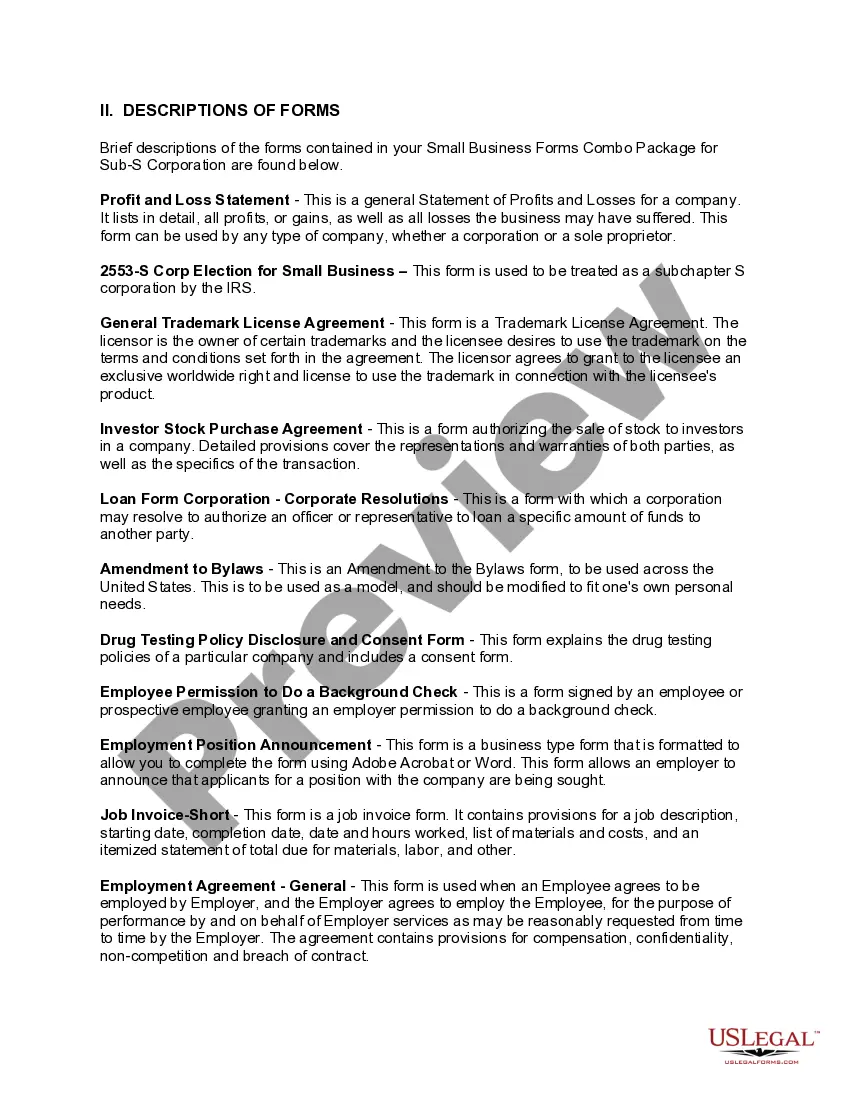
- Employment or Job Termination Agreement
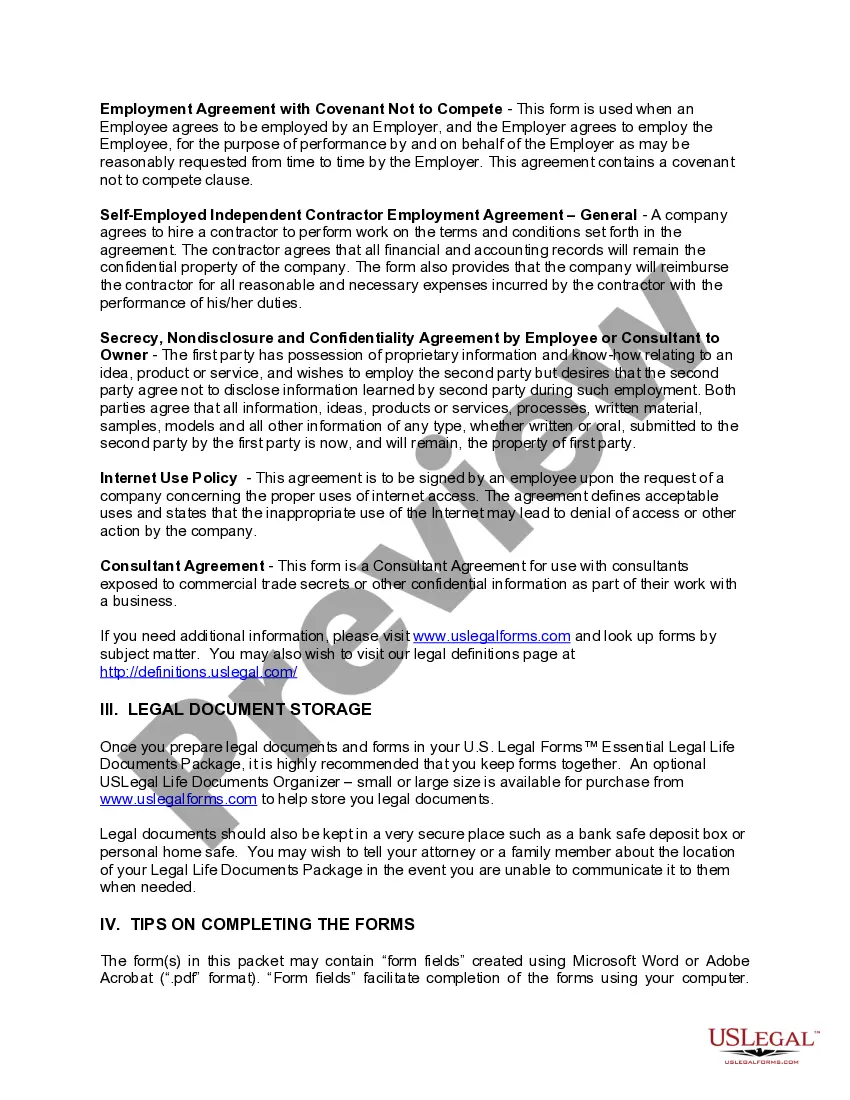
- Internet Use Policy
- Secrecy, Nondisclosure and Confidentiality Agreement by Employee or Consultant to Owner
- Cash Disbursements and Receipts
- Check Request
- Daily Accounts Receivable
- Job Invoice - Short
- Employment Position Announcement
- Drug Testing Policy Disclosure and Consent Form
- Yearly Expenses by Quarter
- Petty Cash Form
- Purchasing Cost Estimate
- Self-Employed Independent Contractor Employment Agreement - General
- Amendment to Bylaws
- Election of 'S' Corporation Status and Instructions - IRS 2553
- General Trademark License Agreement
- Employment Agreement - General
- Employment Agreement with Covenant Not to Compete
- Employee Permission to Do a Background Check
- Investor Stock Purchase Agreement
- Profit and Loss Statement
- Consultant Agreement

Common use cases
This form package is appropriate for small business owners who are starting or managing an S corporation. Use this package when you need to:
- File for S corporation status with the IRS
- Draft essential agreements for employees and contractors
- Implement policies like drug testing or internet use
- Manage financial statements and stock sales
- Modify corporate bylaws or resolutions
Who needs this form package
- Small business owners looking to start or operate an S corporation
- Entrepreneurs seeking to streamline their legal documentation process
- Companies in need of comprehensive forms to establish clear business operations
- Individuals unfamiliar with legal documentation seeking simplified, reliable forms
Steps to complete these forms
- Review all forms included in the package to understand their purposes.
- Identify the relevant parties involved in each agreement or form.
- Fill in the required information in the designated fields using a computer or print and complete by hand.
- Ensure all necessary signatures are obtained where required.
- Save copies of completed forms for your records.
Notarization requirements for forms in this package
Forms in this package typically do not require notarization. However, certain states or document types may still need it. US Legal Forms provides online notarization powered by Notarize, available 24/7 for your convenience.
Get your form ready online
Our built-in tools help you complete, sign, share, and store your documents in one place.
Make edits, fill in missing information, and update formatting in US Legal Forms—just like you would in MS Word.
Download a copy, print it, send it by email, or mail it via USPS—whatever works best for your next step.
Sign and collect signatures with our SignNow integration. Send to multiple recipients, set reminders, and more. Go Premium to unlock E-Sign.
If this form requires notarization, complete it online through a secure video call—no need to meet a notary in person or wait for an appointment.
We protect your documents and personal data by following strict security and privacy standards.

Make edits, fill in missing information, and update formatting in US Legal Forms—just like you would in MS Word.

Download a copy, print it, send it by email, or mail it via USPS—whatever works best for your next step.

Sign and collect signatures with our SignNow integration. Send to multiple recipients, set reminders, and more. Go Premium to unlock E-Sign.

If this form requires notarization, complete it online through a secure video call—no need to meet a notary in person or wait for an appointment.

We protect your documents and personal data by following strict security and privacy standards.
Common mistakes
- Failing to read the instructions carefully, leading to incomplete forms.
- Not obtaining signatures from all required parties.
- Using outdated forms that do not comply with current laws.
- Neglecting to save a copy of signed documents for your records.
Benefits of using this package online
- Convenient access to legally sound documents from anywhere at any time.
- Edit and customize forms to fit your business needs easily.
- Save time and money compared to hiring an attorney for each document.
- Stay organized with a comprehensive package of essential forms.
Legal use & context
- The forms included are designed to comply with federal and state laws governing S corporations.
- These documents can be used to establish and manage the legal structure of your business.
- While these forms are legally binding, users are advised to consult a legal professional for specific situations or complex matters.
Quick recap
- This package offers essential forms for establishing and managing an S corporation.
- The documents are created to help reduce legal costs while ensuring compliance with regulations.
- Users should carefully complete and store the forms to avoid legal pitfalls.
- It is available for use across multiple states, adaptable to local requirements.
Looking for another form?
Form popularity
FAQ
An S corporation is the most common corporate structure for small businesses.S corporations can be particularly beneficial to small businesses due primarily to the tax benefits and legal protection afforded to its shareholders.
You can switch your limited liability company's (LLC) tax status to an S corporation, provided it meets the Internal Revenue Service's (IRS) requirements. You don't have to change your business structure, but you'll need to file a form with the IRS.
Qualifications to Elect S Corporation Status It must be a domestic (U.S.) corporation, with no foreign investors; It must have no more than 100 shareholders; It has only one class of stock; It must use a December 31 year-end.
A business must meet specific guidelines by the Internal Revenue Service (IRS) in order to qualify as an S corporation. An S corporation provides limited liability protection but also offers corporations with 100 shareholders or fewer to be taxed as a partnership. An S corporation is also known as an S subchapter.
The key advantage of an S corp is that it offers tax benefits when it comes to excess profits, known as distributions. The S corp pays its employees a "reasonable" salary, which means it should be tied to industry norms, while also deducting payroll expenses like federal taxes and FICA.
In order to set up an S-corporation, you must first charter your business as a corporation in the state where your headquarters is based. Once that is completed, you must elect S-corporation status by filing Form 2553 Election by A Small Business Corporation with the IRS, which all existing shareholders must sign.
An S corporation, for United States federal income tax, is a closely held corporation (or, in some cases, a limited liability company (LLC) or a partnership) that makes a valid election to be taxed under Subchapter S of Chapter 1 of the Internal Revenue Code.
As an S corp, it is important to note that your shareholder distributions are not considered salary. If you own an S corporation and have not been paying yourself a salary through payroll, meaning you have not been remitting payroll taxes on your wages, you are not eligible to have a salary covered through the PPP.