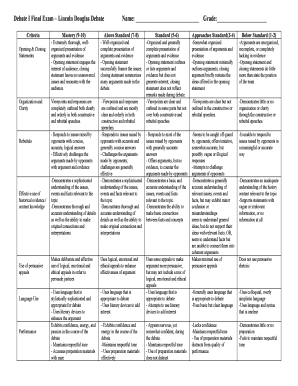
Get Lincoln Douglas Debate Rubric 2020-2026
How it works
-

Open form follow the instructions
-

Easily sign the form with your finger
-

Send filled & signed form or save
How to fill out the Lincoln Douglas Debate Rubric online
Filling out the Lincoln Douglas Debate Rubric online can enhance the evaluation process by providing structured feedback on debaters' performances. This guide offers comprehensive steps to assist users in accurately completing the rubric effectively and efficiently.
Follow the steps to successfully complete your Lincoln Douglas Debate Rubric online.
- Begin by selecting the ‘Get Form’ button to acquire the Lincoln Douglas Debate Rubric and open it in the relevant editor.
- Next, enter the participant’s name in the designated field, ensuring clarity in spelling and formatting.
- Proceed to assign a grade in the specified section. Review each scoring category and select the score that best reflects the debate performance.
- For each criterion, evaluate the performance based on the descriptors provided—ranging from mastery to below standard—and select the appropriate descriptor that aligns with the observed performances.
- Focus on detailed feedback for each category, such as opening and closing statements, organization, clarity, and use of evidence, to provide a comprehensive evaluation.
- Once all sections are completed and reviewed, users can save the changes made to the rubric to ensure they are stored correctly.
- Finally, users have options to download, print, or share the completed rubric for record-keeping or further review.
Take the next step in enhancing your debate evaluations by filling out the Lincoln Douglas Debate Rubric online!
Related links form
An example of a criterion in debate could be the principle of justice, which might be used to frame arguments in favor of or against a resolution. In the Lincoln Douglas Debate Rubric, using a clear criterion helps debaters articulate their perspectives effectively. A strong criterion not only guides the arguments presented but also enhances the judges' understanding of the debate's significance.