Loading
Get Ca Adr-107 2009-2026
How it works
-

Open form follow the instructions
-

Easily sign the form with your finger
-

Send filled & signed form or save
How to fill out the CA ADR-107 online
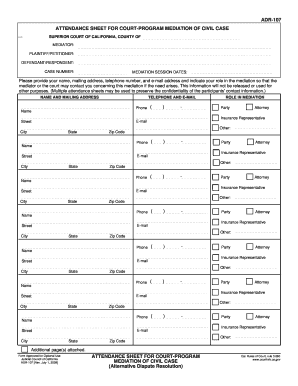
The CA ADR-107 form is an attendance sheet used for court-program mediation in civil cases. This guide provides clear instructions to help users complete the form accurately and efficiently in an online environment.
Follow the steps to successfully complete the CA ADR-107 form online.
- Click the ‘Get Form’ button to obtain the ADR-107 form and open it in your online editor.
- In the first section, fill in the mediator's name. This is the person facilitating the mediation process.
- Next, enter the names of the parties involved: the plaintiff or petitioner and the defendant or respondent. This identifies who is taking part in the mediation.
- Input the case number in the designated field. This is important for the court's records.
- For the mediation session dates, list the scheduled dates for the mediation sessions. This keeps track of the timeline for the mediation process.
- Provide your name, mailing address, telephone number, and email address in the designated fields to ensure the mediator or court can contact you if needed.
- Indicate your role in the mediation by selecting one of the options: party, attorney, insurance representative, or other. If applicable, attach additional pages to include more participants.
- After filling out all required sections, review the information for accuracy and completeness.
- Finally, save your changes, and you can download, print, or share the completed form as needed.
Complete your CA ADR-107 form online today for a smooth mediation process.
Mediation in California involves a neutral third-party mediator who helps conflicting parties reach a mutual agreement. Participants share their perspectives and interests, and the mediator facilitates communication to find common ground. For issues related to business disclosures like CA ADR-107, mediation can be a valuable tool to resolve disputes amicably, often saving time and costs associated with litigation.