Loading
Form preview
  • US Legal Forms
  • Form Library
  • Legal Forms
  • California Legal Forms
  • Ca Gc-360 2016

Get Ca Gc-360 2016-2026

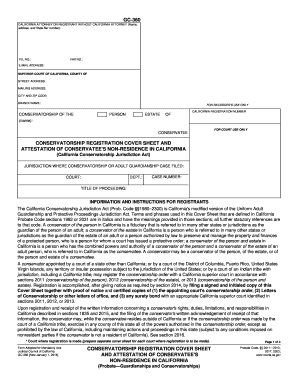
SS: MAILING ADDRESS: CITY AND ZIP CODE: BRANCH NAME: FOR RECORDER'S USE ONLY CONSERVATORSHIP OF THE PERSON ESTATE OF CALIFORNIA REGISTRATION NUMBER (name): FOR COURT USE ONLY CONSERVATEE CONSERVATORSHIP REGISTRATION COVER SHEET AND ATTESTATION OF CONSERVATEE'S NON-RESIDENCE IN CALIFORNIA (California Conservatorship Jurisdiction Act) JURISDICTION WHERE CONSERVATORSHIP OR ADULT GUARDIANSHIP CASE FILED: COURT: DEPT.: CASE NUMBER: TITLE OF PROCEEDING: INFORMATION AND INSTRUCTIONS FOR RE.

How it works

  1. Open form

    Open form follow the instructions

  2. Easily sign form

    Easily sign the form with your finger

  3. Share form

    Send filled & signed form or save

How to fill out the CA GC-360 online

Filling out the CA GC-360 form is an essential step in registering a conservatorship in California. This guide provides detailed instructions to help you complete the form accurately and efficiently, ensuring compliance with legal requirements.

Follow the steps to successfully complete the CA GC-360 online.

  1. Press the ‘Get Form’ button to access the CA GC-360 form and open it in your preferred online editor.
  2. Begin by providing your name, address, and state bar number if applicable, in the section labeled ‘California attorney or registrant without California attorney’. Also, include your phone number, fax number, and email address.
  3. Fill in the superior court information. Enter the county, street address, mailing address, city, zip code, and branch name where you intend to file the form.
  4. In the case details section, provide the conservatorship information, including the name of the conservatee and their California registration number.
  5. Indicate the jurisdiction where the conservatorship case was filed, along with the court name, department, and case number.
  6. Complete the registration criteria by initialing each statement confirming the conservatee's age, legal status regarding involuntary commitment, and the absence of a pending petition for conservatorship in California.
  7. Review the attached documents required for filing, ensuring you have certified copies of the conservatorship order, letters of guardianship, and proof of notice as specified in the form.
  8. Affirm the conservatee's non-residence status in California by signing and dating the attestation section. Ensure the declaration is completed under penalty of perjury.
  9. Once you have filled out all the required sections, save your changes, and either download, print, or share the form as needed.

Complete your CA GC-360 registration online today for a smoother conservatorship process.

Get form

Experience a faster way to fill out and sign forms on the web. Access the most extensive library of templates available.
Get form

Related content

Conservatorship Registration Cover Sheet and...
Conservatorship Registration Cover Sheet and Attestation of Conservatee's Non-Residence in...
Learn more
Case Status Online - Case Status Search
Use this tool to track the status of an immigration application, petition, or request. The...
Learn more
Manual de instalação: Micro Motion Model 2400S...
Montagem e instalação dos cabos. Os transmissores modelo 2400S são montados...
Learn more

Related links form

VA 770 2023 IRS 1065 - Schedule K-3 2023 PA DL-901 2014 VA 760-PMT 2023

Questions & Answers

Get answers to your most pressing questions about US Legal Forms API.

Contact support

The process to get conservatorship in California involves several steps, starting with filing the CA GC-360 form along with other necessary documents. After filing, you will attend a court hearing where you must prove that the person requires a conservator. The judge will then make a decision based on the evidence presented. Using US Legal Forms can simplify this process, ensuring that you have all forms and instructions to move forward confidently.

In California, the two types of conservatorship are general conservatorship and limited conservatorship. A general conservatorship is for individuals who cannot take care of their personal needs or finances. On the other hand, a limited conservatorship applies to individuals with developmental disabilities who may need assistance in specific areas. Understanding these differences is important, and you can find resources on US Legal Forms to help navigate your choices.

To put someone in a conservatorship in California, you first need to file the appropriate forms, including the CA GC-360. After filing, you must attend a court hearing where you'll present evidence demonstrating the necessity of conservatorship. If the court agrees, they will appoint you as the conservator. US Legal Forms provides step-by-step guidance for this process, making it simpler.

To initiate conservatorship in California, you will need several forms, including the CA GC-360 form. This form outlines your request for conservatorship and provides necessary details about the individual in need. Additionally, you will also need the CA GC-310 form and the CA GC-200 form, depending on your situation. By using US Legal Forms, you can easily access these documents and ensure they are filled out correctly.

A standard conservatorship applies to individuals who cannot manage their personal, medical, or financial affairs, while a Lanterman-Petris-Short (LPS) conservatorship is specifically for individuals with severe mental health disorders. The LPS conservatorship allows for treatment and care for those experiencing significant mental health challenges. Understanding these distinctions is crucial when considering the right type of support.

Recent changes to California's conservatorship laws emphasize protecting the rights of conservatees. These updates prioritize ensuring individuals in conservatorships have as much independence as possible. The CA GC-360 forms have been updated to reflect these changes, making it easier for families to navigate the process while respecting the rights of their loved ones.

Partial conservatorship focuses on specific areas instead of covering all aspects of a person's life. In this arrangement, the conservator only has authority over particular decisions, like medical care or financial management, while the conservatee retains more autonomy. This flexible option can better cater to the conservatee's needs and circumstances.

Limited conservatorship permits the conservatee to retain some control over their personal and financial decisions. It’s ideal for individuals with developmental disabilities who can manage certain aspects of their lives. In contrast, general conservatorship grants the conservator full authority to make decisions on behalf of the conservatee, covering all personal, medical, and financial matters.

When a conservator dies, the court must appoint a new conservator to ensure continuity in decision-making for the conservatee. The replacement may be a family member or another individual who has the conservatee's best interests at heart. The CA GC-360 process helps facilitate this transition smoothly, ensuring the conservatee remains protected.

In California, there are two main types of conservatorships: general conservatorship and limited conservatorship. A general conservatorship applies to individuals unable to care for themselves or manage their finances. Conversely, a limited conservatorship is designed for individuals with disabilities who can handle some of their personal affairs and need assistance with specific areas.

Get This Form Now!

Use professional pre-built templates to fill in and sign documents online faster. Get access to thousands of forms.
Get form
If you believe that this page should be taken down, please follow our DMCA take down processhere.
Get CA GC-360
Get form
  • Adoption
  • Bankruptcy
  • Contractors
  • Divorce
  • Home Sales
  • Employment
  • Identity Theft
  • Incorporation
  • Landlord Tenant
  • Living Trust
  • Name Change
  • Personal Planning
  • Small Business
  • Wills & Estates
  • Packages A-Z
  • Affidavits
  • Bankruptcy
  • Bill of Sale
  • Corporate - LLC
  • Divorce
  • Employment
  • Identity Theft
  • Internet Technology
  • Landlord Tenant
  • Living Wills
  • Name Change
  • Power of Attorney
  • Real Estate
  • Small Estates
  • Wills
  • All Forms
  • Forms A-Z
  • Form Library
  • Legal Hub
  • About Us
  • Help Portal
  • Legal Resources
  • Blog
  • Affiliates
  • Contact Us
  • Delete My Account
  • Site Map
  • Industries
  • Forms in Spanish
  • Localized Forms
  • State-specific Forms
  • Forms Kit
  • Real Estate Handbook
  • All Guides
  • Notarize
  • Incorporation services
  • For Consumers
  • For Small Business
  • For Attorneys
  • USLegal
  • FormsPass
  • pdfFiller
  • signNow
  • altaFlow
  • DocHub
  • Instapage
Form Packages
  • Adoption
  • Bankruptcy
  • Contractors
  • Divorce
  • Home Sales
  • Employment
  • Identity Theft
  • Incorporation
  • Landlord Tenant
  • Living Trust
  • Name Change
  • Personal Planning
  • Small Business
  • Wills & Estates
  • Packages A-Z
Form Categories
  • Affidavits
  • Bankruptcy
  • Bill of Sale
  • Corporate - LLC
  • Divorce
  • Employment
  • Identity Theft
  • Internet Technology
  • Landlord Tenant
  • Living Wills
  • Name Change
  • Power of Attorney
  • Real Estate
  • Small Estates
  • Wills
  • All Forms
  • Forms A-Z
  • Form Library
Customer Service
  • Legal Hub
  • About Us
  • Help Portal
  • Legal Resources
  • Blog
  • Affiliates
  • Contact Us
  • Delete My Account
  • Site Map
  • Industries
  • Forms in Spanish
  • Localized Forms
  • State-specific Forms
  • Forms Kit
Legal Guides
  • Real Estate Handbook
  • All Guides
Prepared for you
  • Notarize
  • Incorporation services
Our Customers
  • For Consumers
  • For Small Business
  • For Attorneys
Our Sites
  • USLegal
  • FormsPass
  • pdfFiller
  • signNow
  • altaFlow
  • DocHub
  • Instapage
Social Media
Call us now toll free:
+1 833 426 79 33
As seen in:
© Copyright 1999-2026 airSlate Legal Forms, Inc. 3720 Flowood Dr, Flowood, Mississippi 39232
  • Your Privacy Choices
  • Terms of Service
  • Privacy Notice
  • Content Takedown Policy
  • Bug Bounty Program