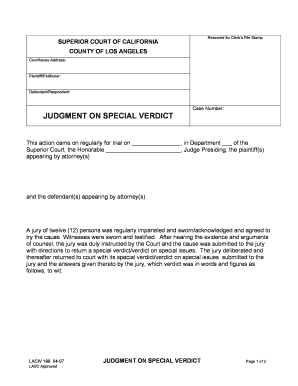
Get Ca Laciv 199 2007
How it works
-

Open form follow the instructions
-

Easily sign the form with your finger
-

Send filled & signed form or save
How to fill out the CA LACIV 199 online
The CA LACIV 199 form is essential for documenting a judgment based on a special verdict in legal cases within the Superior Court of California, County of Los Angeles. This guide provides clear, step-by-step instructions to help users complete the form accurately and efficiently online.
Follow the steps to fill out the CA LACIV 199 form online.
- Click the ‘Get Form’ button to obtain the CA LACIV 199 form and open it in your editor for completion.
- Begin by filling in the courthouse address at the top of the form, ensuring you provide the correct location where your case is being heard.
- Next, enter the plaintiff or petitioner name in the designated field, followed by the defendant or respondent name in the corresponding section. Be sure to use full legal names.
- Include the case number in the specific area provided; this is important for identifying your case within the court system.
- In the section that refers to the trial date, input the date the trial occurred, as well as the department number and the name of the presiding judge.
- Detail the special verdict as returned by the jury, quoting it verbatim in the dedicated space. Accuracy here is crucial since it reflects the jury's decision.
- Indicate the party entitled to judgment against the opposing party. Fill in the names and specify whether it’s the plaintiff, defendant, cross-complainant, or cross-defendant.
- Clearly state the damages awarded, including any punitive damages and interest owed, along with costs and disbursements, ensuring all amounts are accurately noted.
- Lastly, review all information for completeness and accuracy. Once you have confirmed that the form is correctly filled out, you can choose to save the changes, download, print, or share the completed form.
Take the next step in your legal process and complete your documents online today.
Get form
In civil cases, juries do not need to be unanimous. Most often, a majority of jurors can reach a verdict, facilitating quicker resolutions to civil disputes. This approach helps balance the time spent in court with the need for fair representation in decision-making. If you're seeking clarity on the jury requirements, CA LACIV 199 serves as an excellent tool for your legal journey.