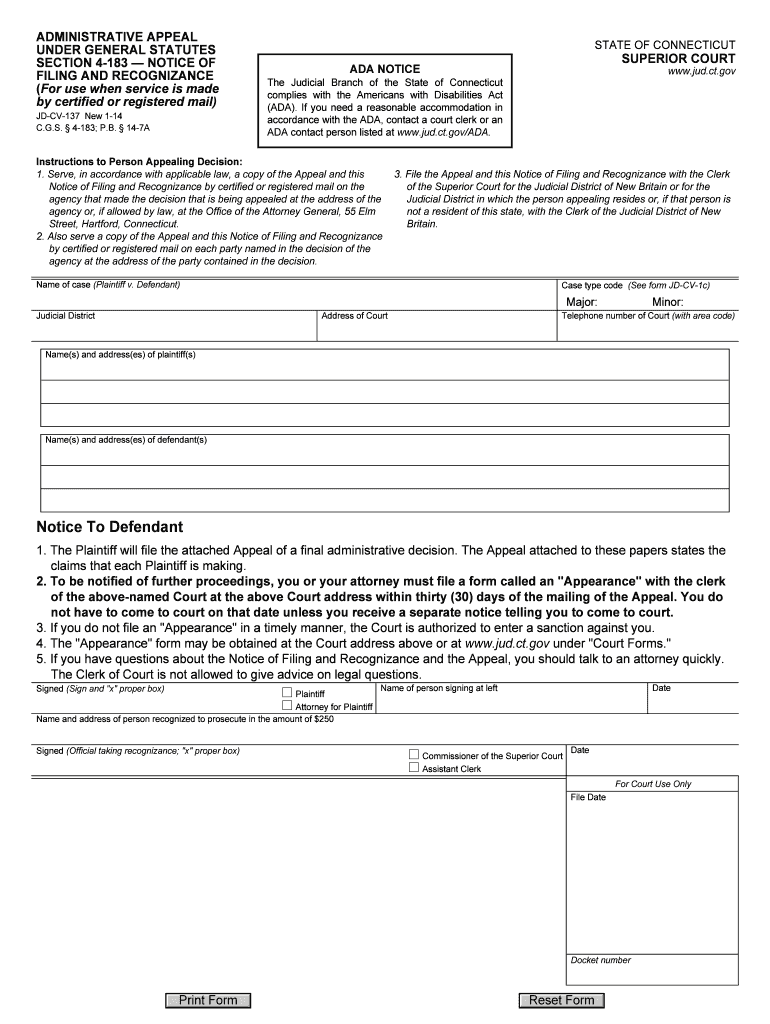
14-7A STATE OF CONNECTICUT www.jud.ct.gov The Judicial Branch of the State of Connecticut complies with the Americans with Disabilities Act (ADA). If you need a reasonable accommodation in accordance with the ADA, contact a court clerk or an ADA contact person listed at www.jud.ct.gov/ADA. Instructions to Person Appealing Decision: 1. Serve, in accordance with applicable law, a copy of the Appeal and this Notice of Filing and Recognizance by certified or registered mail on the agency tha.

Open form follow the instructions

Easily sign the form with your finger

Send filled & signed form or save
How to fill out the CT JD-CV-137 online
The CT JD-CV-137 form is a critical document used for filing an administrative appeal in Connecticut. This guide provides step-by-step instructions to assist users in completing the form accurately and efficiently while filing online.
Follow the steps to fill out the CT JD-CV-137 accurately.
- Press the ‘Get Form’ button to access the CT JD-CV-137 form and open it in your online editor.
- Enter the name of the case in the format 'Plaintiff v. Defendant'. Ensure this is accurately entered, as it is a fundamental component of your filing.
- Select the appropriate judicial district from the designated options, indicating where the court case will be filed.
- Fill in the case type code by referencing form JD-CV-1c. This classification helps in identifying the nature of the case.
- Provide the address of the court, ensuring it matches the judicial district selected, along with the telephone number of the court, including the area code.
- List the names and addresses of all plaintiffs involved in the case. Ensure the information is accurate and complete.
- Similarly, enter the names and addresses of all defendants, as this information is vital for the notification process.
- Review the notice to defendants section, which informs them about the filing of the appeal and additional required actions they must take.
- Next, sign and date the form as the plaintiff or the attorney representing the plaintiff. Ensure the correct box is checked to indicate your status.
- Indicate the name and address of the person recognized to prosecute in the specified amount. This is necessary for the recognizance process.
- Once all sections are completed, save your changes. You can also choose to download, print, or share the form as needed.
Complete your CT JD-CV-137 form online today to ensure a smooth filing process.
Experience a faster way to fill out and sign forms on the web. Access the most extensive library of templates available.
Related content
The Appeal attached to these papers states the claims that the Plaintiff is making. 2. To...
May 6, 2022 — Former President Donald J. Trump, the American Conservative Union, and...
EPIDEMIOLOGY, AETIOLOGY AND PATHOLOGY. 11. 3.1. Epidemiology. 11. 3.2. Aetiology. 11...
Get answers to your most pressing questions about US Legal Forms API.
When to file certificate of closed pleadings CT?
You should file the certificate of closed pleadings in Connecticut immediately after all parties have submitted their pleadings and before moving on to trial. This document is necessary to confirm that the case has reached a stage where it can be duly adjudicated. Incorporating the CT JD-CV-137 form can assist you in efficiently managing this aspect of your legal process.
What does it mean when pleadings are closed?
When pleadings are closed, it signifies that all claims and defenses have been formally presented, preventing any additional pleadings from being filed. This closure is a vital step before trial proceedings can begin. Using forms such as CT JD-CV-137 can help ensure that your pleadings are properly documented and submitted on time.
What does a certificate of closed pleadings mean?
A certificate of closed pleadings indicates that all parties have finished submitting their pleadings in a case. This document is often a prerequisite for moving forward with trial procedures. When preparing filings like CT JD-CV-137, it’s important to include this certificate to confirm that the case is ready for resolution.
How long does it take to file an appeal in CT?
In Connecticut, the time frame to file an appeal typically spans 20 days following the final judgment. It's essential to act swiftly and adhere to this timeline to maintain your rights. Utilizing resources like CT JD-CV-137 can streamline this process and assist in ensuring compliance with all necessary legal procedures.
What is Section 10 35 of the CT practice book?
Section 10 35 of the CT Practice Book outlines the rules regarding motions to strike. Essentially, it allows a party to challenge the legal sufficiency of the opposing party's complaint or any portion of it. Understanding this section is crucial when dealing with legal documents like CT JD-CV-137, as it helps ensure that all pleadings are properly aligned with state law.
How can I avoid paying a judgment?
Avoiding payment on a judgment can involve legitimate strategies, such as appealing the judgment or negotiating a settlement. It is vital to respond appropriately to judgments using forms like the CT JD-CV-137, which can assist in presenting your case. Consulting with a legal professional can provide more tailored advice based on your circumstances.
How long does a judgment lien last in CT?
In Connecticut, a judgment lien lasts for a period of 20 years, but it is important to note that it can be renewed. If you want to challenge or manage a judgment lien, the CT JD-CV-137 form may be essential in your efforts. Understanding the duration and renewal process can help you make informed financial decisions.
How to serve a small claims writ and notice of suit in CT?
To serve a small claims writ and notice of suit in Connecticut, you must first complete the proper paperwork, including the CT JD-CV-137. After completing the documents, you can serve them through a state marshal or a suitable individual authorized to carry out the service. Properly following these steps is critical to ensure your case proceeds smoothly.
What is the statute of limitations in CT for small claims court?
The statute of limitations in Connecticut for small claims is generally six years from the date of the incident. This timeline applies to most types of claims you may file in small claims court. Understanding this time frame is essential, ensuring you file your CT JD-CV-137 form before the period expires. Always consider seeking legal advice if you're unsure about your specific situation.
Do I need to wear a suit to small claims court?
In small claims court, you do not need to wear a suit, but dressing neatly can positively influence how others perceive you. The CT JD-CV-137 does not have specific dress requirements, but it is advisable to present yourself well. A tidy appearance shows respect for the court process. Ultimately, comfort is key, so choose attire that allows you to feel at ease.
Use professional pre-built templates to fill in and sign documents online faster. Get access to thousands of forms.
If you believe that this page should be taken down, please follow our DMCA take down process here.