Loading
Form preview
  • US Legal Forms
  • Other Templates
  • Legal Forms
  • Connecticut Legal Forms
  • Ct Jd-hm-34 2000

Get Ct Jd-hm-34 2000-2026

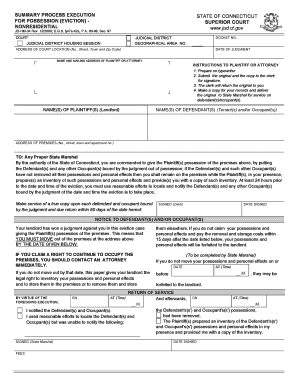
DICIAL DISTRICT GEOGRAPHICAL AREA NO. JUDICIAL DISTRICT HOUSING SESSION ADDRESS OF COURT LOCATION (No., Street, Town and Zip Code) DATE OF JUDGMENT NAME AND MAILING ADDRESS OF PLAINTIFF OR ATTORNEY INSTRUCTIONS TO PLAINTIFF OR ATTORNEY 1. Prepare on typewriter. 2. Submit the original and the copy to the clerk for signature. 3. The clerk will return the original to you. 4. Make a copy for your records and deliver the original to State Marshal for service on defendant(s)/occupant(s). NAME(S).

How it works

  1. Open form

    Open form follow the instructions

  2. Easily sign form

    Easily sign the form with your finger

  3. Share form

    Send filled & signed form or save

How to fill out the CT JD-HM-34 online

Filling out the CT JD-HM-34 form is a crucial step in the eviction process in the State of Connecticut. This guide provides a clear and comprehensive overview of each section of the form to assist users in completing it accurately and efficiently.

Follow the steps to complete the CT JD-HM-34 online

  1. Press the ‘Get Form’ button to access the CT JD-HM-34 form and open it in the editor.
  2. Identify the court details and fill in the docket number, judicial district, geographical area number, and address of the court location.
  3. Enter the date of judgment in the designated field.
  4. Provide the name and mailing address of the plaintiff or attorney, ensuring all details are accurate and up-to-date.
  5. Fill in the names of the plaintiff(s) (landlord) in the specified section.
  6. List the names of the defendant(s) (tenant(s) and/or occupant(s)) in the appropriate field.
  7. Complete the address of the premises, including the number, street, town, and apartment number if applicable.
  8. Review the instructions for the plaintiff or attorney to ensure compliance: prepare on a typewriter, submit forms to the clerk for signature, and make a copy for personal records.
  9. If applicable, ensure that the proper state marshal is indicated to execute the eviction.
  10. Double-check all entered information for accuracy before finalizing.
  11. Once the form is complete, save your changes, and you will have the option to download, print, or share the form as needed.

Complete your CT JD-HM-34 form online today to streamline your eviction process.

Get form

Experience a faster way to fill out and sign forms on the web. Access the most extensive library of templates available.
Get form

Related content

NONRESIDENTIAL - Connecticut Judicial Branch...
The process involves filing the form, a State Marshal giving possession to the landlord, a...
Learn more
Connecticut Journal of International Law Volume 34...
Officers of Administration. Susan Herbst, Ph.D., President, University of Connecticut...
Learn more
Primary Urethral Carcinoma - Cloudfront.net
Imaging work-up should include computed tomography of the chest, abdomen and pelvis for...
Learn more

Related links form

VA 0857g 2024 OR OR-LB-50 2022 CA Checklist 10 Default/Waiver Of Rights - County Of Sonoma 2025 NY MV-45U 2021

Questions & Answers

Get answers to your most pressing questions about US Legal Forms API.

Contact support

In Connecticut, the earliest you can begin eviction proceedings typically follows the issuance of a notice to quit, as defined by CT JD-HM-34. Usually, if there has been no response from the tenant within the stipulated period of the notice, the eviction can commence. However, it’s important to follow the legal process thoroughly to avoid complications. Utilizing a platform like uslegalforms can guide you through the necessary steps to comply with these laws.

In Connecticut, the validity of a notice to quit largely depends on the type of lease agreement. Generally, a notice remains valid for a period defined by CT JD-HM-34, which is typically a minimum of 3 days for non-payment of rent. However, for other lease violations, the timeframe may vary. It's essential to adhere to the specific regulations outlined in CT JD-HM-34 to ensure enforcement.

A notice to quit is a legal document that informs a tenant they must vacate the property, while eviction is the legal process that enforces this action. The notice to quit, under CT JD-HM-34, serves as a preliminary step and notifies the tenant of the intent to terminate the lease. Eviction, on the other hand, requires court intervention if the tenant does not leave voluntarily. Understanding this distinction is crucial to any tenant-landlord situation.

A notice to quit can be deemed invalid in Connecticut primarily due to incorrect information or improper delivery. If the notice is not issued in line with the state's requirements outlined in CT JD-HM-34, it may not hold up in court. Common issues include missing signatures, incorrect tenant names, or failure to provide the required time period for compliance. Ensuring compliance with CT JD-HM-34 can help prevent these issues.

To fight an eviction in Connecticut, you should file an appearance in court and present your defense during the hearing. Consider gathering evidence, documents, and witnesses to strengthen your case. Understanding your rights under the CT JD-HM-34 law can be beneficial, and platforms like UsLegalForms can help you prepare the necessary paperwork and navigate the legal process effectively.

A 3-day notice to quit in Connecticut serves as a formal request for tenants to leave the rental property due to lease violations or non-payment of rent. This notice informs tenants about the urgency of resolving the issue, and if they do not comply, landlords may begin the eviction process. It's important to address this notice immediately and understand your rights under CT JD-HM-34.

If you fail to attend court for an eviction hearing, the judge may issue a default judgment in favor of your landlord. This means you could lose your case without presenting your side, potentially leading to an eviction. Engaging with the court process is crucial to protect your rights and understand your options under the CT JD-HM-34 law.

The eviction timeline in Connecticut generally spans several weeks to months, depending on various factors. After filing for eviction, landlords must wait for a court hearing, where they must present evidence supporting their case. Once the court issues an eviction order, the tenant typically has a few days to vacate the premises, all outlined in accordance with CT JD-HM-34.

In Connecticut, a landlord cannot evict a tenant without a court order. The eviction process requires legal proceedings, which are guided by the CT JD-HM-34 law to protect tenants from unlawful evictions. If you're facing potential eviction, it's crucial to understand your rights and seek legal advice to navigate the situation properly.

The new tenant law in Connecticut, known as CT JD-HM-34, aims to enhance tenant rights and clarify rental agreements. This law introduces specific guidelines for landlords regarding rental increases, security deposits, and tenant notifications. Understanding these regulations is essential for both tenants and landlords to ensure compliance and foster positive relationships.

Get This Form Now!

Use professional pre-built templates to fill in and sign documents online faster. Get access to thousands of forms.
Get form
If you believe that this page should be taken down, please follow our DMCA take down processhere.
Get CT JD-HM-34
Get form
  • Adoption
  • Bankruptcy
  • Contractors
  • Divorce
  • Home Sales
  • Employment
  • Identity Theft
  • Incorporation
  • Landlord Tenant
  • Living Trust
  • Name Change
  • Personal Planning
  • Small Business
  • Wills & Estates
  • Packages A-Z
  • Affidavits
  • Bankruptcy
  • Bill of Sale
  • Corporate - LLC
  • Divorce
  • Employment
  • Identity Theft
  • Internet Technology
  • Landlord Tenant
  • Living Wills
  • Name Change
  • Power of Attorney
  • Real Estate
  • Small Estates
  • Wills
  • All Forms
  • Forms A-Z
  • Other Templates
  • Legal Hub
  • About Us
  • Help Portal
  • Legal Resources
  • Blog
  • Affiliates
  • Contact Us
  • Delete My Account
  • Site Map
  • Industries
  • Forms in Spanish
  • Localized Forms
  • State-specific Forms
  • Forms Kit
  • Real Estate Handbook
  • All Guides
  • Notarize
  • Incorporation services
  • For Consumers
  • For Small Business
  • For Attorneys
  • USLegal
  • FormsPass
  • pdfFiller
  • signNow
  • altaFlow
  • DocHub
  • Instapage
Form Packages
  • Adoption
  • Bankruptcy
  • Contractors
  • Divorce
  • Home Sales
  • Employment
  • Identity Theft
  • Incorporation
  • Landlord Tenant
  • Living Trust
  • Name Change
  • Personal Planning
  • Small Business
  • Wills & Estates
  • Packages A-Z
Form Categories
  • Affidavits
  • Bankruptcy
  • Bill of Sale
  • Corporate - LLC
  • Divorce
  • Employment
  • Identity Theft
  • Internet Technology
  • Landlord Tenant
  • Living Wills
  • Name Change
  • Power of Attorney
  • Real Estate
  • Small Estates
  • Wills
  • All Forms
  • Forms A-Z
  • Other Templates
Customer Service
  • Legal Hub
  • About Us
  • Help Portal
  • Legal Resources
  • Blog
  • Affiliates
  • Contact Us
  • Delete My Account
  • Site Map
  • Industries
  • Forms in Spanish
  • Localized Forms
  • State-specific Forms
  • Forms Kit
Legal Guides
  • Real Estate Handbook
  • All Guides
Prepared for you
  • Notarize
  • Incorporation services
Our Customers
  • For Consumers
  • For Small Business
  • For Attorneys
Our Sites
  • USLegal
  • FormsPass
  • pdfFiller
  • signNow
  • altaFlow
  • DocHub
  • Instapage
Social Media
Call us now toll free:
+1 833 426 79 33
As seen in:
© Copyright 1999-2026 airSlate Legal Forms, Inc. 17 Station Street, Ste. 203, Brookline, MA 02445
  • Your Privacy Choices
  • Terms of Service
  • Privacy Notice
  • Content Takedown Policy
  • Bug Bounty Program