Loading
Form preview
  • US Legal Forms
  • Form Library
  • Legal Forms
  • Connecticut Legal Forms
  • Ct Pc-443 2016

Get Ct Pc-443 2016-2026

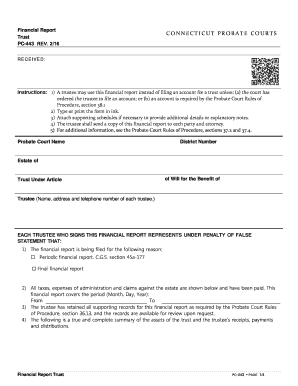
: (a) the court has ordered the trustee to file an account; or (b) an account is required by the Probate Court Rules of Procedure, section 38.1 2) Type or print the form in ink. 3) Attach supporting schedules if necessary to provide additional details or explanatory notes. 4) The trustee shall send a copy of this financial report to each party and attorney. 5) For additional information, see the Probate Court Rules of Procedure, sections 37.2 and 37.4. Probate Court Name District Number Estate.

How it works

  1. Open form

    Open form follow the instructions

  2. Easily sign form

    Easily sign the form with your finger

  3. Share form

    Send filled & signed form or save

How to fill out the CT PC-443 online

The CT PC-443 is a financial report form used in Connecticut probate courts, which allows trustees to report financial activities of a trust. This guide will provide you with comprehensive instructions on how to accurately complete the form online.

Follow the steps to complete the CT PC-443 financial report.

  1. Press the ‘Get Form’ button to access the CT PC-443 form and open it in the designated editor.
  2. Fill in the probate court name and district number at the top of the form to identify the court where the report is being filed.
  3. Enter the estate name and the trust under which the report is being filed, ensuring accurate reference to the respective documents.
  4. Provide the name, address, and telephone number of each trustee involved in managing the trust, ensuring all contact information is current.
  5. Indicate the reason for filing—whether it is a periodic or final financial report—by checking the appropriate box.
  6. Specify the period covered by this report by filling in the start and end dates for the financial activities.
  7. List all supporting records retained for this report as required, making sure these records are available for review if necessary.
  8. Complete the assets and income received section by entering the total amount reported, any additional assets received, and income details, such as interest, dividends, and other relevant sources.
  9. Fill in the administration expenses paid section by detailing all relevant costs, including fees for fiduciaries, attorneys, accounting expenses, and taxes.
  10. Detail any distributions made to beneficiaries during the reporting period, including the fair market value and basis for the distributions, as required.
  11. Verify the total assets on hand at the end of the accounting period, ensuring clarity on valuation methods used.
  12. Each trustee must sign and date the report, ensuring that the representations made are true and accurate.
  13. Certify that a copy of this financial report was sent to all relevant parties by filling out the certification section with names and addresses.
  14. After completing the form, save your changes, and choose your preferred option to download, print, or share the completed report as needed.

Take the next step in managing your trust and complete your CT PC-443 online today.

Get form

Experience a faster way to fill out and sign forms on the web. Access the most extensive library of templates available.
Get form

Related content

Financial Report Trust PC-443 REV. 2/16
EACH TRUSTEE REQUESTS: (1) approval of this financial report; (2) approval of any proposed...
Learn more
Clinical Healthcare Management Certificate...
CLM 443: Leadership: Strategic Planning in Healthcare (3). CLM 444: Leadership: Human...
Learn more
Instalação Operação Manutenção
Software Trane Drive Utility - possui fácil acesso ao PC via porta USB para fácil...
Learn more

Related links form

CA EJ-157 2021 CA GC-356 2025 CA GC-325 2025 CA SV-715 2024 CA WG-022 2007

Questions & Answers

Get answers to your most pressing questions about US Legal Forms API.

Contact support

To initiate probate in Connecticut, you first need to file the will, if there is one, along with the CT PC-443 form at the probate court in your area. This step establishes the legal framework for managing the deceased's estate. Once filed, the court will review and appoint a personal representative to oversee the estate administration. It’s advisable to familiarize yourself with the procedures to avoid any potential pitfalls.

In Connecticut, you must file probate within 30 days after the death of the individual. This timeframe is crucial to ensure that the estate is handled efficiently. Delays in filing could lead to complications, especially if the estate includes properties or significant assets. Using the CT PC-443 form can help streamline this process.

Yes, you can avoid probate in Connecticut through various methods, such as establishing trust arrangements or ensuring account designations like payable-on-death (POD). These strategies allow assets to pass directly to designated individuals. For more comprehensive insights on CT PC-443 and how to effectively navigate probate avoidance, US Legal Forms is an excellent resource to explore.

Joint bank accounts in Connecticut usually pass directly to the surviving account holder, avoiding probate. This non-probate transfer is beneficial for many, ensuring a smoother transition of assets. If you have questions about this aspect or CT PC-443, consider exploring resources available on US Legal Forms to get the clarity you need.

In Connecticut, the general rule is that if an estate's value exceeds $40,000, it typically must go through probate. This amount can include all assets owned at the time of death. If you're unsure about your specific situation, it may be beneficial to consult legal resources or platforms like US Legal Forms for guidance on CT PC-443 and probate laws.

In Connecticut, you should ideally file for probate within 30 days of a person’s death. Though the law allows some flexibility, timely filing is crucial to starting the administration process. Delaying probate can lead to complications and disputes among heirs. By acting promptly, you can help ensure a more efficient administration of the estate.

Having a will in Connecticut does not automatically exempt you from probate. While a will directs how your assets should be distributed, the estate must still go through the probate process to validate the will. However, having a clear and legally executed will can expedite probate. Understanding these dynamics can make the process smoother for beneficiaries.

A will in Connecticut must meet several key requirements to be valid. It must be in writing, signed by the testator, and witnessed by at least two individuals. Additionally, the testator must have the legal capacity to make a will and demonstrate clear intent. Following CT PC-443 guidelines helps ensure that your will withstands legal scrutiny.

To execute a will in Connecticut, follow the guidelines set forth in CT PC-443. You need to ensure the will is signed by you in the presence of at least two witnesses, who must also sign it. It’s also advisable to consider having a notarized self-proving affidavit, which can simplify the probate process later. Taking these steps can make the execution straightforward.

In Connecticut, an executor generally has 18 months to settle an estate, according to CT PC-443 regulations. This timeframe includes gathering assets, paying debts, and distributing the remaining assets to beneficiaries. However, complexity and specific circumstances can extend this period. Being organized and proactive can expedite the settlement process.

Get This Form Now!

Use professional pre-built templates to fill in and sign documents online faster. Get access to thousands of forms.
Get form
If you believe that this page should be taken down, please follow our DMCA take down processhere.
Get CT PC-443
Get form
  • Adoption
  • Bankruptcy
  • Contractors
  • Divorce
  • Home Sales
  • Employment
  • Identity Theft
  • Incorporation
  • Landlord Tenant
  • Living Trust
  • Name Change
  • Personal Planning
  • Small Business
  • Wills & Estates
  • Packages A-Z
  • Affidavits
  • Bankruptcy
  • Bill of Sale
  • Corporate - LLC
  • Divorce
  • Employment
  • Identity Theft
  • Internet Technology
  • Landlord Tenant
  • Living Wills
  • Name Change
  • Power of Attorney
  • Real Estate
  • Small Estates
  • Wills
  • All Forms
  • Forms A-Z
  • Form Library
  • Legal Hub
  • About Us
  • Help Portal
  • Legal Resources
  • Blog
  • Affiliates
  • Contact Us
  • Delete My Account
  • Site Map
  • Industries
  • Forms in Spanish
  • Localized Forms
  • State-specific Forms
  • Forms Kit
  • Real Estate Handbook
  • All Guides
  • Notarize
  • Incorporation services
  • For Consumers
  • For Small Business
  • For Attorneys
  • USLegal
  • FormsPass
  • pdfFiller
  • signNow
  • altaFlow
  • DocHub
  • Instapage
Form Packages
  • Adoption
  • Bankruptcy
  • Contractors
  • Divorce
  • Home Sales
  • Employment
  • Identity Theft
  • Incorporation
  • Landlord Tenant
  • Living Trust
  • Name Change
  • Personal Planning
  • Small Business
  • Wills & Estates
  • Packages A-Z
Form Categories
  • Affidavits
  • Bankruptcy
  • Bill of Sale
  • Corporate - LLC
  • Divorce
  • Employment
  • Identity Theft
  • Internet Technology
  • Landlord Tenant
  • Living Wills
  • Name Change
  • Power of Attorney
  • Real Estate
  • Small Estates
  • Wills
  • All Forms
  • Forms A-Z
  • Form Library
Customer Service
  • Legal Hub
  • About Us
  • Help Portal
  • Legal Resources
  • Blog
  • Affiliates
  • Contact Us
  • Delete My Account
  • Site Map
  • Industries
  • Forms in Spanish
  • Localized Forms
  • State-specific Forms
  • Forms Kit
Legal Guides
  • Real Estate Handbook
  • All Guides
Prepared for you
  • Notarize
  • Incorporation services
Our Customers
  • For Consumers
  • For Small Business
  • For Attorneys
Our Sites
  • USLegal
  • FormsPass
  • pdfFiller
  • signNow
  • altaFlow
  • DocHub
  • Instapage
Social Media
Call us now toll free:
+1 833 426 79 33
As seen in:
© Copyright 1999-2026 airSlate Legal Forms, Inc. 3720 Flowood Dr, Flowood, Mississippi 39232
  • Your Privacy Choices
  • Terms of Service
  • Privacy Notice
  • Content Takedown Policy
  • Bug Bounty Program