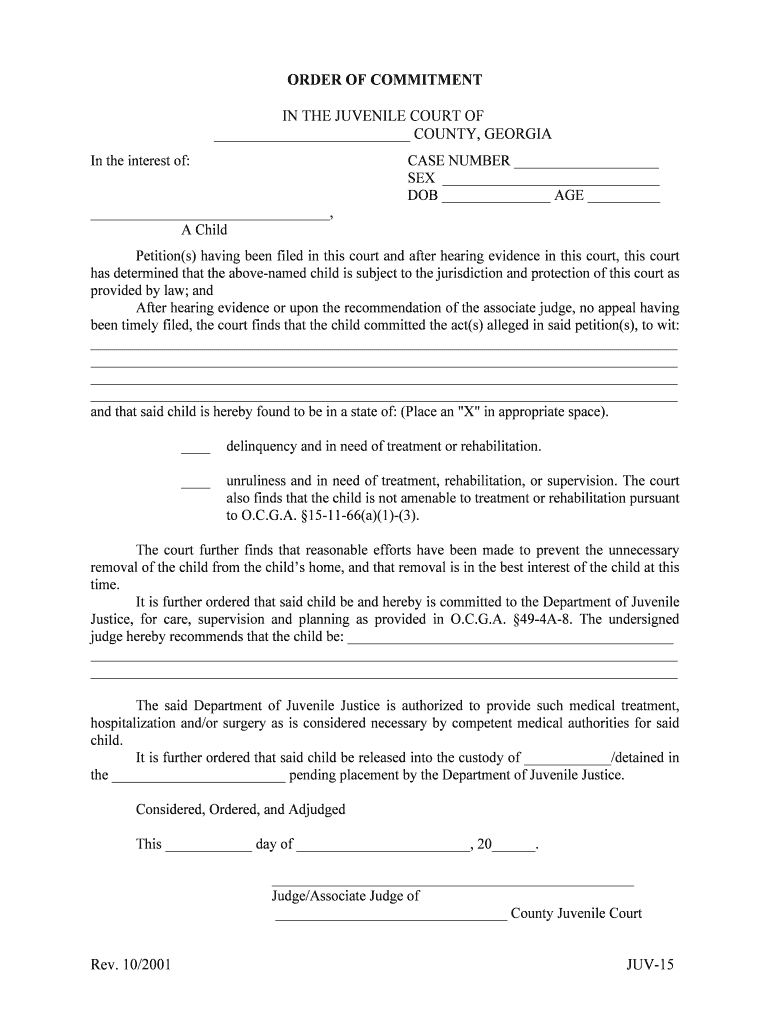
, A Child Petition(s) having been filed in this court and after hearing evidence in this court, this court has determined that the above-named child is subject to the jurisdiction and protection of this court as provided by law; and After hearing evidence or upon the recommendation of the associate judge, no appeal having been timely filed, the court finds that the child committed the act(s) alleged in said petition(s), to wit:.
Loading

Open form follow the instructions

Easily sign the form with your finger

Send filled & signed form or save
How to fill out the GA JUV-15 online
The GA JUV-15 form is an official document used in juvenile court proceedings concerning the commitment of a minor. This guide provides a clear, step-by-step approach to help users fill out the form accurately and efficiently.
Follow the steps to successfully complete the GA JUV-15 online.
- Click 'Get Form' button to obtain the form and open it in the online editor.
- Fill in the county name where the juvenile court is located in the first line of the form.
- Enter the case number assigned to the petition in the designated field.
- Indicate the sex of the child by choosing the appropriate option provided.
- Complete the date of birth and age fields with the correct information about the child.
- Describe the act(s) the child is alleged to have committed in the appropriate space, ensuring to provide accurate and detailed information.
- Select the child's state by placing an 'X' in the box that corresponds to either delinquency or unruliness.
- Include the judge's recommendations about the child, ensuring to fill in any necessary treatment or rehabilitation details.
- Specify whether the child will be released into custody or detained pending placement, filling in the necessary information.
- Review all information entered to ensure accuracy and completeness before finalizing the form.
- Save any changes made to the form, and utilize the options available to download, print, or share the completed document.
Complete the GA JUV-15 form online today to ensure proper processing of your case.
Experience a faster way to fill out and sign forms on the web. Access the most extensive library of templates available.
Related content
DEPENDENCY REMOVAL ORDER. A complaint has been made to the Court concerning the...
Julgado: Uma decisão formal emitida por um juiz. Delinquente: Um menor que comete uma...
Carefully supervise young children when they are in the room with the heater. 15. Do not...
Get answers to your most pressing questions about US Legal Forms API.
At what age are you no longer considered a juvenile in Georgia?
In Georgia, individuals are considered juveniles until they turn 17 years old. Once they reach this age, they are tried as adults for offenses committed after their birthday. However, some exceptions exist for serious crimes committed by younger individuals. Understanding the implications of the GA JUV-15 age threshold is essential for anyone involved in juvenile justice matters.
What are the steps of juvenile detainment?
The steps of juvenile detainment in Georgia begin with an arrest by law enforcement, followed by a detention hearing to determine if the juvenile should remain in custody. During this hearing, the court considers factors like the seriousness of the offense and flight risk. If detained, the juvenile will be held in a facility until their court date. Familiarizing yourself with GA JUV-15 can help clarify this often stressful process.
Who is responsible for juvenile justice in Georgia?
Juvenile justice in Georgia is managed by multiple agencies, including the Department of Juvenile Justice and local court systems. These agencies collaborate to oversee the treatment and rehabilitation of juvenile offenders. They also strive to prevent future offenses through various programs and approaches. Looking into GA JUV-15 can help you navigate these resources effectively.
What are the three types of cases handled in juvenile court?
Juvenile courts in Georgia typically handle three types of cases: status offenses, delinquency cases, and dependency cases. Status offenses include actions that are not crimes for adults, such as truancy. Delinquency cases involve minors accused of committing crimes. Understanding the various case types under GA JUV-15 can help you know what to expect during legal proceedings.
How to get a Guardian ad litem in Georgia?
To obtain a Guardian ad litem in Georgia, you must request one through the juvenile court. This request can be made during the initial stages of a court case involving a juvenile. A Guardian ad litem represents the child's best interests throughout the legal process. Knowing the GA JUV-15 guidelines will assist you in ensuring that the proper steps are taken.
Who usually decides what charges to bring against the juvenile?
The decision regarding charges against a juvenile is usually made by the district attorney's office in Georgia. Prosecutors review the evidence and decide the appropriate charges based on the situation. They work closely with law enforcement and may consider the juvenile's background. Familiarizing yourself with GA JUV-15 can provide insight into how these decisions are made.
Who can file a juvenile complaint in Georgia?
In Georgia, any individual with knowledge of a juvenile’s criminal activity can file a juvenile complaint. This includes parents, guardians, or responsible adults who observe concerning behavior. Filing a complaint typically involves submitting necessary documents to the juvenile court. Understanding the GA JUV-15 process can help make this step more straightforward.
How to file a petition in juvenile court?
Filing a petition in juvenile court involves completing the necessary forms, clearly outlining the reasons for the petition and the relief sought. You should submit this petition to the appropriate court in your county. Utilizing platforms like USLegalForms can simplify this process and ensure that you are adhering to GA JUV-15 standards, thereby increasing the chances of a favorable outcome.
What are the steps of the juvenile justice process?
The juvenile justice process generally begins with an arrest, followed by a detention hearing to decide if the youth should remain in custody. Next, there is an adjudicatory hearing where evidence is presented, and the judge determines if the charges are valid. If there is a finding of delinquency, a dispositional hearing occurs to determine the appropriate consequences. Understanding these steps is crucial, especially if you're navigating the GA JUV-15 guidelines.
How does Juvenile Court work in Georgia?
Juvenile Court in Georgia aims to balance accountability and rehabilitation for minors. The process involves various stages, such as initial hearings and potential counseling services, focusing on the juvenile's needs. Families involved in this system can benefit from understanding how GA JUV-15 shapes these proceedings and offers guidance to ensure fair treatment.
Use professional pre-built templates to fill in and sign documents online faster. Get access to thousands of forms.
If you believe that this page should be taken down, please follow our DMCA take down process here.