Loading
Form preview
  • US Legal Forms
  • Other Templates
  • Legal Forms
  • Nebraska Legal Forms
  • Ne Dc 6:5.32 2015

Get Ne Dc 6:5.32 2015

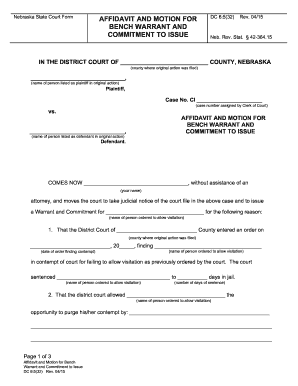
COUNTY, NEBRASKA (county where original action was filed) , (name of person listed as plaintiff in original action) Plaintiff, Case No. CI (case number assigned by Clerk of Court) vs. AFFIDAVIT AND MOTION FOR BENCH WARRANT AND COMMITMENT TO ISSUE , (name of person listed as defendant in original action) Defendant. COMES NOW , without assistance of an (your name) att.

How it works

  1. Open form

    Open form follow the instructions

  2. Easily sign form

    Easily sign the form with your finger

  3. Share form

    Send filled & signed form or save

How to fill out the NE DC 6:5.32 online

This guide provides clear, step-by-step instructions for completing the NE DC 6:5.32 form, also known as the Affidavit and Motion for Bench Warrant and Commitment to Issue, online. Designed for users of all experiences, this resource will help you navigate the necessary fields accurately and efficiently.

Follow the steps to successfully complete the NE DC 6:5.32 form.

  1. Press the ‘Get Form’ button to obtain the form and open it in your online document management interface.
  2. Enter the county where the original action was filed in the designated field under 'IN THE DISTRICT COURT OF'.
  3. Fill in the name of the person listed as the plaintiff in the original action where indicated.
  4. Input the case number assigned by the Clerk of Court in the provided space.
  5. Complete the section listing the name of the person identified as the defendant in the original action.
  6. In the paragraph starting with 'COMES NOW', insert your name in the appropriate space.
  7. State the name of the person ordered to allow visitation in the blank provided in the sentence beginning 'Warrant and Commitment for'.
  8. Include the date of the court order that found the person in contempt and specify their name in the respective sections.
  9. Provide the number of days the court sentenced the person to serve in jail following the contempt finding.
  10. Describe the conditions laid out by the court for the person to purge their contempt in the space provided.
  11. Confirm and reiterate that the person has failed to comply with the visitation required by the purge plan.
  12. Complete the 'Date' section and sign the form with your full name, street address or P.O. Box, city/state/ZIP code, and phone number.
  13. Fill in your email address in the space provided.
  14. In the verification section, write your full name and the county where the verification is signed.
  15. Sign the verification statement and date it appropriately.
  16. Ensure that a notary public subscribes and notarizes the document where indicated.
  17. After completing all fields, you can save the changes, download, print, or share the form as needed.

Complete the necessary court documents online with confidence and clarity.

Get form

Experience a faster way to fill out and sign forms on the web. Access the most extensive library of templates available.

Related content

Affidavit and Motion for Bench Warrant and...
Affidavit and Motion for Bench Warrant and Commitment to Issue (Visitation) ; Form Number...
Learn more
Valinhos 2.2 micron survey of the southern...
by N Epchtein · 1987 · Cited by 115 — Its identification with the emission line object...
Learn more

Related links form

CT JD-CV-41 2018 CT JD-CV-47 2005 CT JD-CV-5 2009 CT JD-CV-50 2009

Questions & Answers

Get answers to your most pressing questions about US Legal Forms API.

Contact support

The Order to Show Cause in Nebraska is a legal mechanism used to compel a party to appear before the court to explain why a particular order should not be enacted. Under NE DC .32, this order plays a vital role in various legal scenarios, ensuring that all parties have an opportunity to be heard. It fosters this principle of due process within the Nebraska judicial system. Utilizing services like uslegalforms can help streamline your understanding and compliance with such legal processes.

The Order to Show Cause notice serves as an official communication to inform the respondent of the impending court hearing. This notice typically outlines the reasons for the request and the specific actions being contested under NE DC .32. By clearly stating the details, the notice ensures that the respondent understands the importance of their participation in the legal process. Addressing this notice promptly can significantly impact the outcomes of the case.

In Nebraska, the penalty for contempt of court can vary depending on the severity of the offense. It often includes fines or, in certain cases, jail time. Under NE DC .32, the court aims to uphold its authority and ensure compliance with its orders. Consequently, understanding contempt penalties is critical for anyone involved in legal proceedings.

The Nebraska Supreme Court consists of a Chief Justice and six associate justices, all of whom are appointed to oversee various legal matters in Nebraska. Their decisions set important legal precedents, including those related to NE DC .32. The justices possess a wealth of experience and must work together to interpret the law fairly. Understanding their roles can enhance your insights into the legal processes in Nebraska.

The response to an Order to Show Cause involves the party named in the order presenting their objections or reasons against the action proposed. This response is crucial in the NE DC .32 framework, as it allows the respondent to communicate their perspective to the court. Typically, this response must be submitted in writing before the scheduled hearing. By doing this, the respondent ensures their voice is heard in the legal proceedings.

After an Order to Show Cause is issued under NE DC .32, a court hearing is usually scheduled. The involved parties must prepare to present their arguments regarding the matter at hand. The judge will then evaluate the evidence and decide whether to grant the request of the petitioner or take other necessary actions. This process ultimately aims to ensure a just resolution.

An Order to Show Cause is a legal document that requires a party to explain why a certain action should not occur. In the context of NE DC .32, this order compels the respondent to justify their position in a court hearing. The notice to the respondent informs them of the time and place of this hearing, ensuring they have an opportunity to present their side. This legal process aims to maintain fairness in court procedures.

Stop-motion animation was developed in the late 1800s by pioneers such as J Stuart Blackton. Blackton's The Humpty Dumpty Circus (1898) is considered one of the genre's earliest examples.

The first place stop motion shows up is in 1898, in a movie called The Humpty Dumpty Circus, which has been lost to the world. The first example we can see is from 1902, called Fun in a Bakery Shop a movie made by Edwin S. Porter and produced by the one and only Thomas A. Edison.

The first place stop motion shows up is in 1898, in a movie called The Humpty Dumpty Circus, which has been lost to the world. The first example we can see is from 1902, called Fun in a Bakery Shop a movie made by Edwin S. Porter and produced by the one and only Thomas A. Edison.

Get This Form Now!

Use professional pre-built templates to fill in and sign documents online faster. Get access to thousands of forms.
If you believe that this page should be taken down, please follow our DMCA take down processhere.
Get NE DC 6:5.32
  • Adoption
  • Bankruptcy
  • Contractors
  • Divorce
  • Home Sales
  • Employment
  • Identity Theft
  • Incorporation
  • Landlord Tenant
  • Living Trust
  • Name Change
  • Personal Planning
  • Small Business
  • Wills & Estates
  • Packages A-Z
  • Affidavits
  • Bankruptcy
  • Bill of Sale
  • Corporate - LLC
  • Divorce
  • Employment
  • Identity Theft
  • Internet Technology
  • Landlord Tenant
  • Living Wills
  • Name Change
  • Power of Attorney
  • Real Estate
  • Small Estates
  • Wills
  • All Forms
  • Forms A-Z
  • Other Templates
  • Legal Hub
  • About Us
  • Help Portal
  • Legal Resources
  • Blog
  • Affiliates
  • Contact Us
  • Delete My Account
  • Site Map
  • Industries
  • Forms in Spanish
  • Localized Forms
  • State-specific Forms
  • Forms Kit
  • Real Estate Handbook
  • All Guides
  • Notarize
  • Incorporation services
  • For Consumers
  • For Small Business
  • For Attorneys
  • USLegal
  • FormsPass
  • pdfFiller
  • signNow
  • altaFlow
  • DocHub
  • Instapage
Form Packages
  • Adoption
  • Bankruptcy
  • Contractors
  • Divorce
  • Home Sales
  • Employment
  • Identity Theft
  • Incorporation
  • Landlord Tenant
  • Living Trust
  • Name Change
  • Personal Planning
  • Small Business
  • Wills & Estates
  • Packages A-Z
Form Categories
  • Affidavits
  • Bankruptcy
  • Bill of Sale
  • Corporate - LLC
  • Divorce
  • Employment
  • Identity Theft
  • Internet Technology
  • Landlord Tenant
  • Living Wills
  • Name Change
  • Power of Attorney
  • Real Estate
  • Small Estates
  • Wills
  • All Forms
  • Forms A-Z
  • Other Templates
Customer Service
  • Legal Hub
  • About Us
  • Help Portal
  • Legal Resources
  • Blog
  • Affiliates
  • Contact Us
  • Delete My Account
  • Site Map
  • Industries
  • Forms in Spanish
  • Localized Forms
  • State-specific Forms
  • Forms Kit
Legal Guides
  • Real Estate Handbook
  • All Guides
Prepared for you
  • Notarize
  • Incorporation services
Our Customers
  • For Consumers
  • For Small Business
  • For Attorneys
Our Sites
  • USLegal
  • FormsPass
  • pdfFiller
  • signNow
  • altaFlow
  • DocHub
  • Instapage
Social Media
Call us now toll free:
+1 833 426 79 33
As seen in:
© Copyright 1999-2026 airSlate Legal Forms, Inc. 17 Station Street, Ste. 203, Brookline, MA 02445
  • Your Privacy Choices
  • Terms of Service
  • Privacy Notice
  • Content Takedown Policy
  • Bug Bounty Program
NE DC 6:5.32
This form is available in several versions.
Select the version you need from the drop-down list below.
2019 NE DC 6:5.32
Select form
  • 2019 NE DC 6:5.32
  • 2015 NE DC 6:5.32
Select form