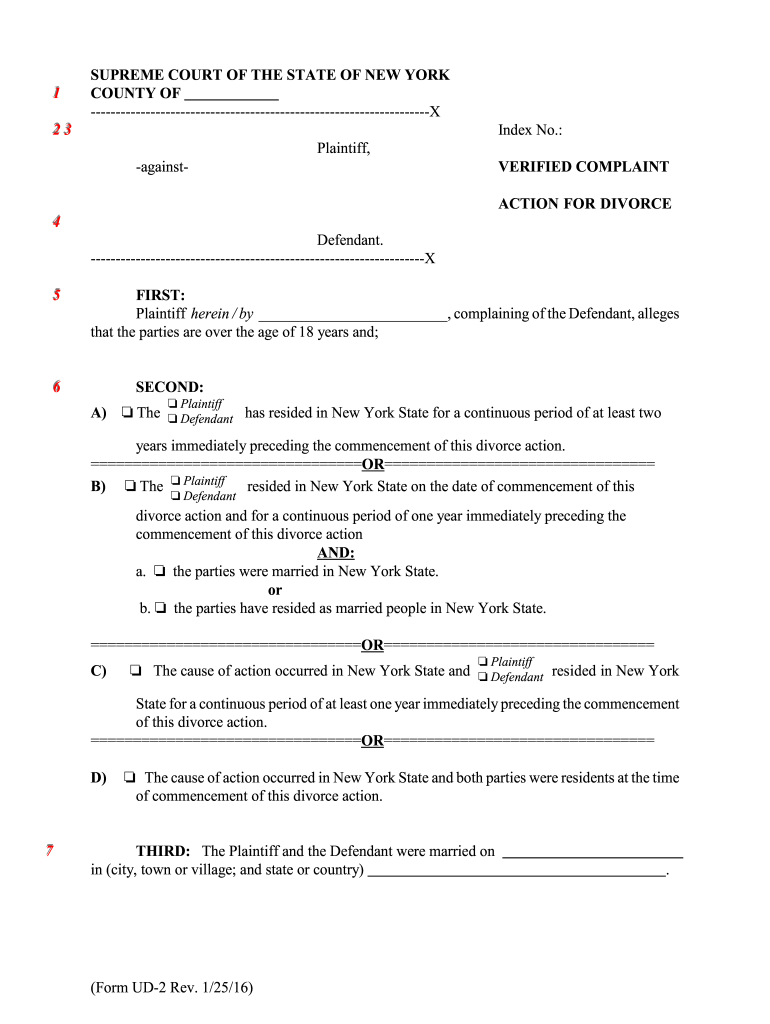
1SUPREME COURT OF THE STATE OF NEW YORK COUNTY OF X23Index No.: Plaintiff, againstVERIFIED COMPLAINT ACTION FOR DIVORCE4 Defendant. X 5FIRST: Plaintiff herein / by , complaining of the Defendant,.

Open form follow the instructions

Easily sign the form with your finger

Send filled & signed form or save
How to fill out the NY UD-2 online
The NY UD-2 is a crucial form used in eviction proceedings in New York State. This guide will provide you with a clear step-by-step process to complete the NY UD-2 form online, ensuring that you understand each component and can fill it out accurately.
Follow the steps to successfully complete the NY UD-2
- Click ‘Get Form’ button to access the NY UD-2 form and open it in your preferred editor.
- Begin by entering the petitioner’s information in the designated fields. This typically includes your name, address, and contact information.
- Next, provide details about the respondent. Include their name, address, and any other required identifiers.
- In the 'Grounds for eviction' section, clearly state the reason for the eviction. Ensure that this complies with legal requirements.
- Complete the section regarding the property involved, including the address of the premises and any relevant description of the rental unit.
- If applicable, include details on the lease or rental agreement, such as its start and end dates, and any relevant payment history.
- Review all entries for accuracy. Make any necessary corrections to ensure that the information is complete and correct.
- Once you have completed the form, save your changes. You can then download, print, or share the filled-out NY UD-2 form as needed.
Take the next step in your eviction process by completing the NY UD-2 form online today.
Experience a faster way to fill out and sign forms on the web. Access the most extensive library of templates available.
Related content
Conduct may include physical, verbal, sexual or emotional behavior.) (Attach an additional...
This is a verified complaint for divorce, alleging cruel and inhuman treatment...
Controle 2: Otimização. Qualquer. —. —. —. —. —. Controle 3: Profundidade. 1,9...
Get answers to your most pressing questions about US Legal Forms API.
What are the 7 grounds for divorce in NY?
New York recognizes seven grounds for divorce, including cruel and inhuman treatment, abandonment, imprisonment, adultery, living apart for a year under a separation agreement, irretrievable breakdown of the marriage, and a legal separation. Each ground has its requirements and implications, so it is crucial to choose wisely. Understanding these grounds will help you navigate your divorce effectively. For comprehensive assistance, explore the tools and templates at US Legal Forms.
Is a complaint in a divorce required to be verified?
A divorce complaint in New York is required to be verified, which means the individual filing must confirm the truthfulness of their claims. This requirement underlines the seriousness and legality of the divorce proceedings. Ensuring all documents are properly verified can streamline your case and reduce potential issues. For more information, US Legal Forms offers valuable resources regarding divorce documentation.
Is verification of answer to complaint mandatory in NY?
In New York, verifying the answer to a complaint is indeed mandatory. The respondent must verify their answer to affirm the statements made within it. This step is crucial for maintaining fairness and accountability in legal disputes. To manage this process efficiently, consider utilizing the tools provided by US Legal Forms.
Does a divorce complaint need to be verified in NY?
Yes, a divorce complaint in New York needs verification. This verification serves as a formal confirmation that the information provided is accurate and sworn to by the person filing. Failing to verify could potentially lead to dismissals or complications in proceedings. For guidance on proper verification, check out the resources available on US Legal Forms.
Is a complaint in a divorce action required to be verified in NY?
In New York, a complaint in a divorce action must be verified. This means that the party filing the complaint must affirm the truth of the document’s contents under oath. By verifying the complaint, the court ensures that the claims made are credible, which supports the integrity of the legal process. For detailed templates and further assistance, you can rely on US Legal Forms.
What assets are divided in a divorce in NY?
In New York, assets that are subject to division during a divorce include marital property accumulated during the marriage, such as homes, bank accounts, and retirement plans. Separate property, which is owned before marriage or acquired through inheritance, typically remains with the original owner. Engaging with NY UD-2 can simplify your understanding of asset division in New York divorce cases.
What does NY 2d mean?
NY 2d refers to New York's Second Department, which is a division of the Appellate Division of the New York Supreme Court. This court hears appeals from lower courts, including family law cases such as divorces. Familiarity with the NY UD-2 can assist you in navigating through legal processes within this department.
What is a wife entitled to in a divorce in NY state?
In a divorce in New York, a wife is entitled to a fair distribution of marital property, which includes assets acquired during the marriage. This entitlement can cover both tangible items and financial assets. Knowing your rights through the NY UD-2 process can empower you to advocate for your interests effectively.
How long do you have to be married to get half of everything in NY?
In New York, the duration of marriage plays a crucial role in asset division. While there isn't a specific time frame that guarantees a 50/50 split, generally, the longer you are married, the more likely you'll receive a fair distribution of assets. Understanding the NY UD-2 form can help clarify rights and entitlements during asset division.
Is everything split 50/50 in a divorce in New York?
In New York, property division during divorce does not automatically split everything 50/50. Instead, the court uses the equitable distribution principle, which means assets are divided fairly based on various factors including financial contributions and the length of the marriage. Thus, it’s essential to understand the NY UD-2 process for a clear overview of how assets may be divided.
Use professional pre-built templates to fill in and sign documents online faster. Get access to thousands of forms.
If you believe that this page should be taken down, please follow our DMCA take down process here.