Loading
Get Ca Jv-820 2020-2026
How it works
-

Open form follow the instructions
-

Easily sign the form with your finger
-

Send filled & signed form or save
How to fill out the CA JV-820 online
The CA JV-820 is a crucial form for individuals seeking to challenge a juvenile court's decision regarding a permanent plan for a child. This guide will provide a clear and detailed approach to filling out the form online, ensuring that all required information is accurately submitted.
Follow the steps to complete the CA JV-820 online effectively.
- Click ‘Get Form’ button to access the form and open it in your preferred digital editor.
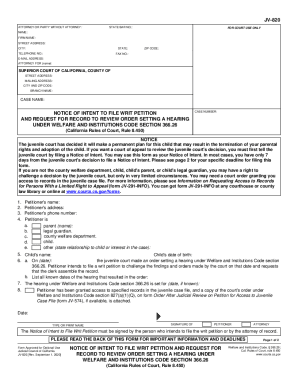
- Fill in the section titled 'Attorney or party without attorney.' Enter your name, firm name, address, city, state, telephone number, fax number, email address, and indicate the party you represent.
- Provide the details for the 'Superior Court of California' section. Include the street address, mailing address, city and zip code, and branch name to ensure proper court identification.
- Complete the 'Case name' and 'Case number' fields accurately to link your Notice of Intent to the correct juvenile case.
- In the 'Petitioner's name' section, specify the name, address, and phone number of the petitioner. Indicate if the petitioner is a parent, legal guardian, child, county welfare department, or other, and describe the relationship.
- Document the date the juvenile court made an order regarding the hearing under Welfare and Institutions Code section 366.26, and list any known hearing dates linked to the mentioned order.
- If applicable, confirm whether the petitioner has been granted access to specific records within the juvenile case file, attaching necessary legal documents.
- Ensure that the form is signed by the petitioner or their attorney, which is necessary for validation of the intent to file.
- Once all fields are filled out, review the information for accuracy. Users can then save changes, download, print, or share the form as needed.
Start completing your forms online today to ensure you meet all necessary deadlines and requirements.
If your petition is rejected, then your case moves to the California Court of Appeal, and possibly the California Supreme Court. You will file a Habeas Corpus petition in California if you are arguing that your conviction violated a state law, or that a California law is unconstitutional.