Loading
Get Ky Aoc-343 2019-2026
How it works
-

Open form follow the instructions
-

Easily sign the form with your finger
-

Send filled & signed form or save
How to fill out the KY AOC-343 online
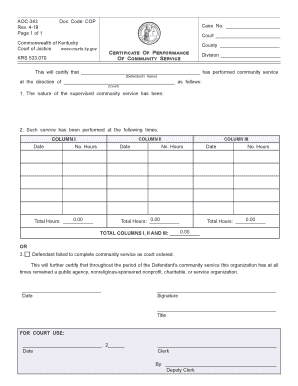
The KY AOC-343 is a certificate of performance of community service required by the Commonwealth of Kentucky. This guide provides step-by-step instructions on how to effectively fill out this form online, ensuring accurate and complete submission.
Follow the steps to complete the KY AOC-343 online.
- Click ‘Get Form’ button to obtain the KY AOC-343 and open it in the online editor.
- Begin by entering the court name and case number at the top of the form. This identifies the specific case related to the community service.
- In the section labeled ‘Defendant's Name,’ provide the name of the individual who performed community service.
- Next, fill in the name of the court that directed the community service under the respective section.
- Describe the nature of the supervised community service in the provided text box, ensuring to include all pertinent details about the work performed.
- In the following tables, record the dates and the number of hours completed for the community service in the designated columns.
- Calculate the total hours completed and enter this number in the appropriate space on the form.
- If the defendant failed to complete the community service as ordered, check the appropriate box and provide any additional required details.
- Include the date and signature of the individual responsible for certifying the completion of community service. Ensure to fill in their title.
- For court use, leave the designated sections for the clerk and deputy clerk to fill out as needed.
- Once all fields are completed, you can save your changes, download the filled form, print it, or share it with the relevant parties.
Complete your documents online to ensure a smooth and efficient filing process.
Casey's Law refers to the Matthew Casey Wethington Act for Substance Abuse Intervention. ... The law allows the parents, relatives, or friends of an addicted person to lawfully intervene and request involuntary, court-ordered addiction treatment for their addicted loved one.