Loading
Form preview
  • US Legal Forms
  • Form Library
  • Tax Forms
  • Executive Department Treasury IRS Forms
  • Irs 1040 - Schedule D 2015

Get Irs 1040 - Schedule D 2015

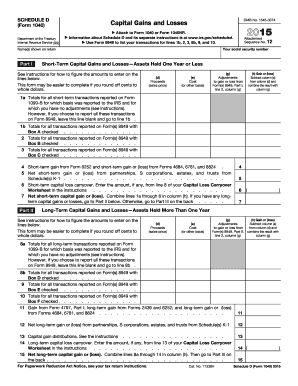
Ox F checked . . . . . . . . . . . . . . 11 Gain from Form 4797, Part I; long-term gain from Forms 2439 and 6252; and long-term gain or (loss) from Forms 4684, 6781, and 8824 . . . . . . . . . . . . . . . . . . . . . . 11 12 Net long-term gain or (loss) from partnerships, S corporations, estates, and trusts from Schedule(s) K-1 12 13 Capital gain distributions. See the instructions . . . . . . . . . . . . . . . . . . 14 Long-term capital loss carryover. Enter the amount, if any, from line 13.

This website is not affiliated with IRS

How it works

  1. Open form

    Open form follow the instructions

  2. Easily sign form

    Easily sign the form with your finger

  3. Share form

    Send filled & signed form or save

How to fill out the IRS 1040 - Schedule D online

The IRS 1040 - Schedule D is used to report capital gains and losses. Filling out this form online can simplify the process and ensure accurate reporting of your financial transactions.

Follow the steps to successfully complete Schedule D online.

  1. Click ‘Get Form’ button to obtain the form and open it in the editor.
  2. Enter your social security number and the name(s) as shown on your tax return at the top of the form. This information is essential for tax identification.
  3. In Part I, report your short-term capital gains and losses for assets held for one year or less. Round off cents to whole dollars for simplicity.
  4. For each transaction, fill in the proceeds (sales price) in column (d) and the cost (or other basis) in column (e). Follow guidelines for any necessary adjustments in column (g).
  5. Calculate the gain or loss for each transaction by subtracting column (e) from column (d) and adding any adjustments from column (g) to find the amount for column (h).
  6. Continue filling in total amounts on lines 1a through 6 as directed, ensuring that any transactions reported on Form 8949 are properly accounted for.
  7. Move on to Part II to report long-term capital gains and losses for assets held for more than one year. Complete columns (d), (e), (g), and (h) as per previous instructions.
  8. Similarly, report totals for long-term transactions on lines 8a through 14, ensuring accuracy in your calculations and adjustments.
  9. In Part III, summarize your results by combining lines 7 and 15. This will give you the overall gain or loss to be reported on your Form 1040.
  10. If you have gains, proceed to enter the amount from line 16 on Form 1040, line 13, or Form 1040NR, line 14. If you have a loss, skip to line 21 for reporting.
  11. Once all fields are completed, you can save your changes, download, print, or share the form as required.

Complete your Schedule D form online today for efficient tax preparation.

Get form

Experience a faster way to fill out and sign forms on the web. Access the most extensive library of templates available.

Related content

About Schedule D (Form 1040), Capital Gains and...
Mar 25, 2025 — Use Schedule D (Form 1040) to report the following: The sale or exchange...
Learn more
2012 Form 1040 (Schedule D)
by D SCHEDULE · Cited by 1 — Complete the Qualified Dividends and Capital Gain Tax...
Learn more
f1045--2017.pdf
19. Enter the loss, if any, from line 21 of your 2017 Schedule D (Form 1040). (Estates and...
Learn more

Related links form

IRS 1098-T 2016 IRS 1098-T 2015 IRS 1098-T 2014 IRS 1098-T 2013

Questions & Answers

Get answers to your most pressing questions about US Legal Forms API.

Contact support

The $3000 capital loss rule allows taxpayers to deduct up to $3000 of capital losses from their ordinary income on IRS 1040 - Schedule D. If your total capital losses exceed your total capital gains, you can use this deduction to offset taxable income, which can lead to a lower overall tax bill. It’s an important strategy for managing investment losses.

Schedule D income refers to the net gain or loss from the sale of assets, such as stocks or real estate, which you report on IRS 1040 - Schedule D. This income can significantly impact your tax bill, so it’s essential to accurately report all transactions. Additionally, understanding the classification of your income from investment sales is vital for compliance with tax regulations.

IRS 1040 - Schedule D is not considered income itself; rather, it is a form used to report your capital gains and losses. The results from Schedule D contribute to your overall taxable income, but the schedule itself is simply a way to track your investment activity. Properly completing this form is crucial for calculating your tax obligation.

Income for tax purposes generally includes wages, salaries, dividends, and capital gains reported on IRS 1040 - Schedule D. Any form of payment you receive, whether from employment or investments, contributes to your overall taxable income. It’s important to gather all sources of income to ensure accurate reporting.

Certain individuals may be exempt from filing IRS 1040 - Schedule D if they do not have any capital gains or losses to report. Additionally, if your only capital loss is a carryover from a previous year, you may not need to file Schedule D. Always consult with a tax professional to confirm your filing requirements.

The tax rate for capital gains reported on IRS 1040 - Schedule D depends on several factors, including your total taxable income and how long you held the asset. Short-term capital gains are typically taxed at your ordinary income rate, while long-term capital gains benefit from reduced rates that can be 0%, 15%, or 20%. Understanding these rates helps you minimize your tax liability.

You can enter your IRS 1040 - Schedule D information in TurboTax by navigating to the 'Wages & Income' section. From there, you will find the 'Investments' category. Select 'Stocks, Mutual Funds, Bonds, Other' and follow the prompts to input your capital gains and losses. TurboTax will guide you through the process to ensure accurate reporting.

Schedule D is a form that outlines your capital gains and losses, which you report when filing your IRS 1040 tax return. It is essential for anyone who has sold assets like stocks, bonds, or real estate during the tax year. By summarizing these transactions, Schedule D helps determine how much tax you owe or if you can claim a capital loss. Understanding this form can lead to more accurate tax filings and better financial planning.

You typically do not need to file Schedule D just for reporting qualified dividends. However, if you also have capital gains or losses from other transactions, including Schedule D in your IRS 1040 filing would be necessary. It's wise to evaluate all your income sources to ensure accurate reporting. If you are unsure, you might benefit from using available resources to confirm your filing requirements.

You may not be required to file Schedule D if you had no capital gains or losses to report for the tax year. Also, if you only have qualified dividends and no other capital transactions, you might be exempt from filing this schedule. Reviewing the IRS guidelines will help clarify your obligation. If you remain uncertain, consider reaching out to a tax professional for assistance.

Get This Form Now!

Use professional pre-built templates to fill in and sign documents online faster. Get access to thousands of forms.
If you believe that this page should be taken down, please follow our DMCA take down processhere.

Industry-leading security and compliance

US Legal Forms protects your data by complying with industry-specific security standards.
  • In businnes since 1997
    25+ years providing professional legal documents.
  • Accredited business
    Guarantees that a business meets BBB accreditation standards in the US and Canada.
  • Secured by Braintree
    Validated Level 1 PCI DSS compliant payment gateway that accepts most major credit and debit card brands from across the globe.
Get IRS 1040 - Schedule D
  • Adoption
  • Bankruptcy
  • Contractors
  • Divorce
  • Home Sales
  • Employment
  • Identity Theft
  • Incorporation
  • Landlord Tenant
  • Living Trust
  • Name Change
  • Personal Planning
  • Small Business
  • Wills & Estates
  • Packages A-Z
  • Affidavits
  • Bankruptcy
  • Bill of Sale
  • Corporate - LLC
  • Divorce
  • Employment
  • Identity Theft
  • Internet Technology
  • Landlord Tenant
  • Living Wills
  • Name Change
  • Power of Attorney
  • Real Estate
  • Small Estates
  • Wills
  • All Forms
  • Forms A-Z
  • Form Library
  • Legal Hub
  • About Us
  • Help Portal
  • Legal Resources
  • Blog
  • Affiliates
  • Contact Us
  • Delete My Account
  • Site Map
  • Industries
  • Forms in Spanish
  • Localized Forms
  • State-specific Forms
  • Forms Kit
  • Real Estate Handbook
  • All Guides
  • Notarize
  • Incorporation services
  • For Consumers
  • For Small Business
  • For Attorneys
  • USLegal
  • FormsPass
  • pdfFiller
  • signNow
  • altaFlow
  • DocHub
  • Instapage
Form Packages
  • Adoption
  • Bankruptcy
  • Contractors
  • Divorce
  • Home Sales
  • Employment
  • Identity Theft
  • Incorporation
  • Landlord Tenant
  • Living Trust
  • Name Change
  • Personal Planning
  • Small Business
  • Wills & Estates
  • Packages A-Z
Form Categories
  • Affidavits
  • Bankruptcy
  • Bill of Sale
  • Corporate - LLC
  • Divorce
  • Employment
  • Identity Theft
  • Internet Technology
  • Landlord Tenant
  • Living Wills
  • Name Change
  • Power of Attorney
  • Real Estate
  • Small Estates
  • Wills
  • All Forms
  • Forms A-Z
  • Form Library
Customer Service
  • Legal Hub
  • About Us
  • Help Portal
  • Legal Resources
  • Blog
  • Affiliates
  • Contact Us
  • Delete My Account
  • Site Map
  • Industries
  • Forms in Spanish
  • Localized Forms
  • State-specific Forms
  • Forms Kit
Legal Guides
  • Real Estate Handbook
  • All Guides
Prepared for you
  • Notarize
  • Incorporation services
Our Customers
  • For Consumers
  • For Small Business
  • For Attorneys
Our Sites
  • USLegal
  • FormsPass
  • pdfFiller
  • signNow
  • altaFlow
  • DocHub
  • Instapage
Social Media
Call us now toll free:
+1 833 426 79 33
As seen in:
© Copyright 1999-2026 airSlate Legal Forms, Inc. 3720 Flowood Dr, Flowood, Mississippi 39232
  • Your Privacy Choices
  • Terms of Service
  • Privacy Notice
  • Content Takedown Policy
  • Bug Bounty Program
IRS 1040 - Schedule D
This form is available in several versions.
Select the version you need from the drop-down list below.
2021 IRS 1040 - Schedule D
Select form
  • 2021 IRS 1040 - Schedule D
  • 2020 IRS 1040 - Schedule D
  • 2019 IRS 1040 - Schedule D
  • 2018 IRS 1040 - Schedule D
  • 2017 IRS 1040 - Schedule D
  • 2016 IRS 1040 - Schedule D
  • 2015 IRS 1040 - Schedule D
  • 2014 IRS 1040 - Schedule D
  • 2013 IRS 1040 - Schedule D
  • 2012 IRS 1040 - Schedule D
  • 2011 IRS 1040 - Schedule D
  • 2010 IRS 1040 - Schedule D
  • 1997 IRS 1040 - Schedule D
Select form