Motion To Strike Form For Jury Trial In Massachusetts
Description






Get your form ready online
Our built-in tools help you complete, sign, share, and store your documents in one place.
Make edits, fill in missing information, and update formatting in US Legal Forms—just like you would in MS Word.
Download a copy, print it, send it by email, or mail it via USPS—whatever works best for your next step.
Sign and collect signatures with our SignNow integration. Send to multiple recipients, set reminders, and more. Go Premium to unlock E-Sign.
If this form requires notarization, complete it online through a secure video call—no need to meet a notary in person or wait for an appointment.
We protect your documents and personal data by following strict security and privacy standards.
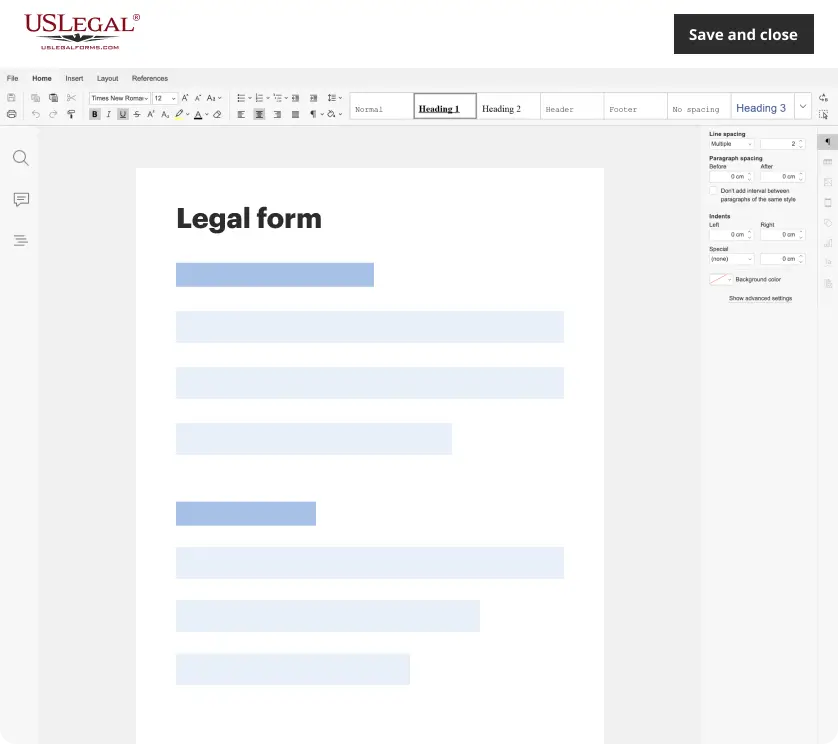
Make edits, fill in missing information, and update formatting in US Legal Forms—just like you would in MS Word.
Download a copy, print it, send it by email, or mail it via USPS—whatever works best for your next step.
Sign and collect signatures with our SignNow integration. Send to multiple recipients, set reminders, and more. Go Premium to unlock E-Sign.
If this form requires notarization, complete it online through a secure video call—no need to meet a notary in person or wait for an appointment.
We protect your documents and personal data by following strict security and privacy standards.
Looking for another form?
Form popularity
FAQ
A motion to strike is a request by one party in a United States trial requesting that the presiding judge order the removal of all or part of the opposing party's pleading to the court.
This form is where you tell the Judge all of the important and relevant facts in support of your Motion. An Affidavit is a form of evidence that the Court can consider when making decisions, just like live testimony in Court and exhibits.
A motion to strike is a request to a judge that part of a party's pleading or a piece of evidence be removed from the record. During the pleading stage, this can be accomplished by a tool such as Rule 12(f) of the Federal Rules of Civil Procedure or a state equivalent.
The motion for a new trial can be made if it appears there was some sort of judicial error or bias in the first trial. If there are any grounds for another trial because of a miscarriage of justice, the court can overturn the conviction and order a new trial.
General format - each motion generally consists of a case caption, a title that briefly identifies the relief sought, a series of numbered paragraphs that explains -- in a logical way -- why you are entitled to that relief, a prayer for relief, a signature block, a certification that a copy of the motion was sent to ...
Rule 56 - Summary Judgment (a)Motions for Summary Judgment. A party may move for summary judgment subsequent to the commencement of any proceeding under these rules except in actions for divorce or in actions for custody or visitation or for criminal contempt.
A motion to dismiss asks the court to dismiss either whole or part of a complaint, counterclaim, or crossclaim. Motion to strike or "Demurrer": In some jurisdictions, a motion to strike or a "demurrer" is the equivalent to a motion to dismiss for failure to state a claim upon which relief can be granted.
Motion to Strike This asks the court to take something out of the Complaint because it is not understandable, it is repetitive, it isn't legal, or it doesn't matter. This motion can help to limit what the case is about so you do not have to defend that part of the case.
To request a continuance regarding your DALA case, you (the party seeking the continuance or "the moving party") should submit a written request (a "motion") at least seven (7) days before the event. You can send your request by mail, fax, or e-mail.
A motion is a request that the judge grant some kind of relief related to your court case. There are a few different ways that you can make a motion. Oral motion - You can make a motion verbally (orally) while in court. This can be at the initial appearance, at a status appearance, or during a hearing.
