Spousal Support For In Michigan
Description






Get your form ready online
Our built-in tools help you complete, sign, share, and store your documents in one place.
Make edits, fill in missing information, and update formatting in US Legal Forms—just like you would in MS Word.
Download a copy, print it, send it by email, or mail it via USPS—whatever works best for your next step.
Sign and collect signatures with our SignNow integration. Send to multiple recipients, set reminders, and more. Go Premium to unlock E-Sign.
If this form requires notarization, complete it online through a secure video call—no need to meet a notary in person or wait for an appointment.
We protect your documents and personal data by following strict security and privacy standards.
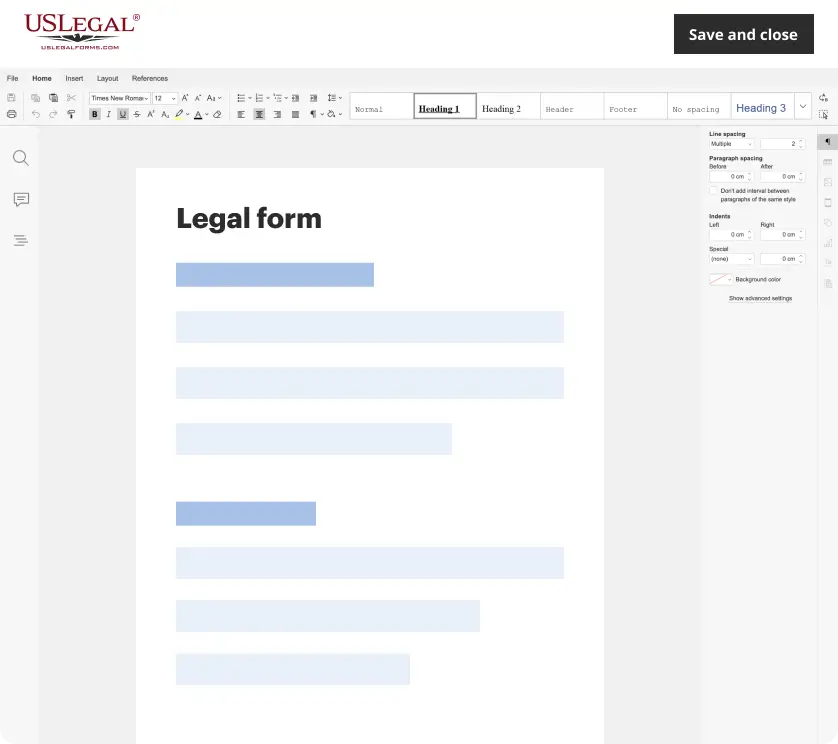
Make edits, fill in missing information, and update formatting in US Legal Forms—just like you would in MS Word.
Download a copy, print it, send it by email, or mail it via USPS—whatever works best for your next step.
Sign and collect signatures with our SignNow integration. Send to multiple recipients, set reminders, and more. Go Premium to unlock E-Sign.

If this form requires notarization, complete it online through a secure video call—no need to meet a notary in person or wait for an appointment.
We protect your documents and personal data by following strict security and privacy standards.
Looking for another form?


Form popularity
FAQ
In instances of divorce after 10 years of marriage in Michigan, an ex-spouse has the right to claim up to half of the other's workers' compensation benefits, Social Security benefits, and military pension benefits.
In Michigan, anyone who is married, no matter how soon after marriage they divorce, is entitled to an equitable share of the marital assets. Because divorce settlements involving property division in Michigan rely on the rule of “equitable distribution,” it is unlikely that the marital property will be divided 50/50.
There is No Specific Formula for Spousal Support Unlike with child support, there is no formula that will tell you whether or not you will get spousal support or how much you will get. Spousal support is decided on a case-by-case basis.
In Michigan, the court evaluates various factors such as each party's income, age, health, and the duration of the marriage to determine the necessity, amount, and duration of spousal support.
Alimony law in the Michigan statutes does not give an amount of time in Michigan to be married to get alimony. The court does take the length of the marriage, along with other factors, when determining spousal support. A party is more likely to be awarded permanent support for long-term marriages.
The guideline states that the paying spouse's support be presumptively 40% of his or her net monthly income, reduced by one-half of the receiving spouse's net monthly income. If child support is an issue, spousal support is calculated after child support is calculated.
In Michigan, either spouse can ask for spousal support in a divorce. It's important to understand that for the court to consider a request for support, you must address it in your initial divorce paperwork. For the filing spouse, you'll have to tell the court you need financial support in your petition for divorce.
