Tort Negligence Liability With Example In Miami-Dade
Description








Form popularity
FAQ
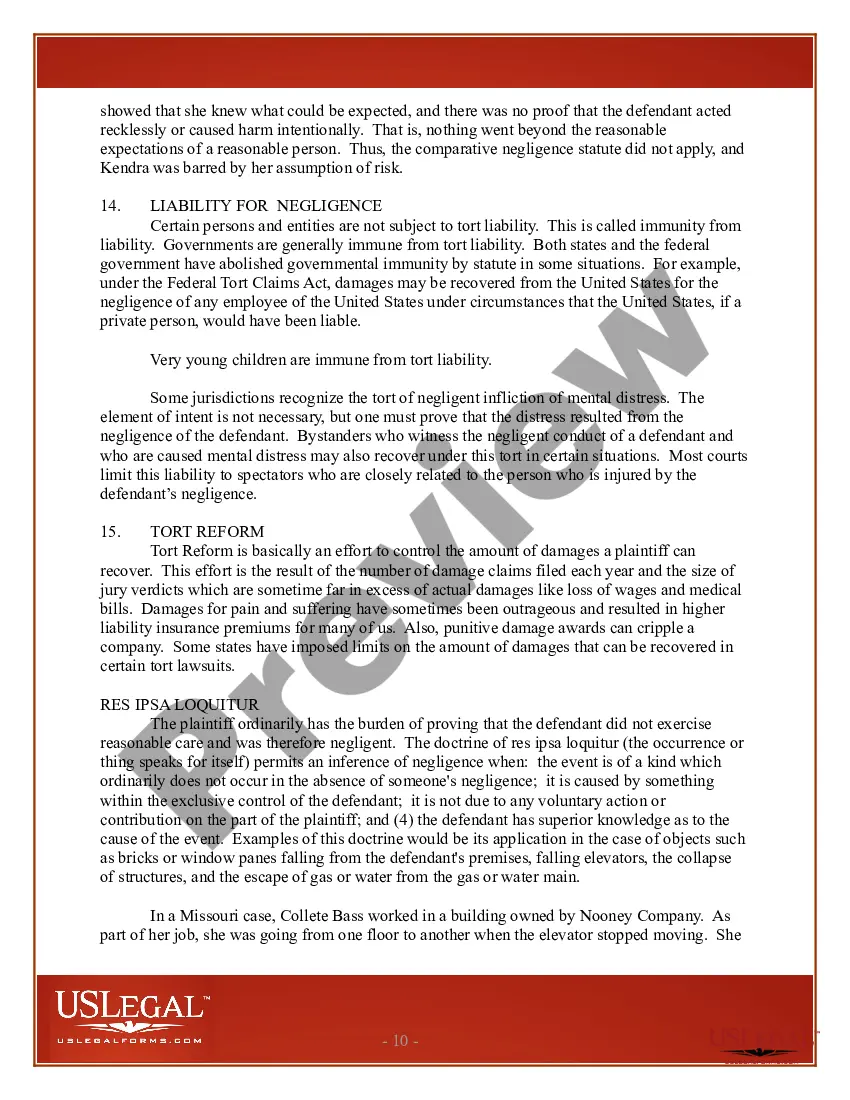
Torts are legal wrongs that one party suffers at the hands of another. Negligence is a form of tort which evolved because some types of loss or damage occur between parties that have no contract between them, and therefore there is nothing for one party to sue the other over.
In Florida, injured parties must file a Notice of Claim with the Department of Financial Services to preserve their right to file a lawsuit against a government entity. The notice of claim must be filed in writing within three years of the injury date (two years for wrongful death).
Negligent torts can encompass a wide range of situations, such as car accidents caused by reckless driving, medical malpractice resulting from a doctor's negligent treatment, or slip and fall accidents due to a property owner's failure to maintain safe premises.
Four of them are personal: assault, battery, intentional infliction of emotional distress, and false imprisonment. The other three are trespass to chattels, trespass to property, and conversion.
Different Types of Negligence. While seemingly straightforward, the concept of negligence itself can also be broken down into four types of negligence: gross negligence, comparative negligence, contributory negligence, and vicarious negligence or vicarious liability.
A negligence claim requires that the person bringing the claim (the plaintiff) establish four distinct elements: duty of care, breach, causation, and damages.
So you should say something like: “In order to sue B in negligence for compensation for injury to his leg, A will have to show that: (1) B owed him a duty of care; (2) B breached that duty of care; (3) B's breach caused A to suffer the leg injury for which he wants compensation; and (4) that loss is actionable (that is ...
Under the traditional rules of legal duty in negligence cases, a plaintiff must prove that the defendant's actions were the actual cause of the plaintiff's injury. This is often referred to as "but-for" causation, meaning that, but for the defendant's actions, the plaintiff's injury would not have occurred.
A driver runs a stop sign and slams into another car. A driver operates illegally in the bicycle lane and hits a bicyclist. A driver runs a red light and hits a pedestrian in a crosswalk.
Most civil lawsuits for injuries allege the wrongdoer was negligent. To win in a negligence lawsuit, the victim must establish 4 elements: (1) the wrongdoer owed a duty to the victim, (2) the wrongdoer breached the duty, (3) the breach caused the injury (4) the victim suffered damages.
