Employment Discrimination Sample With Replacement In Hennepin
Description




Get your form ready online
Our built-in tools help you complete, sign, share, and store your documents in one place.
Make edits, fill in missing information, and update formatting in US Legal Forms—just like you would in MS Word.
Download a copy, print it, send it by email, or mail it via USPS—whatever works best for your next step.
Sign and collect signatures with our SignNow integration. Send to multiple recipients, set reminders, and more. Go Premium to unlock E-Sign.
If this form requires notarization, complete it online through a secure video call—no need to meet a notary in person or wait for an appointment.
We protect your documents and personal data by following strict security and privacy standards.
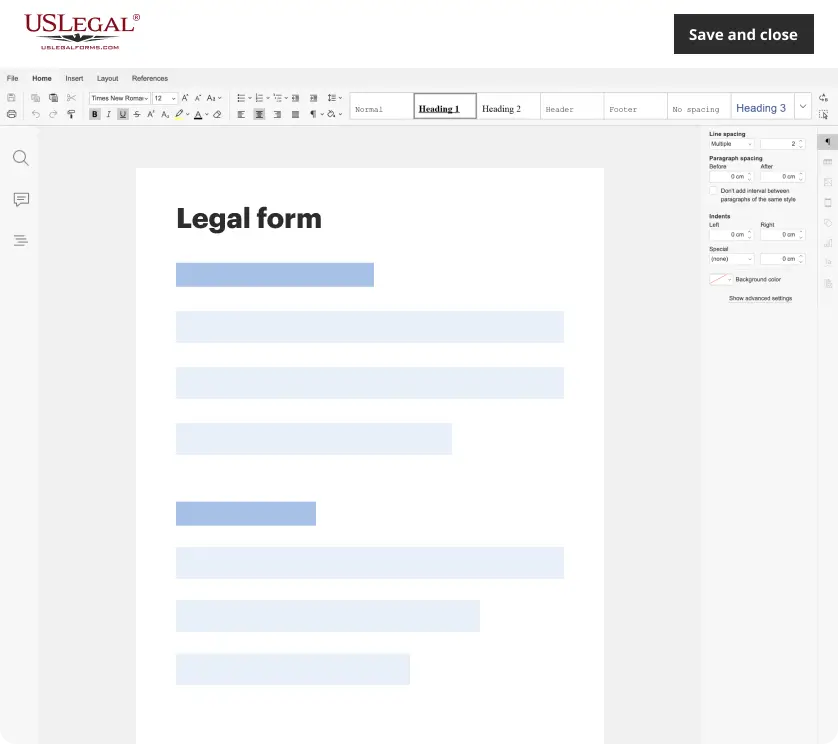
Make edits, fill in missing information, and update formatting in US Legal Forms—just like you would in MS Word.
Download a copy, print it, send it by email, or mail it via USPS—whatever works best for your next step.
Sign and collect signatures with our SignNow integration. Send to multiple recipients, set reminders, and more. Go Premium to unlock E-Sign.
If this form requires notarization, complete it online through a secure video call—no need to meet a notary in person or wait for an appointment.
We protect your documents and personal data by following strict security and privacy standards.
Looking for another form?

Form popularity
FAQ
A job discrimination complaint may be filed by mail or in person at the nearest EEOC office. You can find the closest EEOC office by calling the EEOC at 1-800-669-4000, or by going to the EEOC's Field Office List and Jurisdiction Map and selecting the office closest to you.
It will not only benefit you, but your co-workers as well because it will likely make your workplace safer by creating a better environment for all. When you sue, you can also obtain a legal remedy for the discrimination you have faced. Employers often offer a significant sum in these cases.
The chances of winning your discrimination case can vary dramatically depending on the particular circumstances you face. When a lot of evidence has accumulated against your employer, such as emails and history of discriminatory remarks in front of multiple witnesses, your chances of winning a lawsuit are higher.
However, discrimination is a state of mind and, therefore, notoriously hard to prove. Sophisticated employers are well aware that discrimination is illegal. Thus, most cases are established through circumstantial evidence.
How to Prove Discrimination in the Workplace You have been treated unjustly based on one of your protected characteristics. You are qualified, capable and honest and performed your job satisfactorily. Discrimination has negatively affected your job. Job decisions were not objective.
Wronged employees have three ways of proving their employers intended to discriminate: circumstantial evidence, direct evidence, and pattern and practice. Circumstantial evidence is evidence that proves a fact by inference, as opposed to direct evidence which directly proves a fact.
With 95% of EEOC district court cases being successful, it is clear that legal recourse can be an effective tool for victims of discrimination.
What to Ask for in a Discrimination Settlement Lost Wages and Benefits. Emotional Distress and Mental Anguish. Legal Fees and Court Costs. Punitive Damages. Job Reinstatement or Policy Changes. Understand Your Worth. Gather Strong Evidence. Be Ready to Compromise.
In cases of discrimination in the workplace, you can typically seek compensation for lost wages, emotional distress, and punitive damages. While there's no limit on lost wages, emotional distress and punitive damages are capped at $300,000 under laws like Title VII and the ADA.
When it comes to California discrimination lawsuits, the potential payout varies greatly depending on the company's size. Take small businesses with fewer than 100 employees - they're looking at a maximum payout of $50,000. But scale up to 101-200 employees, and that number jumps to $100,000.
