4th Amendment Us Constitution With 5th In Fairfax
Description






Get your form ready online
Our built-in tools help you complete, sign, share, and store your documents in one place.
Make edits, fill in missing information, and update formatting in US Legal Forms—just like you would in MS Word.
Download a copy, print it, send it by email, or mail it via USPS—whatever works best for your next step.
Sign and collect signatures with our SignNow integration. Send to multiple recipients, set reminders, and more. Go Premium to unlock E-Sign.
If this form requires notarization, complete it online through a secure video call—no need to meet a notary in person or wait for an appointment.
We protect your documents and personal data by following strict security and privacy standards.
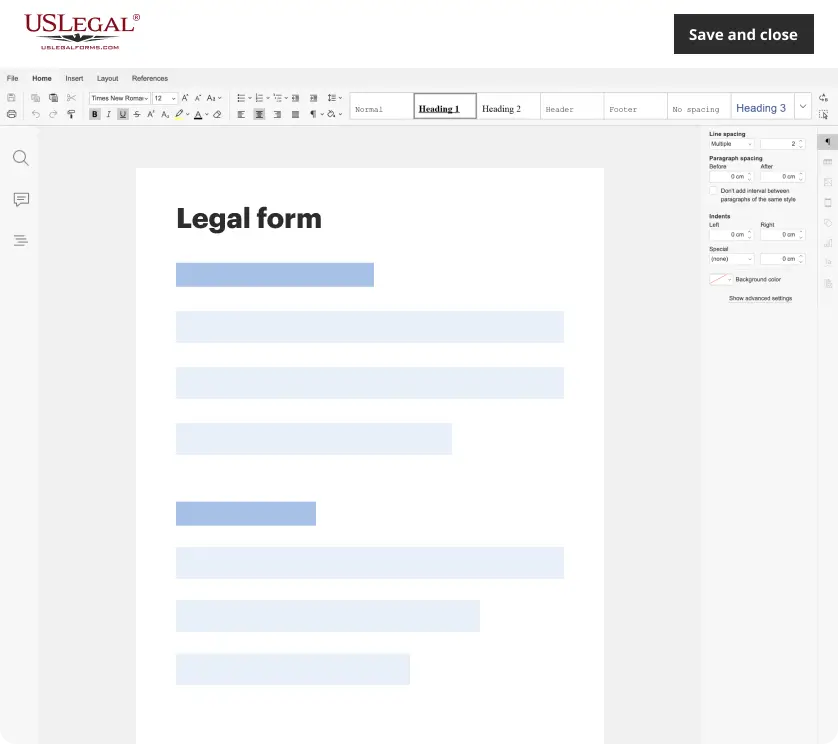
Make edits, fill in missing information, and update formatting in US Legal Forms—just like you would in MS Word.
Download a copy, print it, send it by email, or mail it via USPS—whatever works best for your next step.
Sign and collect signatures with our SignNow integration. Send to multiple recipients, set reminders, and more. Go Premium to unlock E-Sign.

If this form requires notarization, complete it online through a secure video call—no need to meet a notary in person or wait for an appointment.
We protect your documents and personal data by following strict security and privacy standards.
Looking for another form?
Form popularity
FAQ
In a more formal setting, such as a deposition or hearing, the person might say: “On the advice of counsel, I invoke my fifth amendment privilege against self-incrimination and respectfully decline to answer your question.”
To cite the U.S. Constitution, abbreviate the titles and the works are cited by sections. It is recommended to reference the Constitution in the sentence itself and only provide the amendment and section number in the parenthetical citation at the end of the sentence. (U.S. Constitution, amend. 12, sec.
If you are citing a specific part or article of the U.S. Constitution, you must cite it in the text of the paper using an in-text parenthetical reference using the abbreviations used in "Bluebook Style." For example: In 1920, Suffragettes succeeding in winning the right for women to vote (U. S. Const. amend.
Answer. To cite an Amendment of the Constitution (ing to the APA Style blog): All citations of the U.S. Constitution begin with U.S. Const., followed by the article, amendment, section, and/or clause numbers as relevant.
To propose amendments, two-thirds of both houses of Congress can vote to propose an amendment, or two-thirds of the state legislatures can ask Congress to call a national convention to propose amendments.
The first time you reference the work, include the institutional author (US) and date (1776) in your parenthetical reference. Ex: ". . . in the Declaration of Independence (US 1776)." If you refer to a specific section, parenthetically reference it in your text.
While the Fifth Amendment only applies to the federal government, the identical text in the Fourteenth Amendment explicitly applies this due process requirement to the states as well.
If you are citing a specific part or article of the U.S. Constitution, you must cite it in the text of the paper using an in-text parenthetical reference using the abbreviations used in "Bluebook Style." For example: In 1920, Suffragettes succeeding in winning the right for women to vote (U. S. Const. amend. XIX).
To claim a violation of Fourth Amendment rights as the basis for suppressing relevant evidence, courts have long required that the claimant must prove that they were the victim of an invasion of privacy to have a valid standing.
The Fourth Amendment is very brief. Despite its importance, it's only one sentence long. It has two clauses: the "unreasonable search and seizure" clause and the "warrants" clause.
