Patent Infringement In Us In Ohio
Description

Get your form ready online
Our built-in tools help you complete, sign, share, and store your documents in one place.
Make edits, fill in missing information, and update formatting in US Legal Forms—just like you would in MS Word.
Download a copy, print it, send it by email, or mail it via USPS—whatever works best for your next step.
Sign and collect signatures with our SignNow integration. Send to multiple recipients, set reminders, and more. Go Premium to unlock E-Sign.
If this form requires notarization, complete it online through a secure video call—no need to meet a notary in person or wait for an appointment.
We protect your documents and personal data by following strict security and privacy standards.

Make edits, fill in missing information, and update formatting in US Legal Forms—just like you would in MS Word.

Download a copy, print it, send it by email, or mail it via USPS—whatever works best for your next step.

Sign and collect signatures with our SignNow integration. Send to multiple recipients, set reminders, and more. Go Premium to unlock E-Sign.

If this form requires notarization, complete it online through a secure video call—no need to meet a notary in person or wait for an appointment.

We protect your documents and personal data by following strict security and privacy standards.
Looking for another form?




Form popularity
FAQ
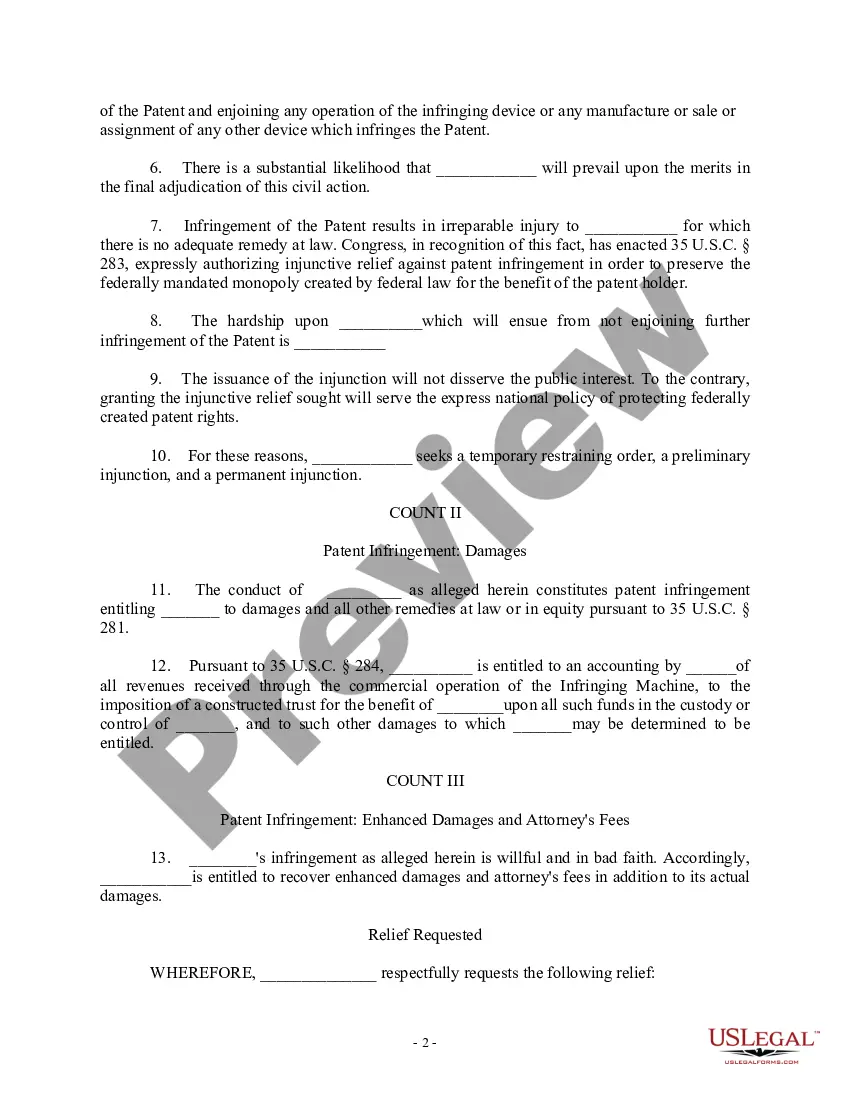
In the United States, a valid patent provides its proprietor with the right to exclude others from practicing the invention claimed in that patent. A person who practices that invention without the permission of the patent holder infringes that patent.
The two main types of damages awarded in patent infringement actions are reasonable royalties and lost profits. (However, the Patent Act does not limit damages to certain types, and a judge can award other types of damages that may be appropriate under the facts of the case.)
If the State has waived its sovereign immunity to patent infringement, yes. Alternatively, a state may have provided by state statute an alternative remedy for its infringement of a patent. If so, the patentee may sue to obtain that alternative remedy.
A reasonable royalty equal to 25% of the licensee's profits might apply to a small number of patents that involve a vital and commercially important technology. But even in such cases, the rate should be proven reasonable using independent evidence and should not merely be assumed reasonable.
What factors are involved in “willful infringement” of a patent? The courts often enter awards of increased damages where the infringer acted in wanton disregard of the patentee's patent rights, that is, where the infringement is “willful.” Courts consider the “totality of the circumstances” in determining willfulness.
There are three types of patent infringement under this statute: direct infringement, induced infringement, and contributory infringement. Induced and contributory infringement are two types of indirect infringement.
The two main types of damages awarded in patent infringement actions are reasonable royalties and lost profits. (However, the Patent Act does not limit damages to certain types, and a judge can award other types of damages that may be appropriate under the facts of the case.)
This probably will require hiring a patent attorney. You should make sure to find an attorney who has handled patent infringement cases previously and who is familiar with your industry. Your attorney will file a formal complaint in federal court, explaining how the defendant has infringed on your patent.