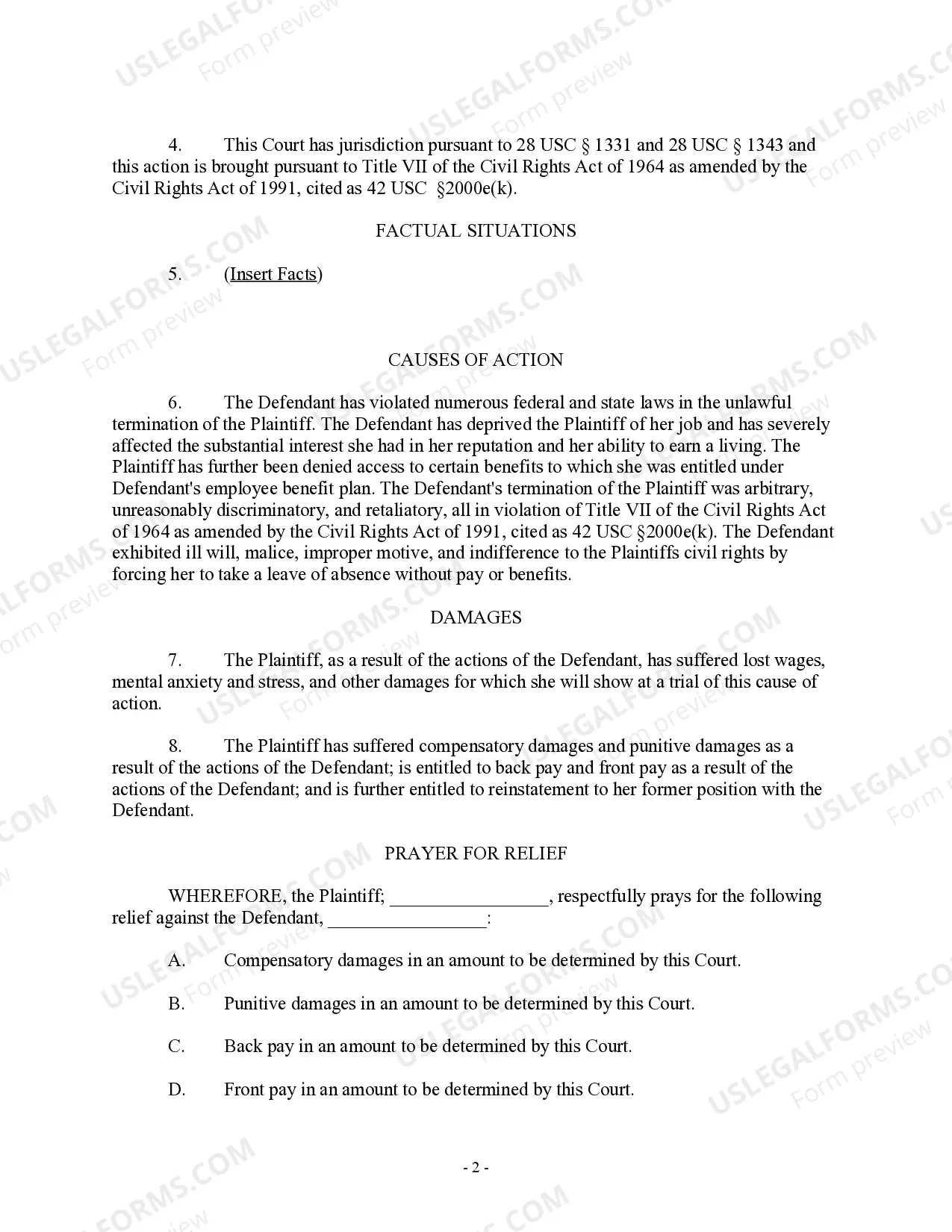
This is a multi-state form covering the subject matter of the title.
Wrongful Termination Court With Federal In Tarrant
Category:
State:
Multi-State
County:
Tarrant
Control #:
US-000291
Format:
Word;
Rich Text
Instant download
Description
Free preview




Get your form ready online
Our built-in tools help you complete, sign, share, and store your documents in one place.
Built-in online Word editor
Make edits, fill in missing information, and update formatting in US Legal Forms—just like you would in MS Word.
Export easily
Download a copy, print it, send it by email, or mail it via USPS—whatever works best for your next step.
E-sign your document
Sign and collect signatures with our SignNow integration. Send to multiple recipients, set reminders, and more. Go Premium to unlock E-Sign.
Notarize online 24/7
If this form requires notarization, complete it online through a secure video call—no need to meet a notary in person or wait for an appointment.
Store your document securely
We protect your documents and personal data by following strict security and privacy standards.

Make edits, fill in missing information, and update formatting in US Legal Forms—just like you would in MS Word.

Download a copy, print it, send it by email, or mail it via USPS—whatever works best for your next step.

Sign and collect signatures with our SignNow integration. Send to multiple recipients, set reminders, and more. Go Premium to unlock E-Sign.

If this form requires notarization, complete it online through a secure video call—no need to meet a notary in person or wait for an appointment.

We protect your documents and personal data by following strict security and privacy standards.
Looking for another form?
Form popularity
FAQ
These cases are difficult to prove. You will most likely need the help of an experienced attorney to successfully navigate the process. An employment law attorney will help you gather the necessary evidence. This will be necessary to prove the elements of a wrongful termination lawsuit.
What happens if you get fired from a federal job? If you're fired from a federal job, you will typically lose benefits like health insurance, and you may not qualify for unemployment benefits if dismissed for misconduct.
What Can a Federal Employee Sue the Federal Government For? Wrongful termination and workplace discrimination are the most common lawsuits employees bring against their employers. Yes, you can sue the federal government for either of these reasons, though the process is different than with a private employer.
The average payout for a wrongful termination lawsuit in Texas is between $5,000 and $100,000. However, there are cases in Texas, including San Antonio, where damages reached $700,000.
When the government is your employer, the question often arises: Can a federal employee sue the federal government? The answer is yes, with some caveats. Because the federal government has sovereign immunity, federal employees cannot file lawsuits against it unless the government waives this immunity.
When you have a lawyer for a wrongful termination case the likelihood of receiving compensation is 64% and the likelihood of receiving compensation without a lawyer is 30%.
In the federal government, you cannot be fired because of your age, color, disability, national origin, pregnancy, race or religion. In addition, it is unlawful to fire a federal employee in retaliation due complaints about an unlwaful action.
These cases are difficult to prove. You will most likely need the help of an experienced attorney to successfully navigate the process. An employment law attorney will help you gather the necessary evidence. This will be necessary to prove the elements of a wrongful termination lawsuit.