Workplace Discrimination In Australia In Middlesex
Description




Get your form ready online
Our built-in tools help you complete, sign, share, and store your documents in one place.
Make edits, fill in missing information, and update formatting in US Legal Forms—just like you would in MS Word.
Download a copy, print it, send it by email, or mail it via USPS—whatever works best for your next step.
Sign and collect signatures with our SignNow integration. Send to multiple recipients, set reminders, and more. Go Premium to unlock E-Sign.
If this form requires notarization, complete it online through a secure video call—no need to meet a notary in person or wait for an appointment.
We protect your documents and personal data by following strict security and privacy standards.
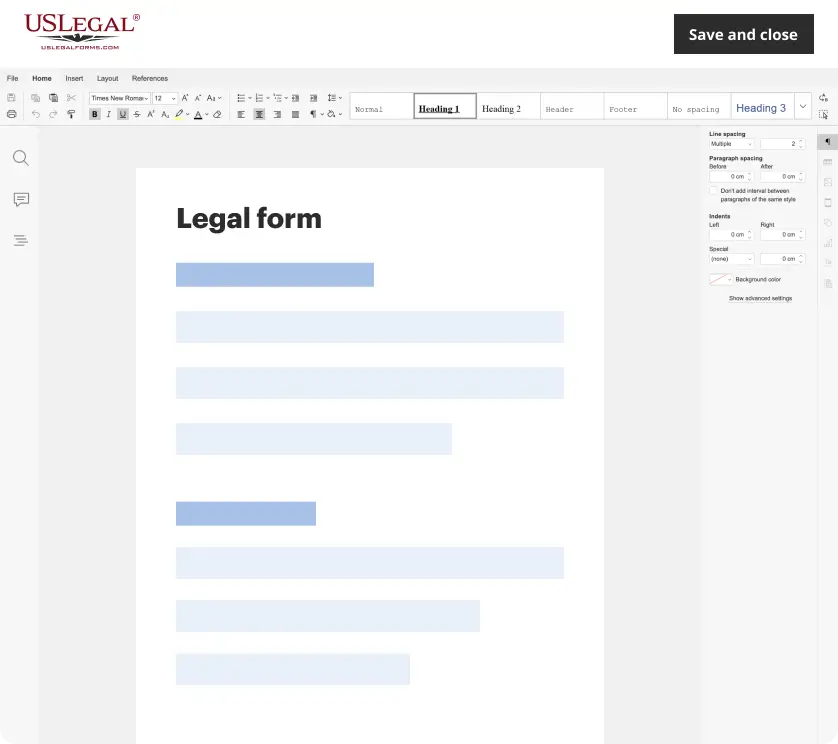
Make edits, fill in missing information, and update formatting in US Legal Forms—just like you would in MS Word.
Download a copy, print it, send it by email, or mail it via USPS—whatever works best for your next step.
Sign and collect signatures with our SignNow integration. Send to multiple recipients, set reminders, and more. Go Premium to unlock E-Sign.
If this form requires notarization, complete it online through a secure video call—no need to meet a notary in person or wait for an appointment.
We protect your documents and personal data by following strict security and privacy standards.
Looking for another form?


Form popularity
FAQ
You can make a complaint no matter where you live in Australia. If you are not sure if you can make a complaint about something, you can contact the Commission's National Information Service by phone on 1300 656 419 or by email to infoservice@humanrights.au.
For Example: An employer refused to hire a suitably qualified person as a shop assistant because they were Aboriginal, and instead hired a less qualified person of a different racial background. This could be racial discrimination.
In 2020, the General Social Survey (GSS) found that 13.3% of people aged 18 years and over experienced some form of discrimination in the previous 12 months.
The Equal Status Acts 2000-2018 ('the Acts') prohibit discrimination in the provision of goods and services, accommodation and education. They cover the nine grounds of gender, marital status, family status, age, disability, sexual orientation, race, religion, and membership of the Traveller community.
You can apply to the Federal Court or Federal Circuit and Family Court to have your case heard by the court. You must go through the Australian Human Rights Commission conciliation process first before you can lodge an application. The commission will issue a notice that your complaint has been closed.
While anti-discrimination law is clear about the right of employees to speak their language of choice, often the employer has to deal with resistance from employees and other managers when implementing this part of the law.
Employees have a right to speak languages other than English in the workplace; If directed not to speak in a particular language or to speak in one language only in the workplace, employees should be aware of their rights.
Although English is not the official language of Australia in law, it is the de facto official and national language. It is the most widely spoken language in the country, and is used as the only language in the home by 72% of the population.