Discrimination Definition By Oxford In Montgomery
Description




Get your form ready online
Our built-in tools help you complete, sign, share, and store your documents in one place.
Make edits, fill in missing information, and update formatting in US Legal Forms—just like you would in MS Word.
Download a copy, print it, send it by email, or mail it via USPS—whatever works best for your next step.
Sign and collect signatures with our SignNow integration. Send to multiple recipients, set reminders, and more. Go Premium to unlock E-Sign.
If this form requires notarization, complete it online through a secure video call—no need to meet a notary in person or wait for an appointment.
We protect your documents and personal data by following strict security and privacy standards.
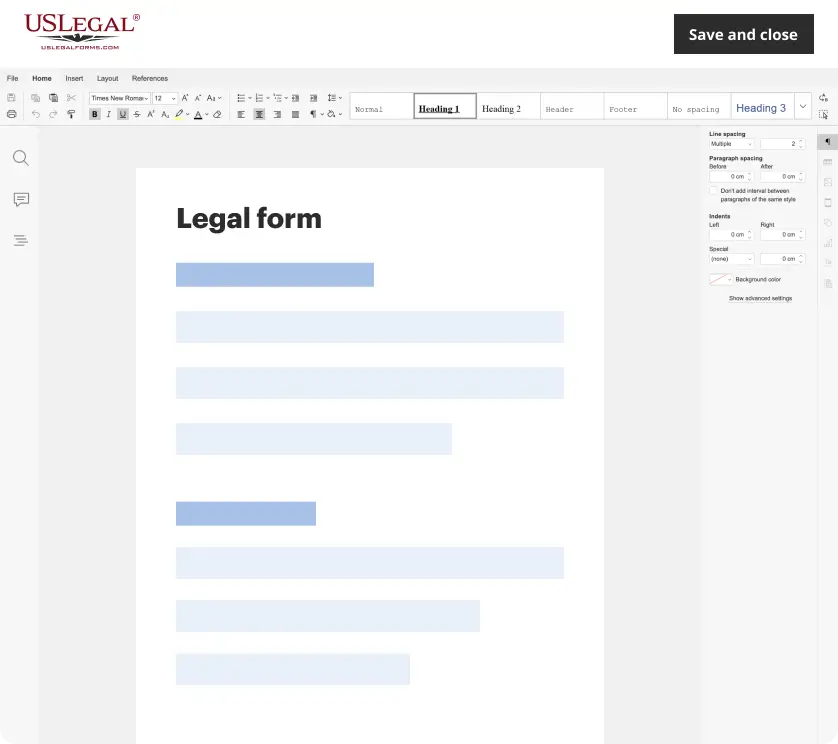
Make edits, fill in missing information, and update formatting in US Legal Forms—just like you would in MS Word.
Download a copy, print it, send it by email, or mail it via USPS—whatever works best for your next step.
Sign and collect signatures with our SignNow integration. Send to multiple recipients, set reminders, and more. Go Premium to unlock E-Sign.
If this form requires notarization, complete it online through a secure video call—no need to meet a notary in person or wait for an appointment.
We protect your documents and personal data by following strict security and privacy standards.
Looking for another form?

Form popularity
FAQ
A simplified description of the legal definition of discrimination is when a person is treated disfavourably or when a person's dignity is violated. The disfavourable treatment or the violation of a person's dignity must also be related to one of the seven grounds of discrimination.
Treating one or more members of a specified group unfairly as compared with other people.
To treat a person or particular group of people differently, especially in a worse way from the way in which you treat other people, because of their race, gender, sexuality, etc.: be discriminated against She felt she had been discriminated against because of her age.
Discrimination is the unfair or prejudicial treatment of people and groups based on characteristics such as race, gender, age, or sexual orientation.
Discrimination is the unfair or prejudicial treatment of people and groups based on characteristics such as race, gender, age, or sexual orientation.
Discrimination, in psychology, the ability to perceive and respond to differences among stimuli. It is considered a more advanced form of learning than generalization (q.v.), the ability to perceive similarities, although animals can be trained to discriminate as well as to generalize.
The original, neutral sense of discrimination, "the act of distinguishing," came into English by the early 17th century, followed by the positive one associated with superior discernment in the 18th century. Discrimination in the "prejudice" sense has been in use since the early 19th century, almost 200 years ago.