Workplace Discrimination In Canada In Salt Lake
Description




Get your form ready online
Our built-in tools help you complete, sign, share, and store your documents in one place.
Make edits, fill in missing information, and update formatting in US Legal Forms—just like you would in MS Word.
Download a copy, print it, send it by email, or mail it via USPS—whatever works best for your next step.
Sign and collect signatures with our SignNow integration. Send to multiple recipients, set reminders, and more. Go Premium to unlock E-Sign.
If this form requires notarization, complete it online through a secure video call—no need to meet a notary in person or wait for an appointment.
We protect your documents and personal data by following strict security and privacy standards.
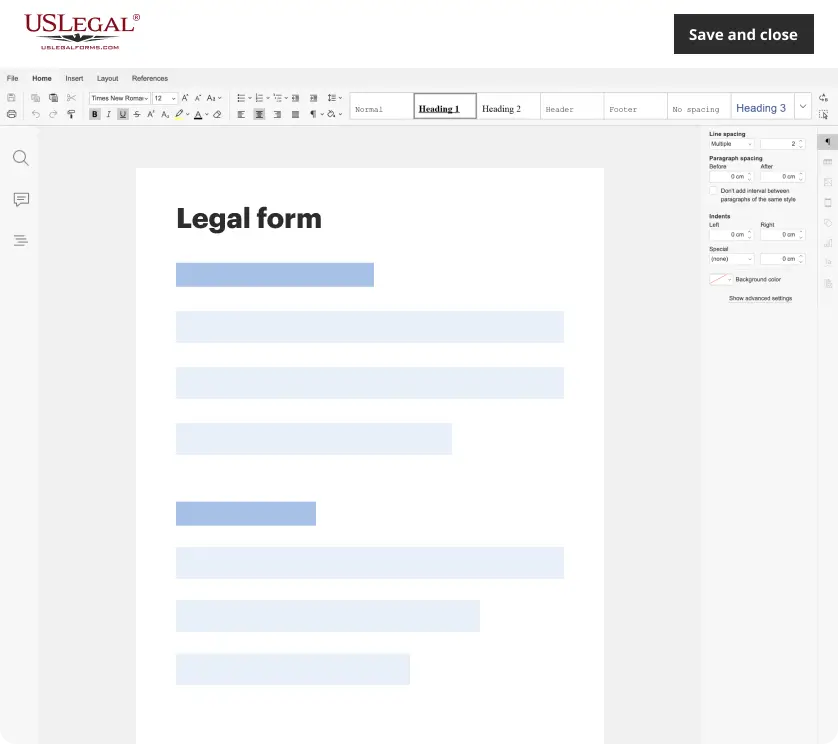
Make edits, fill in missing information, and update formatting in US Legal Forms—just like you would in MS Word.
Download a copy, print it, send it by email, or mail it via USPS—whatever works best for your next step.
Sign and collect signatures with our SignNow integration. Send to multiple recipients, set reminders, and more. Go Premium to unlock E-Sign.
If this form requires notarization, complete it online through a secure video call—no need to meet a notary in person or wait for an appointment.
We protect your documents and personal data by following strict security and privacy standards.
Looking for another form?



Form popularity
FAQ
In Canada, four in ten (41%) Black Canadians reported experiencing discrimination based on their race or skin colour, which is approximately 15 times higher than the proportion among the non-Indigenous, non-racialized population (3%).
25% of discrimination complaints received by the Canadian Human Rights Commission in 2016 relate to race, colour, national or ethnic origin, and/or religion. 43% of hate crimes in 2017 were motivated by hatred of a race or ethnicity. 16% of hate crimes in 2017 were specifically against Black populations.
The following are some statistics behind gender inequality in the Canadian workplace: Women make $0.71 for every dollar men make. In 2020, only 53.9% of women were employed while 62.1% of men were employed. In 2020, only 75.6% of those women were employed full time, while 87.7% of men were employed full time.
Provision. 13. A witness who testifies in any proceedings has the right not to have any incriminating evidence so given used to incriminate that witness in any other proceedings, except in a prosecution for perjury or for the giving of contradictory evidence.
Discrimination in the labour market Additionally, prospective employers discount experiences and education from outside of Canada. ing to Statistics Canada, immigrants with education from outside of Canada are almost three times more likely to be overqualified in their current jobs than non-immigrants.
They are called grounds of discrimination and are listed in the Canadian Human Rights Act. For example: Were you fired because of your race? Were you denied a service because of your gender identity, your colour, your disability? Maybe it was about more than one thing.
Please contact the Commission at complaint.plainte@chrc-ccdp.gc.ca or 1-888-214-1090 before you file your complaint.) You cannot file a complaint on someone's behalf without their permission, or proof that you have the authority to file on their behalf. Refer to the Complaint Form FAQ for more information.)
They are called grounds of discrimination and are listed in the Canadian Human Rights Act. For example: Were you fired because of your race? Were you denied a service because of your gender identity, your colour, your disability? Maybe it was about more than one thing.
To prove discrimination, a complainant has to prove that: they have a characteristic protected by the Human Rights Code Code; they experienced an adverse impact with respect to an area protected by the Code; and. the protected characteristic was a factor in the adverse impact.