Discrimination Definition In Psychology In San Diego
Description




Get your form ready online
Our built-in tools help you complete, sign, share, and store your documents in one place.
Make edits, fill in missing information, and update formatting in US Legal Forms—just like you would in MS Word.
Download a copy, print it, send it by email, or mail it via USPS—whatever works best for your next step.
Sign and collect signatures with our SignNow integration. Send to multiple recipients, set reminders, and more. Go Premium to unlock E-Sign.
If this form requires notarization, complete it online through a secure video call—no need to meet a notary in person or wait for an appointment.
We protect your documents and personal data by following strict security and privacy standards.
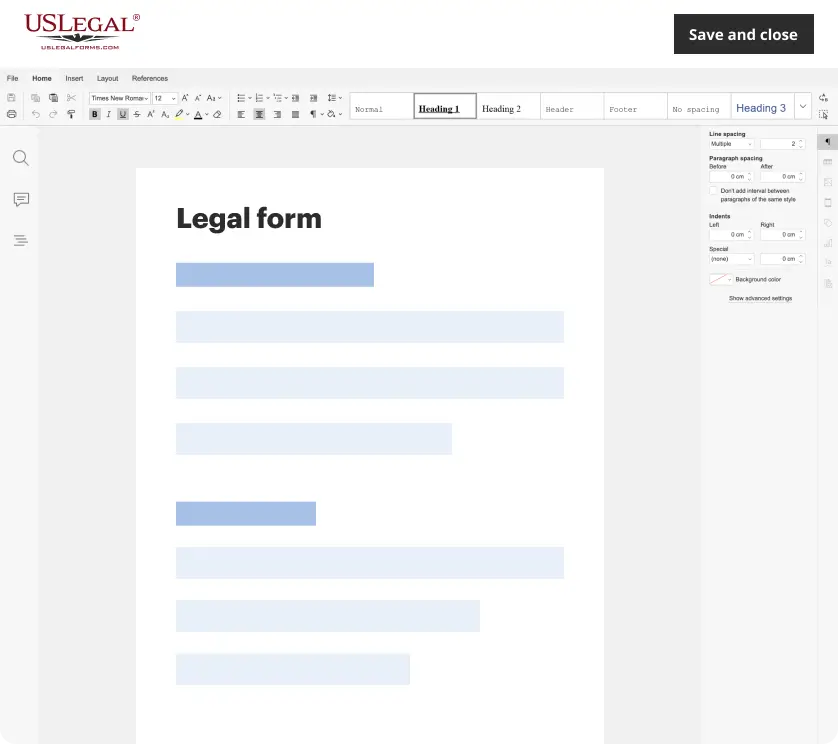
Make edits, fill in missing information, and update formatting in US Legal Forms—just like you would in MS Word.
Download a copy, print it, send it by email, or mail it via USPS—whatever works best for your next step.
Sign and collect signatures with our SignNow integration. Send to multiple recipients, set reminders, and more. Go Premium to unlock E-Sign.
If this form requires notarization, complete it online through a secure video call—no need to meet a notary in person or wait for an appointment.
We protect your documents and personal data by following strict security and privacy standards.
Looking for another form?
Form popularity
FAQ
To prove discrimination in the workplace, wrongful termination or workplace retaliation in California, you may need to present evidence that: You have been treated unjustly based on one of your protected characteristics. You are qualified, capable and honest and performed your job satisfactorily.
Average Disability Discrimination Settlements in California The average settlement for a disability discrimination case can range from around $25,000 to $500,000. Less complex cases often settle for about $100,000 or less, while more involved cases can exceed $1,000,000.
California law protects individuals from illegal discrimination by employers based on the following: Race, color. Ancestry, national origin. Religion, creed.
Call 800-884-1684 (voice), 800-700-2320 (TTY) or California's Relay Service at 711.
Direct evidence often involves a statement from a decision-maker that expresses a discriminatory motive. Direct evidence can also include express or admitted classifications, in which a recipient explicitly distributes benefits or burdens based on race, color, or national origin.
Discrimination is usually the behavioral manifestation of prejudice and therefore involves negative, hostile, and injurious treatment of the members of rejected groups. By contrast, reverse discrimination is the favorable treatment of the oppressed group rather than the typically favored group.
If you've experienced unlawful discrimination, you can complain to the person or organisation who's discriminated against you. You can also make a discrimination claim in the civil courts.
To file a complaint of discrimination, go to the CRD Web site home page and click on "File a Pre- Complaint Inquiry." If assistance is required to complete the online Pre-Complaint Inquiry, please call 800-884-1684. The completion and submission of the Pre-Complaint Inquiry will initiate the complaint process.
It is okay to walk away and focus on your healing. Speak up when you are ready. Don't be afraid to have your voice heard. Engage in self-care activities. Your well-being is the key in fighting against discrimination. Embrace your strengths and identity. Seek professional support.
If you've experienced unlawful discrimination, you can complain to the person or organisation who's discriminated against you. You can also make a discrimination claim in the civil courts. Read this page to find out what you should do before you take action about unlawful discrimination.