Restraining Order Template With Child Involved In Harris
Description
















Get your form ready online
Our built-in tools help you complete, sign, share, and store your documents in one place.
Make edits, fill in missing information, and update formatting in US Legal Forms—just like you would in MS Word.
Download a copy, print it, send it by email, or mail it via USPS—whatever works best for your next step.
Sign and collect signatures with our SignNow integration. Send to multiple recipients, set reminders, and more. Go Premium to unlock E-Sign.
If this form requires notarization, complete it online through a secure video call—no need to meet a notary in person or wait for an appointment.
We protect your documents and personal data by following strict security and privacy standards.
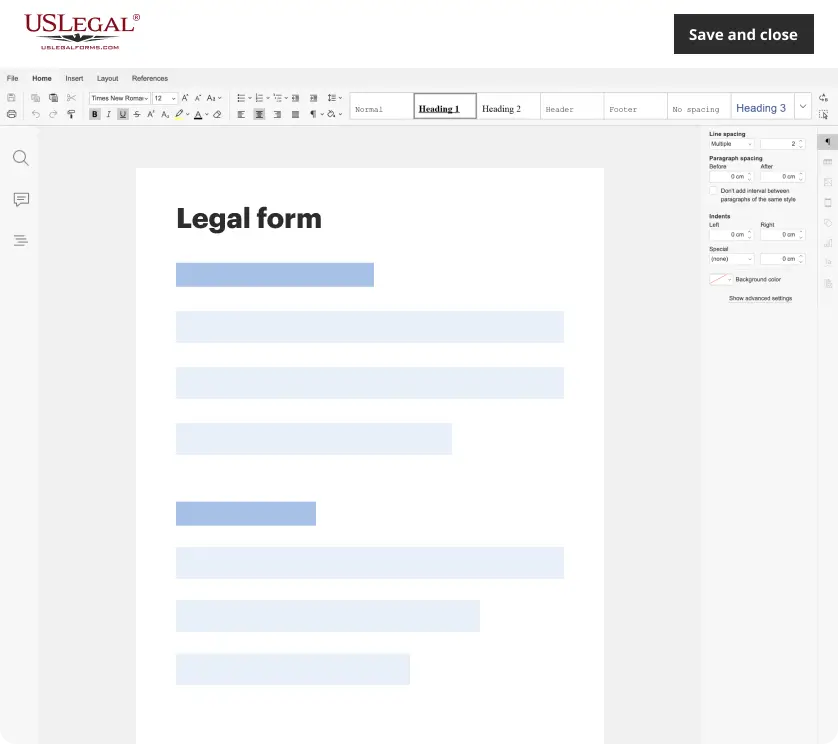
Make edits, fill in missing information, and update formatting in US Legal Forms—just like you would in MS Word.
Download a copy, print it, send it by email, or mail it via USPS—whatever works best for your next step.
Sign and collect signatures with our SignNow integration. Send to multiple recipients, set reminders, and more. Go Premium to unlock E-Sign.
If this form requires notarization, complete it online through a secure video call—no need to meet a notary in person or wait for an appointment.
We protect your documents and personal data by following strict security and privacy standards.
Looking for another form?
Form popularity
FAQ
Three Common Co-parenting Styles. 1. High conflict co-parenting. 2. Parallel co-parenting. 3. Cooperative and collaborative co-parenting.
A neutral party will have to handle the task of handing off the child and conveying information each parent is entitled to know or have a say in decision-making. The parents will need to inform the court of the dilemma since restraining orders typically include no-contact provisions.
Some signs of co-parent harassment include: Repeated calls, texts, and emails. Verbal abuse or degrading language. Intentionally causing emotional distress.
For co-parenting is anything that undermines the other parent wants the child returns to them. It is speaking badly about the other parent in front of the child. Intentionally doing things that cause the other parent stress or trouble with the child's schedule or behavior. Some examples include:
Avoid These 5 Things if Co-Parenting 1. Don't EVER put the kid(s) in the middle. 2. Don't blame the other parent for the problems (now or in the past) 3. Don't ``Just Say No'' 4. Don't make ``take it or leave it'' offers. 5. Don't pretend you can read your ex's mind.
Using the facts of the incident only, keep your statement brief and to the point. Briefly describe the most recent incident of abuse and/or threats of abuse or other behaviors. Focus on the actual behavior. Do not include prior incidents, (that will be the next paragraph).
The specific elements you need to prove to get a restraining order vary from state to state, but in general, you need to show: A specific instance or instances of abuse or harassment (such as sexual assault by an intimate partner) The threat of violence or of further abusive behavior or harassment.
If a child's safety is threatened, parents should immediately inform the authorities. In some cases, California parents can also file for a restraining order on behalf of their children.
