Agreement Form Assign Contract Without In Palm Beach
Description










Form popularity
FAQ
Neither party shall assign the contract as a whole without written consent of the other. If either party attempts to make such an assignment without such consent, that party shall nonetheless remain legally responsible for all obligations under the contract.
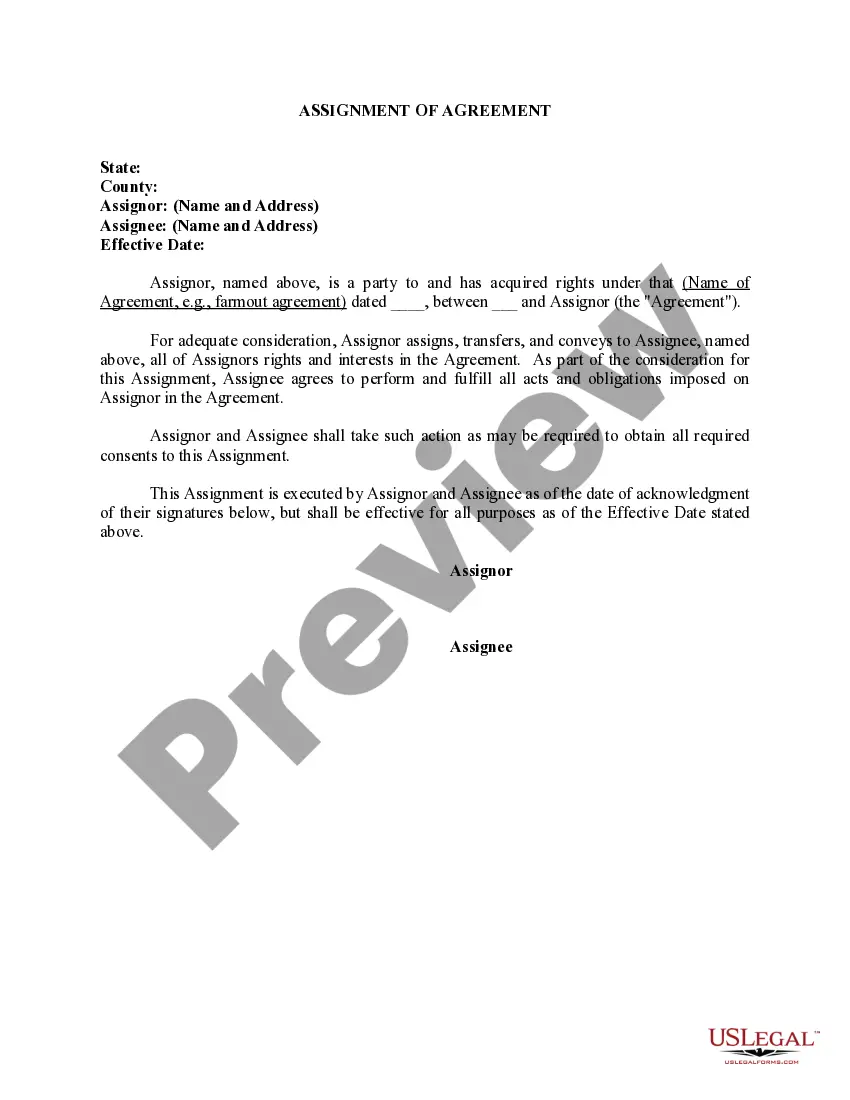
The assignor must agree to assign their rights and duties under the contract to the assignee. The assignee must agree to accept, or "assume," those contractual rights and duties. The other party to the initial contract must consent to the transfer of rights and obligations to the assignee.
If the buyer selects this option, they can assign the contract to another party, but they will retain liability under the terms of the agreement. This may be suitable when the buyer wishes to involve another entity but still wants to maintain some level of responsibility for fulfilling the contract.
An assignment will generally be permitted under the law unless there is an express prohibition against assignment in the underlying contract or lease. Where assignments are permitted, the assignor need not consult the other party to the contract but may merely assign the rights at that time.
You cannot form a valid contract in Florida without consideration. Both parties must give “consideration” for a contract to be formed. If one party does not receive consideration as part of the agreement, only a mere promise has been made. Promises are not enforceable in Florida.
“No Assignment” clause specifies that the rights or obligations outlined in the contract cannot be transferred or assigned to another party without obtaining prior consent from the original contracting party.
This clause limits each party's ability to assign or transfer their rights and obligations under the contract to another party. It states that neither party can assign or transfer any part of the contract to someone else without first getting written consent from the other party.
In Florida, a contractual right is assignable unless: The assignment is prohibited by statute or on public policy grounds (see, for example, Law Office of David J. Stern, P.A.
Requirements for a Legal (Statutory) Assignment These statutory assignments are enforceable if the parties comply with the following procedures: The assignment is absolute. The assignment is in writing, signed by the assignor. the non-assigning obligor is given express written notice.
Generally, a contract is binding when the following is true: the parties intend to make a contract. there is an offer and an acceptance. the parties receive something in return for their promises.
