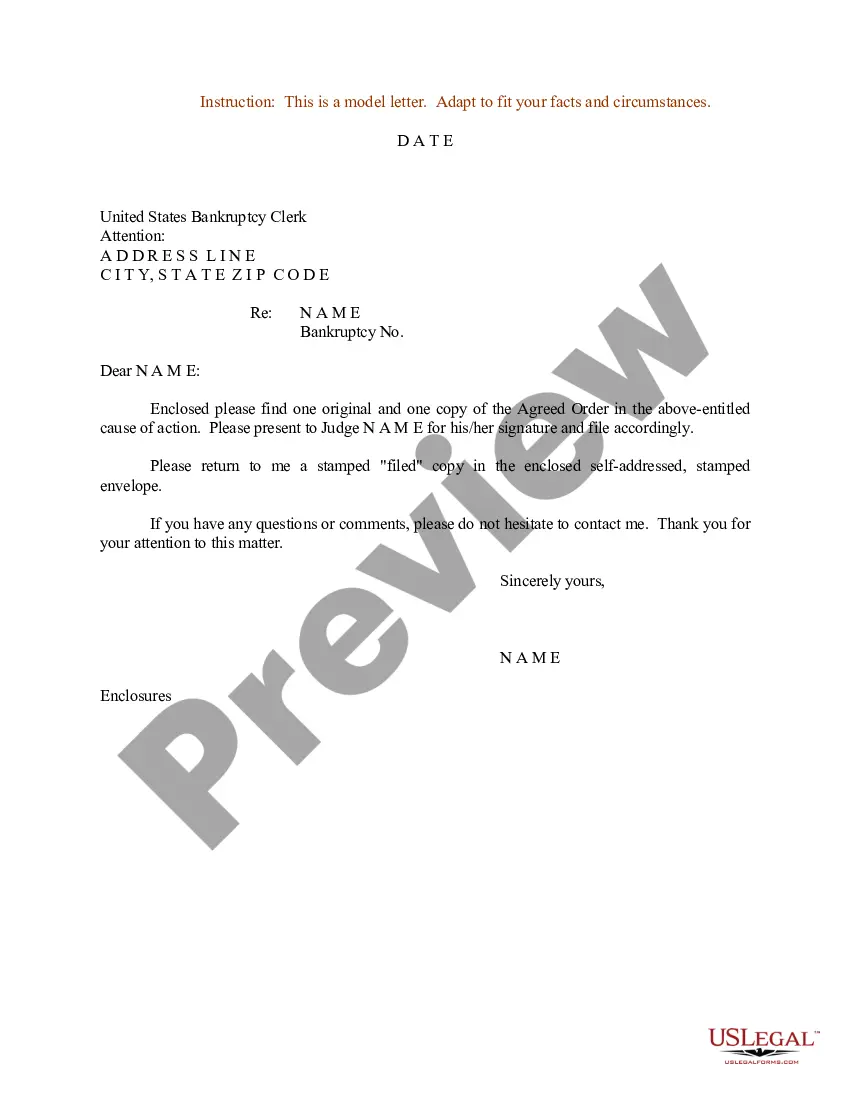
Sample Letter Judge With Proposed Order In San Antonio
Description


Get your form ready online
Our built-in tools help you complete, sign, share, and store your documents in one place.
Make edits, fill in missing information, and update formatting in US Legal Forms—just like you would in MS Word.
Download a copy, print it, send it by email, or mail it via USPS—whatever works best for your next step.
Sign and collect signatures with our SignNow integration. Send to multiple recipients, set reminders, and more. Go Premium to unlock E-Sign.
If this form requires notarization, complete it online through a secure video call—no need to meet a notary in person or wait for an appointment.
We protect your documents and personal data by following strict security and privacy standards.

Make edits, fill in missing information, and update formatting in US Legal Forms—just like you would in MS Word.

Download a copy, print it, send it by email, or mail it via USPS—whatever works best for your next step.

Sign and collect signatures with our SignNow integration. Send to multiple recipients, set reminders, and more. Go Premium to unlock E-Sign.

If this form requires notarization, complete it online through a secure video call—no need to meet a notary in person or wait for an appointment.

We protect your documents and personal data by following strict security and privacy standards.
Looking for another form?

Form popularity
FAQ
Writing a Persuasive Motion to Dismiss Be Clear and Concise: Use straightforward language and be diligent with proofreading. Stay Focused on the Legal Issues: Avoid unnecessary details and stick to the relevant legal arguments. Support Every Claim: Use statutes, case law, and rules of procedure to back up your points.
Quick Guide: Writing a Motion for Court Be clear and concise so the motion feels persuasive and logical to a judge. Present the information in a sequential way and include details about your reasoning, supporting facts, and ideas for next steps.
A motion is a paper you can file in your case. It asks the court to decide something in your case. For example, if you need more time to answer a complaint against you, you can file a motion to extend the time to answer. If you do not have a case, you cannot file a motion.
General format - each motion generally consists of a case caption, a title that briefly identifies the relief sought, a series of numbered paragraphs that explains -- in a logical way -- why you are entitled to that relief, a prayer for relief, a signature block, a certification that a copy of the motion was sent to ...
Yes. Certain ex parte communications to a judge or court personnel are allowed by law. For example, if you are contesting a citation (commonly called a “ticket”) for a traffic infraction, the law allows you to submit a written explanation directly to the court.
Under Texas law, there is a waiting period of at least 60 days—counted beginning the day after the Petition is filed—before a divorce can be finalized. A divorce can take longer than 60 days, but it cannot be finalized in fewer than 60 days unless one of two exceptions involving family violence applies.
Divorces and Suits Affecting the Parent-Child Relationships Civil District Judge's Standing Order - must be attached to all new petitions for Divorce and Suits Affecting the Parent-Child Relationship.
The Bexar County Standing Orders are Special Orders that apply to both parties once a divorce is filed. These Standing Orders automatically go into place at the time a divorce action is filed. The Standing Orders also include provisions for children, for the child custody part of a divorce.
These orders are court orders and are legally enforceable. The following Dallas-area counties have standing orders that protect both parties when a divorce is filed: Dallas, Collin, Denton, Rockwall, and Kaufman. Tarrant County does not have standing orders to protect parties during a divorce or modification suit.
A proposed order, in the context of legal proceedings, is a document that outlines the specific actions or decisions that a party involved in a case is asking the court to make. It is typically drafted by one of the parties or their attorney and presented to the court for approval.

