Shareholder Meeting Without Notice In Philadelphia
Description




Get your form ready online
Our built-in tools help you complete, sign, share, and store your documents in one place.
Make edits, fill in missing information, and update formatting in US Legal Forms—just like you would in MS Word.
Download a copy, print it, send it by email, or mail it via USPS—whatever works best for your next step.
Sign and collect signatures with our SignNow integration. Send to multiple recipients, set reminders, and more. Go Premium to unlock E-Sign.
If this form requires notarization, complete it online through a secure video call—no need to meet a notary in person or wait for an appointment.
We protect your documents and personal data by following strict security and privacy standards.

Make edits, fill in missing information, and update formatting in US Legal Forms—just like you would in MS Word.

Download a copy, print it, send it by email, or mail it via USPS—whatever works best for your next step.

Sign and collect signatures with our SignNow integration. Send to multiple recipients, set reminders, and more. Go Premium to unlock E-Sign.

If this form requires notarization, complete it online through a secure video call—no need to meet a notary in person or wait for an appointment.

We protect your documents and personal data by following strict security and privacy standards.
Looking for another form?
Form popularity
FAQ
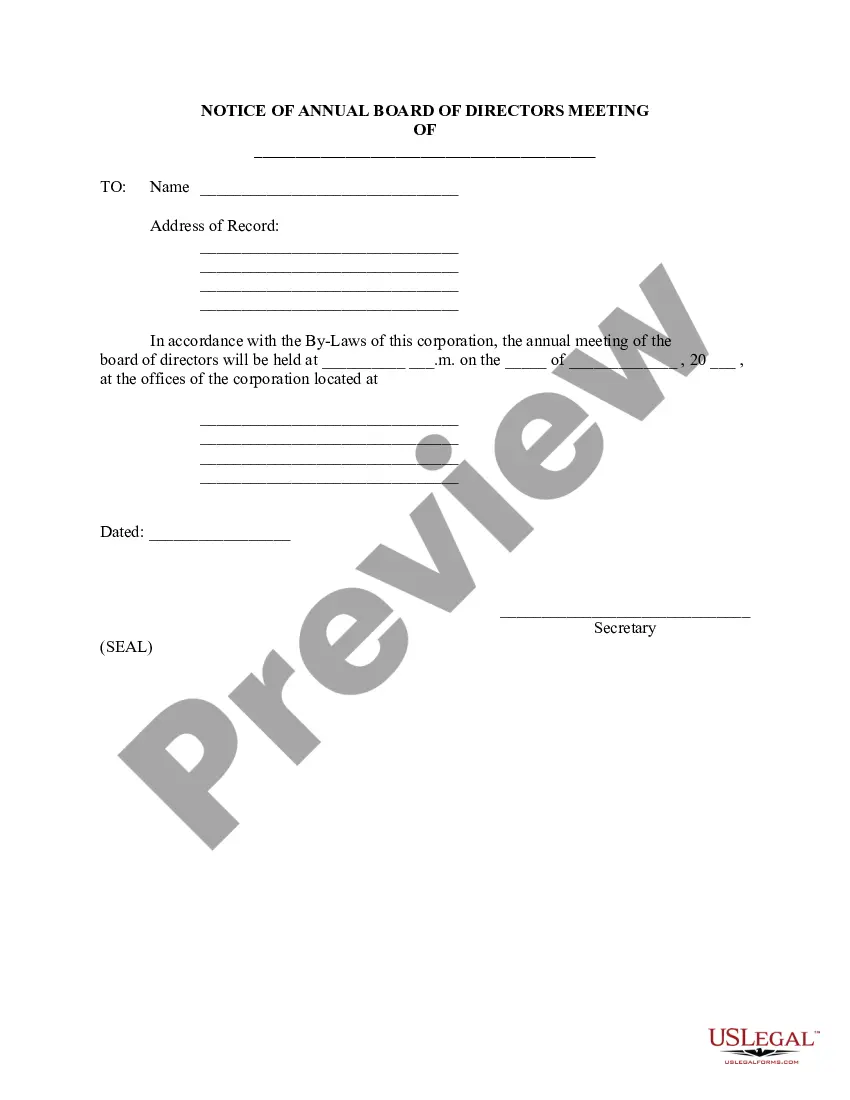
A notice of meeting is a written document that informs company members and shareholders that a meeting will take place. It is an invitation that details the time and place of the scheduled meeting and also informs stakeholders of the topics to be discussed.
The requirements for giving notice of shareholder meetings are strictly regulated under the Corporations Act 2001 (Cth). Generally, companies must provide at least 21 days' written notice for a meeting, though longer periods may be specified in the company constitution.
(a) initially, no more than 18 months after the company's date of incorporation; and. (b) thereafter, once in every calendar year, but no more than 15 months after the date of the previous annual general meeting, or within an extended time allowed by the Companies Tribunal, on good cause shown.
A corporation's bylaws or certificate of incorporation may allow the board, executives, or qualifying shareholders to call a special meeting. Notice requirements vary by state but often require 10–60 days' advance notice, with Delaware and California offering clear statutory guidelines.
A shareholders' meeting cannot commence without a quorum, typically at least 25% of voting rights present. Specific matters require the presence of attendees representing at least 25% of the voting rights for that item. Meetings cannot start or proceed unless at least three shareholders are present.
When should I hold a shareholder meeting? An annual shareholder meeting is typically scheduled just after the end of the fiscal year. This allows for the previous year's financial performance to be fully assessed and discussed.
First Shareholders' Meeting Once this meeting has been completed, the directors can call a shareholders' meeting where the shareholders will elect directors (or re-elect the initial directors) and confirm the by-laws and auditor.
(i) Date, time and place of meeting; (ii) Purpose of the meeting; (iii) Notice of any special business to be conducted; (iv) Nature of special business in sufficient details; (v) The text of any special resolution or by-law to be submitted to the meeting; and (vi) Any additional details required by the by-laws or ...
The board of directors has the power to call general meetings and the majority of general meetings will be called by the directors (S302 of the Companies Act 2006). The members also have the ability to demand a general meeting.